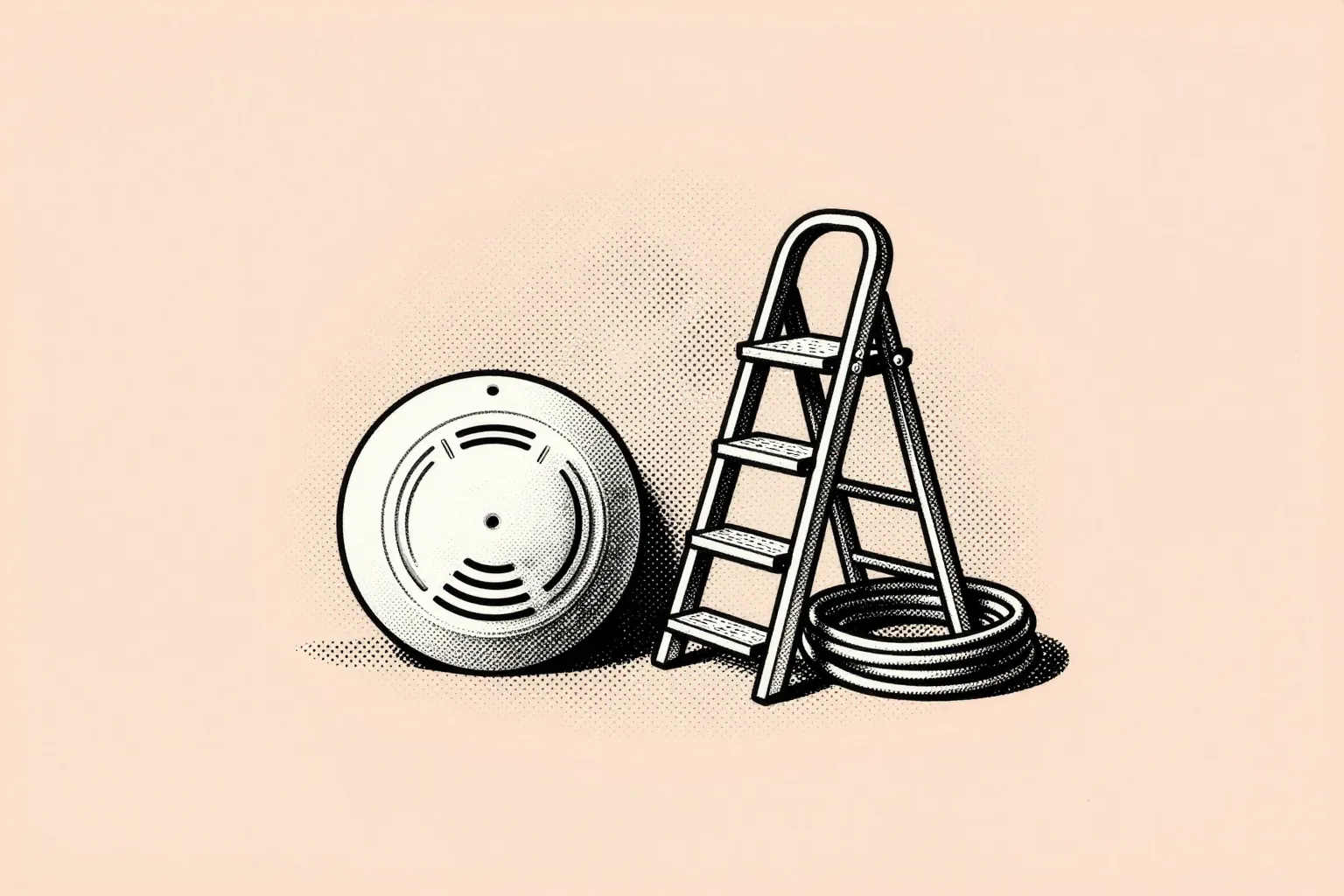

A missing or dead alarm can turn a routine repair into a life-safety emergency, and it is easy to document and prevent. Smoke detector rental requirements are not one rule. They are a layered set of state laws, local fire and building codes, and, for some housing, federal inspection standards. This guide explains where the requirements come from, where alarms usually have to go, when carbon monoxide alarms are required, who tests and maintains them, and how to build a record that protects you. It is part of our compliance and legal hub for independent landlords and small property managers.
Note: This article is general education, not legal advice. Smoke and carbon monoxide alarm rules vary by state and municipality and change over time, and your local fire marshal or building department may require more than the examples below. Consult a local attorney or your fire authority before relying on any summary of the law.
Why requirements come from state and local codes, not one federal rule
Landlords often ask what "the" smoke detector law is. For most private rentals there is no single national answer. The duty to install and maintain alarms usually comes from three places:
- State statutes. Many states set a landlord duty to install working alarms and say who tests them and who replaces batteries.
- Local fire and building codes. Cities and counties adopt model codes and amend them, so a property can have stricter alarm rules than the state baseline.
- Standards and program rules. NFPA 72, the National Fire Alarm and Signaling Code published by the National Fire Protection Association, is the technical standard most codes draw on. It is a consensus standard, not a statute, so it binds you only where a state or city adopts it or a program points to it. HUD, for example, states in 24 CFR 5.703 that following NFPA 72 specifications satisfies its smoke alarm requirements for units in HUD-inspected housing.
Start with the strictest source that applies to your property, then write one consistent practice for every unit.
Where smoke alarms usually have to go
The details differ, but most rules follow the same placement logic: a smoke alarm in every sleeping room, one in the area outside sleeping rooms, and at least one on every level.
- Each sleeping area. Under HUD regulation 24 CFR 5.703(d)(3)(i), a unit needs working smoke alarms inside each bedroom, on each level, and within 21 feet of any bedroom door, measured along the path of travel.
- Outside sleeping areas. Texas Property Code section 92.255 requires at least one alarm in each separate bedroom and, where several bedrooms share a corridor, at least one in the corridor in the immediate vicinity of the bedrooms.
- Each level. Both the HUD regulation and Texas section 92.255 call for at least one alarm on each level of the unit.
Here is an illustrative layout, not a code determination. A two-story house with three bedrooms upstairs and a gas furnace in the basement would typically need an alarm in each of the three bedrooms, one in the upstairs hallway, one on the main level and one in the basement. That is six smoke alarms. Confirm the exact count and locations with your local code before you buy.
Manufacturers also publish spacing rules, and California section 13113.7 requires alarms to be installed in accordance with the manufacturer's instructions, so keep the instruction sheet for each model.
When carbon monoxide alarms are required
Carbon monoxide, often shortened to CO, is produced by burning fuel, so the trigger for most rental rules is a fuel-burning source in or attached to the unit. State rules decide when a landlord must install them. Three examples you can verify:
- California. Health and Safety Code section 17926 requires an owner to install a CO device in each existing dwelling unit that has a fossil fuel burning heater or appliance, a fireplace, or an attached garage. Section 17926.1 requires the device to be operable when the tenant takes possession.
- Colorado. C.R.S. 38-45-104 applies to rental dwellings with fuel-fired appliances or an attached garage and, among other things, requires the owner to replace a missing or nonworking CO alarm before a new occupancy and to give the tenant any batteries needed when the tenant moves in.
- Oregon. ORS 90.316 bars a landlord from entering a new tenancy for a unit that contains a CO source, or sits in a structure with a CO source connected by a door, ductwork or ventilation shaft, unless it has a properly functioning CO alarm when the tenant takes possession.
In practice, treat any unit with a fuel-burning appliance, fireplace or attached garage as a CO unit unless your local code clearly says otherwise.
Who tests alarms, who replaces batteries, and the tenant duty not to disable them
State laws split these duties differently, and the differences matter when something goes wrong. Verify your own state, and use these as a sense of the range:
| State | Landlord duty | Tenant duty |
|---|---|---|
| California (smoke) | Section 13113.7 makes the owner responsible for testing and maintaining alarms in rented units, and requires them to be operable when a new tenancy begins. An owner may enter with written notice, and 24 hours is presumed reasonable. | Notify the owner or manager if an alarm is inoperable. |
| Texas (smoke) | Section 92.258 requires the landlord to confirm the alarm works at the start of possession, using smoke, the test button, or the manufacturer's procedure. During the lease, the landlord must inspect and repair once the tenant gives notice or asks. | Section 92.2611 makes a tenant liable for removing a battery without immediately replacing it, or for knowingly disconnecting or damaging an alarm. |
| Colorado (carbon monoxide) | Replace missing or nonworking alarms between occupancies, provide batteries at move-in, and fix reported deficiencies. | Keep, test and maintain CO alarms, and notify the owner in writing of battery needs, missing or failed alarms. Removing batteries or disabling an alarm is prohibited except to maintain or replace it. |
Colorado puts routine battery care for CO alarms on the tenant, while California puts testing and maintenance of smoke alarms on the owner. Do not copy another state's approach into your lease. Texas also ties some landlord remedies, among other conditions, to a bold or underlined lease notice that the tenant must not disconnect or damage the alarm, so lease wording matters.
Whatever the statute says, tell renters at move-in how to test the alarm, ask them to report chirping or failures through one channel, and state that disabling an alarm is a lease violation. Our guide to landlord entry notice laws and how much notice you must give tenants covers the notice rules you need before you enter to test or replace an alarm.
Ten-year sealed battery alarms
Removed batteries are a common reason alarms fail. A ten-year sealed battery alarm removes that failure point because the battery is built in and lasts about as long as the alarm.
Under the Public and Federally Assisted Housing Fire Safety Act of 2022, as HUD describes it in an August 2025 Federal Register notice for one of its assisted housing programs, a qualifying smoke alarm in a unit built before December 29, 2022 is either hardwired or a battery alarm that uses a 10-year non-rechargeable, non-replaceable primary battery and is sealed, tamper resistant, has a silencing means and provides notification for people with hearing loss. For newer or substantially rehabilitated units, the alarm must be hardwired. These rules apply to specific HUD-assisted housing, so confirm with your housing agency whether they cover your units.
The U.S. Fire Administration says smoke alarms need to be replaced 10 years from the manufacture date and should be tested monthly. Write the manufacture date in your records when you install each unit.
Voucher inspections and HUD NSPIRE
If you rent to Housing Choice Voucher holders, alarms are an inspection item, not a courtesy. HUD's National Standards for the Physical Inspection of Real Estate, known as NSPIRE, set the standards, and the HUD regulation at 24 CFR 5.703 includes the smoke alarm placement rules above and CO requirements that follow HUD's standards. Under HUD's NSPIRE standards, a smoke alarm that is not installed where required, or that does not sound when tested, is a life-threatening deficiency with a 24-hour correction timeframe, and housing agency guidance treats missing or nonworking CO alarms the same way. Under 24 CFR 982.404, a life-threatening deficiency must be corrected within 24 hours of notification, and the housing agency must abate assistance payments if the owner fails to make required repairs. For the full inspection process, see our guide to NSPIRE inspections for landlords renting to Housing Choice Voucher holders.
Move-in inspection and documentation
If an alarm fails or a fire happens, the question is what you did and when. Good documentation answers it. For each unit, a defensible file includes:
- The make, model, location and manufacture date of every smoke and CO alarm.
- A move-in test, with a photo or video of each alarm in its location and a note that it sounded when tested.
- A signed acknowledgment from the tenant of how to test the alarm and the rule against disabling it.
- Receipts for installation and replacement, plus a log of each report and repair.
Texas section 92.258 expects the landlord to confirm the alarm works at the start of possession, which is exactly the record a move-in test creates. Our walkthrough on how to write a move-in inspection report with a free template shows how to build the room-by-room record, and our guide to documentation best practices for landlords and building a defensible record system covers retention.
Liability exposure when alarms are missing or not maintained
California makes a violation of section 13113.7 an infraction punishable by a fine of up to $200 per offense, and Texas makes a landlord liable under its smoke alarm subchapter when no alarm was installed at the start of occupancy or when the landlord does not install, inspect or repair an alarm within seven days after the tenant makes a request and gives the notice the statute requires.
Beyond fines, a missing alarm weakens your position in any dispute or insurance question after a loss, and it can feed a habitability claim, which we cover in our guide to the implied warranty of habitability and what landlords are legally required to provide.
A simple alarm routine for small landlords
- Look up the rule. Check your state statute and local fire code for placement, interconnection and CO requirements.
- Audit every unit. Count alarms by room and level, record manufacture dates, and replace any alarm that is ten years old or fails a test.
- Test at every turnover. Test and photograph each alarm before the new tenant takes possession.
- Set expectations in writing. Give tenants a short alarm notice: how to test, whom to tell, and that disabling an alarm is prohibited.
- Respond fast to reports. Fix the problem within the legal window and log the date.
Frequently asked questions
Is a landlord required to provide smoke detectors?
In most states, yes. State laws such as California Health and Safety Code section 13113.7 and Texas Property Code section 92.255 require landlords to install working smoke alarms, and local fire codes may add more. Check your state and city.
Where do smoke detectors have to be placed in a rental?
Most rules call for an alarm inside each bedroom, one outside the sleeping areas, and one on every level. HUD's regulation at 24 CFR 5.703 adds that an alarm must be within 21 feet of any bedroom door.
Do rental properties need carbon monoxide detectors?
Many states require them in units with fuel-burning appliances, fireplaces or attached garages, including California, Colorado and Oregon. Your local code may require them more broadly.
Who replaces smoke detector batteries, the landlord or the tenant?
It depends on the state. California makes the owner responsible for testing and maintaining smoke alarms, while Colorado puts routine CO alarm battery care on the tenant. Tenants generally may not remove batteries or disable alarms.
How often should smoke alarms be replaced?
The U.S. Fire Administration says smoke alarms need to be replaced 10 years from the manufacture date and should be tested monthly. Replace any alarm that fails a test.
What to do next
Alarm compliance fails in the gaps between steps: the move-in test nobody photographed, the chirping report sent by text and never logged, the alarm that aged out and nobody noticed. For a small landlord, the real problem is keeping one dated, consistent record of what was installed, tested and fixed in every unit.
Shuk gives you the records side of that routine. The Inspection Tool supports walkthrough, move-in and move-out inspections with photos, videos and notes on each item and a final inspection report, and it can be completed by you, assigned to a teammate or led by the renter. Maintenance request tracking lets renters submit a problem with photos, videos and notes while you track it from submission through completion. Centralized in-app messaging with email and push notifications keeps alarm instructions and reminders in one thread per property and renter. Unlimited Adobe-powered e-signatures let renters sign an alarm acknowledgment that you prepare and upload, and Property Documents keeps invoices, manufacture dates and signed forms inside each property.
At as low as $2 per unit per month, with no setup fees and no contract, and with White Glove Onboarding included at no additional cost, Shuk makes a consistent, documented alarm and inspection routine feasible for landlords and property managers up to 200 units.
Book a demo at shukrentals.com/book-a-demo to see how the Inspection Tool, maintenance request tracking, in-app messaging, e-signatures and Property Documents work together so every alarm check is recorded and every reported problem is tracked to completion.