

Tenant Screening Hub

Rental Application Form: What to Include and What to Avoid

photo of Miles Lerner, Blog Post Author
Miles Lerner

A Strong Application Collects What You Need and Keeps You Out of Trouble

A strong rental application form collects the information you need to screen tenants quickly and keeps you out of Fair Housing trouble. Get it wrong and you will waste days chasing missing documents, or worse, create a paper trail that looks discriminatory even when you did not mean it.

Many landlords inherit a form from a prior owner, download a generic template, or "just ask what they need in the moment." That is when illegal questions sneak in ("Do you have kids?"), consistency breaks down (different questions for different applicants), or fees are collected in ways your state does not allow. HUD guidance emphasizes neutral, consistent screening criteria and careful record-keeping, especially as more owners rely on third-party screening tools or automated workflows.

Note: This article provides general education about rental application design and Fair Housing compliance, not legal advice. Fair Housing Act requirements, FCRA rules, state-specific application fee caps, and local protected class additions vary by jurisdiction. Before designing or modifying your application, confirm your obligations under applicable law.

This guide shows you exactly what to include, what to avoid, how to structure the form for speed and compliance, and how application details feed credit/background checks and assistance-animal handling.

What a Compliant Application Must Accomplish

At its core, a rental application should collect only the information needed to evaluate whether an applicant can meet lease obligations, pay rent on time, follow rules, and care for the property, without probing into protected characteristics. Under the federal Fair Housing Act, you must not treat applicants differently based on race, color, religion, national origin, sex, familial status, or disability. Many states and cities add extra protected classes (such as sexual orientation, source of income, or marital status), but even at the federal level, the safest approach is to keep your form focused on objective criteria.

HUD and DOJ best practices stress transparency: publish your screening criteria, apply them consistently, document decisions, and train anyone involved in leasing. This matters because application design influences outcomes. A question about "native language" can become evidence in a national origin complaint, and a "no pets, exceptions?" section can become evidence in a disability discrimination complaint if handled incorrectly.

Real-world enforcement is not hypothetical. HUD has pursued cases where applicants were denied due to an assistance animal (a disability-related issue), and the agency has reached settlements involving limited-English-proficiency discrimination. A California familial-status case resulted in a multi-million-dollar settlement over restrictive policies affecting children. While those examples are not "application form" questions specifically, they show the same compliance principle: avoid rules or questions that single out protected groups, and stick to neutral, business-necessary criteria.

How to Design an Efficient, Fair Housing-Safe Application (6 Steps)

1) Start with Written Screening Criteria

Before you edit a single question, write your tenant selection criteria in plain language: income multiple, credit standards, rental history requirements, occupancy standards, pet policy. HUD best practices emphasize transparency and consistency. Your criteria should be publicized and applied the same way for every applicant.

Put a short "Screening Criteria Summary" at the top of your application (or as a pre-screen page) and require applicants to acknowledge it.

Red flag. You deny one applicant for insufficient income, but you never asked another applicant to provide pay stubs because they "seemed stable." Inconsistent process is a common trigger for complaints.

2) Collect Core Identity and Contact Details Without Protected-Class Data

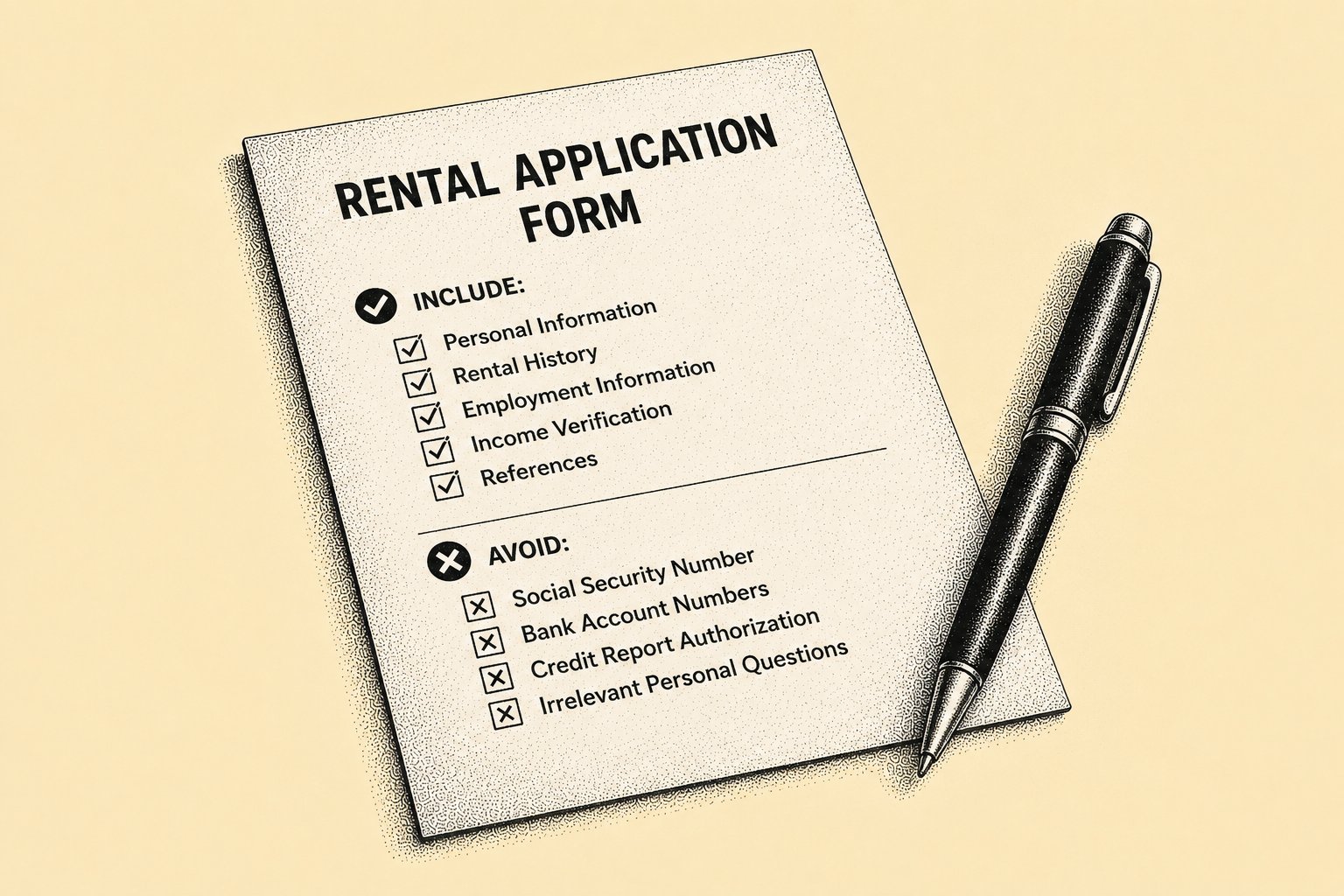
Include: full legal name, prior names/aliases, date of birth (for identity verification), phone/email, current address, and government ID number if your screening provider requires it (only if stored securely).

Avoid: questions that directly or indirectly seek protected characteristics. HUD identifies protected classes and the core compliance principle: do not inquire about race/color, religion, national origin, sex, familial status, or disability.

Examples of illegal or high-risk questions to remove: "What country were you born in?" (national origin). "What religion do you practice?" (religion). "Are you pregnant / planning to have children?" (familial status).

3) Capture Complete Rental History

Ask for 2 to 3 years of address history, landlord/property manager contact info, move-in/move-out dates, rent amount, and reason for leaving. Then use the same verification script for every applicant.

Include checkboxes for common outcomes ("Would you rent to this tenant again?" "Any lease violations?" "Notice given?") to keep references consistent.

Common red flags from screening practice: Evictions or unpaid balances in prior housing. Repeated short stays with vague reasons ("roommate issues" every 6 months). Landlord references that cannot be reached or do not match ownership records.

4) Verify Income and Employment

Ask for employer name, supervisor/contact, position, start date, and monthly/annual gross income. Provide a clear list of acceptable proofs: recent pay stubs, offer letter, benefit letter, bank statements, or tax returns for self-employed applicants.

Structuring tip. Ask applicants to upload documents in the same step where they enter numbers. This reduces "I will send it later" drop-off.

Red flag. Income numbers do not reconcile with documents (for example, applicant writes $7,000/month but uploads a pay stub showing a different employer and lower earnings). Flag it for clarification, and document the request.

5) Add References and Occupant Details Carefully

You can ask for personal or professional references, but keep it optional and neutral. For occupants, you may ask: "List all proposed occupants and their relationship to the applicant." Be cautious: familial status is federally protected, so do not ask questions that discourage children or imply different treatment.

If you have occupancy standards, apply them uniformly. The familial-status enforcement environment shows that "children-specific" restrictions can become costly discrimination claims.

6) Use a Robust Authorization Section

Your application must include signed authorizations to: run credit, criminal background, eviction, and rental history checks (where permitted); contact employers and prior landlords; share adverse action notices if required.

HUD notes that even when using third-party screening or AI-based tools, housing providers are still responsible for ensuring practices are not discriminatory. So your authorization should also disclose the use of screening vendors and explain how disputes can be handled.

Assistance animals / ESA handling. Do not ask "What disability do you have?" If an applicant requests a reasonable accommodation related to an assistance animal, handle it as a separate accommodation workflow rather than embedding disability questions in your rental application. HUD has brought disability-related enforcement actions tied to assistance animals.

Copy-Ready Rental Application Sections

A) Applicant Info (include). Legal name, prior names. DOB (identity verification), phone, email. Current address plus 2 to 3 years address history. Government ID (only if necessary for screening; store securely). Avoid: Race/color, religion, national origin, sex/gender questions. "Native language" or "Where are you really from?"

B) Household and Occupancy (include). List intended occupants by name. Emergency contact. Vehicle info (if parking is regulated). Avoid: "Are you pregnant?" "How many kids?" "Do your children play outside?" (familial status). Any question that discourages families with children.

C) Rental History (include). Prior landlord contacts, dates, rent, reason for leaving. "Ever been evicted?" (allowed in many places; confirm local rules).

D) Employment and Income (include). Employer contact, position, start date. Monthly gross income plus upload proof list. Other income sources (optional; avoid "source of income" pitfalls where protected).

E) References (include). 1 to 2 references with contact info (optional).

F) Screening and Authorization (include). Consent for credit/background/eviction checks. Consent to verify employment and rental history. Applicant certification of truthfulness. Electronic signature language (if digital).

G) Fee Disclosure (include). Exact fee amount, what it covers, refund policy (state-specific). Acknowledgment that fee is for screening cost (where required).

Frequently Asked Questions

How much can you charge for an application fee?

Fee rules vary widely by state. California caps the tenant screening fee (2026 maximum is $65.86, CPI-adjusted) and limits it to actual screening costs, with added refund rules under newer updates. Texas has no statutory cap, but requires written disclosure of tenant selection criteria and includes penalties if fees are wrongfully withheld; typical fees often fall in the $15 to $50 range. New York caps application fees at $20 for credit/background checks.

Can you ask about criminal history?

This is highly jurisdiction-dependent. HUD has emphasized that screening practices, especially automated ones, must not be discriminatory in effect, and you remain responsible even when using third-party tools. If you include criminal-history questions, keep them narrowly tailored, apply them consistently, and consult local restrictions.

What questions are illegal under Fair Housing?

Questions that reveal or imply a decision based on protected classes: race, color, religion, national origin, sex, familial status, or disability. Examples include asking about pregnancy or family plans (familial status) or asking about disabilities or medical conditions (disability).

How long should you keep applications and screening records?

HUD best practices highlight record-keeping and documentation as key compliance tools. Retention periods vary by state and program type, but keeping organized, timestamped records of criteria, applications, communications, and decisions is a defensive best practice.

What to Do Next

If you are still piecing together PDFs, email attachments, and inconsistent questions, you are absorbing unnecessary risk. Consistency is what protects you: the same questions, the same criteria, the same process for every applicant.

Shuk's tenant screening through our partner (RentPrep/TransUnion) for credit, criminal, and eviction reports gives you FCRA-regulated screening data from established sources. Document storage keeps applications, screening reports, adverse action notices, and decision documentation organized in one place per applicant. Centralized in-app messaging with email and push notifications creates a time-stamped record of applicant communication. And e-signature through our Adobe-powered integration handles authorization forms cleanly.

At $5 per unit per month with no setup fees, and with White Glove Onboarding included at no additional cost, Shuk makes consistent, documented screening feasible for landlords and property managers running 1 to 100 units.

Book a demo at shukrentals.com/book-a-demo to see how screening and documentation work together so every applicant gets the same process, every time.
QUICK VIEW
DIVE DEEPER
Stop Reacting to Vacancies. Start Seeing Them Coming.

Shuk helps landlords and property managers get ahead of vacancies, improve renewal visibility, and bring more predictability to every lease cycle.

Book a free 20-min demo to see Shuk today.

Stay in the Shuk Loop

A Strong Application Collects What You Need and Keeps You Out of Trouble

A strong rental application form collects the information you need to screen tenants quickly and keeps you out of Fair Housing trouble. Get it wrong and you will waste days chasing missing documents, or worse, create a paper trail that looks discriminatory even when you did not mean it.

Many landlords inherit a form from a prior owner, download a generic template, or "just ask what they need in the moment." That is when illegal questions sneak in ("Do you have kids?"), consistency breaks down (different questions for different applicants), or fees are collected in ways your state does not allow. HUD guidance emphasizes neutral, consistent screening criteria and careful record-keeping, especially as more owners rely on third-party screening tools or automated workflows.

Note: This article provides general education about rental application design and Fair Housing compliance, not legal advice. Fair Housing Act requirements, FCRA rules, state-specific application fee caps, and local protected class additions vary by jurisdiction. Before designing or modifying your application, confirm your obligations under applicable law.

This guide shows you exactly what to include, what to avoid, how to structure the form for speed and compliance, and how application details feed credit/background checks and assistance-animal handling.

What a Compliant Application Must Accomplish

At its core, a rental application should collect only the information needed to evaluate whether an applicant can meet lease obligations, pay rent on time, follow rules, and care for the property, without probing into protected characteristics. Under the federal Fair Housing Act, you must not treat applicants differently based on race, color, religion, national origin, sex, familial status, or disability. Many states and cities add extra protected classes (such as sexual orientation, source of income, or marital status), but even at the federal level, the safest approach is to keep your form focused on objective criteria.

HUD and DOJ best practices stress transparency: publish your screening criteria, apply them consistently, document decisions, and train anyone involved in leasing. This matters because application design influences outcomes. A question about "native language" can become evidence in a national origin complaint, and a "no pets, exceptions?" section can become evidence in a disability discrimination complaint if handled incorrectly.

Real-world enforcement is not hypothetical. HUD has pursued cases where applicants were denied due to an assistance animal (a disability-related issue), and the agency has reached settlements involving limited-English-proficiency discrimination. A California familial-status case resulted in a multi-million-dollar settlement over restrictive policies affecting children. While those examples are not "application form" questions specifically, they show the same compliance principle: avoid rules or questions that single out protected groups, and stick to neutral, business-necessary criteria.

How to Design an Efficient, Fair Housing-Safe Application (6 Steps)

1) Start with Written Screening Criteria

Before you edit a single question, write your tenant selection criteria in plain language: income multiple, credit standards, rental history requirements, occupancy standards, pet policy. HUD best practices emphasize transparency and consistency. Your criteria should be publicized and applied the same way for every applicant.

Put a short "Screening Criteria Summary" at the top of your application (or as a pre-screen page) and require applicants to acknowledge it.

Red flag. You deny one applicant for insufficient income, but you never asked another applicant to provide pay stubs because they "seemed stable." Inconsistent process is a common trigger for complaints.

2) Collect Core Identity and Contact Details Without Protected-Class Data

Include: full legal name, prior names/aliases, date of birth (for identity verification), phone/email, current address, and government ID number if your screening provider requires it (only if stored securely).

Avoid: questions that directly or indirectly seek protected characteristics. HUD identifies protected classes and the core compliance principle: do not inquire about race/color, religion, national origin, sex, familial status, or disability.

Examples of illegal or high-risk questions to remove: "What country were you born in?" (national origin). "What religion do you practice?" (religion). "Are you pregnant / planning to have children?" (familial status).

3) Capture Complete Rental History

Ask for 2 to 3 years of address history, landlord/property manager contact info, move-in/move-out dates, rent amount, and reason for leaving. Then use the same verification script for every applicant.

Include checkboxes for common outcomes ("Would you rent to this tenant again?" "Any lease violations?" "Notice given?") to keep references consistent.

Common red flags from screening practice: Evictions or unpaid balances in prior housing. Repeated short stays with vague reasons ("roommate issues" every 6 months). Landlord references that cannot be reached or do not match ownership records.

4) Verify Income and Employment

Ask for employer name, supervisor/contact, position, start date, and monthly/annual gross income. Provide a clear list of acceptable proofs: recent pay stubs, offer letter, benefit letter, bank statements, or tax returns for self-employed applicants.

Structuring tip. Ask applicants to upload documents in the same step where they enter numbers. This reduces "I will send it later" drop-off.

Red flag. Income numbers do not reconcile with documents (for example, applicant writes $7,000/month but uploads a pay stub showing a different employer and lower earnings). Flag it for clarification, and document the request.

5) Add References and Occupant Details Carefully

You can ask for personal or professional references, but keep it optional and neutral. For occupants, you may ask: "List all proposed occupants and their relationship to the applicant." Be cautious: familial status is federally protected, so do not ask questions that discourage children or imply different treatment.

If you have occupancy standards, apply them uniformly. The familial-status enforcement environment shows that "children-specific" restrictions can become costly discrimination claims.

6) Use a Robust Authorization Section

Your application must include signed authorizations to: run credit, criminal background, eviction, and rental history checks (where permitted); contact employers and prior landlords; share adverse action notices if required.

HUD notes that even when using third-party screening or AI-based tools, housing providers are still responsible for ensuring practices are not discriminatory. So your authorization should also disclose the use of screening vendors and explain how disputes can be handled.

Assistance animals / ESA handling. Do not ask "What disability do you have?" If an applicant requests a reasonable accommodation related to an assistance animal, handle it as a separate accommodation workflow rather than embedding disability questions in your rental application. HUD has brought disability-related enforcement actions tied to assistance animals.

Copy-Ready Rental Application Sections

A) Applicant Info (include). Legal name, prior names. DOB (identity verification), phone, email. Current address plus 2 to 3 years address history. Government ID (only if necessary for screening; store securely). Avoid: Race/color, religion, national origin, sex/gender questions. "Native language" or "Where are you really from?"

B) Household and Occupancy (include). List intended occupants by name. Emergency contact. Vehicle info (if parking is regulated). Avoid: "Are you pregnant?" "How many kids?" "Do your children play outside?" (familial status). Any question that discourages families with children.

C) Rental History (include). Prior landlord contacts, dates, rent, reason for leaving. "Ever been evicted?" (allowed in many places; confirm local rules).

D) Employment and Income (include). Employer contact, position, start date. Monthly gross income plus upload proof list. Other income sources (optional; avoid "source of income" pitfalls where protected).

E) References (include). 1 to 2 references with contact info (optional).

F) Screening and Authorization (include). Consent for credit/background/eviction checks. Consent to verify employment and rental history. Applicant certification of truthfulness. Electronic signature language (if digital).

G) Fee Disclosure (include). Exact fee amount, what it covers, refund policy (state-specific). Acknowledgment that fee is for screening cost (where required).

Frequently Asked Questions

How much can you charge for an application fee?

Fee rules vary widely by state. California caps the tenant screening fee (2026 maximum is $65.86, CPI-adjusted) and limits it to actual screening costs, with added refund rules under newer updates. Texas has no statutory cap, but requires written disclosure of tenant selection criteria and includes penalties if fees are wrongfully withheld; typical fees often fall in the $15 to $50 range. New York caps application fees at $20 for credit/background checks.

Can you ask about criminal history?

This is highly jurisdiction-dependent. HUD has emphasized that screening practices, especially automated ones, must not be discriminatory in effect, and you remain responsible even when using third-party tools. If you include criminal-history questions, keep them narrowly tailored, apply them consistently, and consult local restrictions.

What questions are illegal under Fair Housing?

Questions that reveal or imply a decision based on protected classes: race, color, religion, national origin, sex, familial status, or disability. Examples include asking about pregnancy or family plans (familial status) or asking about disabilities or medical conditions (disability).

How long should you keep applications and screening records?

HUD best practices highlight record-keeping and documentation as key compliance tools. Retention periods vary by state and program type, but keeping organized, timestamped records of criteria, applications, communications, and decisions is a defensive best practice.

What to Do Next

If you are still piecing together PDFs, email attachments, and inconsistent questions, you are absorbing unnecessary risk. Consistency is what protects you: the same questions, the same criteria, the same process for every applicant.

Shuk's tenant screening through our partner (RentPrep/TransUnion) for credit, criminal, and eviction reports gives you FCRA-regulated screening data from established sources. Document storage keeps applications, screening reports, adverse action notices, and decision documentation organized in one place per applicant. Centralized in-app messaging with email and push notifications creates a time-stamped record of applicant communication. And e-signature through our Adobe-powered integration handles authorization forms cleanly.

At $5 per unit per month with no setup fees, and with White Glove Onboarding included at no additional cost, Shuk makes consistent, documented screening feasible for landlords and property managers running 1 to 100 units.

Book a demo at shukrentals.com/book-a-demo to see how screening and documentation work together so every applicant gets the same process, every time.

{

  "@context": "https://schema.org",

  "@type": "FAQPage",

  "mainEntity": [

    {

      "@type": "Question",

      "name": "How much can you charge for a rental application fee?",

      "acceptedAnswer": {

        "@type": "Answer",

        "text": "Fee rules vary widely by state. California caps the tenant screening fee at $65.86 CPI-adjusted and limits it to actual screening costs. Texas has no statutory cap but requires written disclosure. New York caps application fees at $20 for credit and background checks."

      }

    },

    {

      "@type": "Question",

      "name": "What questions are illegal on a rental application under Fair Housing?",

      "acceptedAnswer": {

        "@type": "Answer",

        "text": "Questions that reveal or imply a decision based on protected classes including race, color, religion, national origin, sex, familial status, or disability. Examples include asking about pregnancy or family plans or asking about disabilities or medical conditions."

      }

    },

    {

      "@type": "Question",

      "name": "Can you ask about criminal history on a rental application?",

      "acceptedAnswer": {

        "@type": "Answer",

        "text": "This is highly jurisdiction-dependent. HUD has emphasized that screening practices must not be discriminatory in effect. If you include criminal-history questions keep them narrowly tailored, apply them consistently, and consult local restrictions."

      }

    }

  ]

}

Stop Reacting to Vacancies. Start Seeing Them Coming.

Shuk helps landlords and property managers get ahead of vacancies, improve renewal visibility, and bring more predictability to every lease cycle.

Book a demo to get started with a free trial.

Stay in the Shuk Loop

View Similar Articles

View Similar Articles

All Articles
Compliance and Legal
Security Deposit Laws by State: A Landlord's Compliance Guide

Security Deposit Laws by State: A Landlord's Compliance Guide

Security deposit laws by state govern how much a landlord can collect, how the money must be held, what deductions are permitted, and the exact deadline for returning the deposit with a written itemization after a tenant moves out. The rules vary significantly across jurisdictions, and the consequences for noncompliance are not limited to returning the deposit. Many states impose multiplier damages of two to three times the withheld amount, plus attorney fees, for late returns or improper deductions. In states like Massachusetts, Hawaii, and Georgia, technical violations of the process can trigger these penalties even when the underlying damage claim is legitimate.

This guide is part of the compliance and legal hub for independent landlords.

This guide covers the core compliance framework, a state-by-state reference for landlords managing properties across multiple markets, and a repeatable workflow that reduces the most common failure points: missed deadlines, improper labeling, insufficient documentation, and missing required notices.

The Seven Dimensions of Security Deposit Compliance

Security deposit compliance in every state reduces to seven questions. Knowing the answer for each jurisdiction where you operate is the foundation of a defensible deposit process.

How much can you collect? Some states cap deposits at one month's rent. California generally limits most landlords to one month's rent as of July 1, 2024, following passage of AB 12. Connecticut caps deposits at two months' rent but only one month for tenants 62 or older. Hawaii limits deposits to one month's rent plus a separate one-month pet deposit. States with no cap include Florida, Georgia, Idaho, Indiana, Louisiana, and Minnesota.

Deposit terms must align with your lease — see the lease agreement legal requirements guide to confirm your deposit clause is correctly worded and within the applicable cap.

Can any portion be non-refundable? Many states prohibit calling a charge a "non-refundable deposit," treating it instead as a refundable deposit regardless of how it is labeled. California generally bans non-refundable deposits. Massachusetts does the same. States like Alabama and Florida allow non-refundable fees if they are clearly labeled as fees rather than deposits, describe what they cover, and do not circumvent applicable caps.

Where must the money be held? Several states require deposits to be held in a separate escrow or interest-bearing account. Connecticut, Massachusetts, Maine, and Illinois for covered buildings all impose escrow or segregated account requirements. Florida requires the deposit to be held in a Florida bank escrow account, an interest-bearing account, or covered by a surety bond.

Do you owe interest? Massachusetts requires interest at 5% or the prevailing bank rate. Minnesota requires 1% simple interest annually beginning after the first month. Maryland requires interest at a minimum rate tied to Treasury yields. Connecticut requires interest at the Banking Commissioner rate. Some states impose interest only at the local level, meaning a property in one city may have obligations that a property in another city does not.

What deductions are permitted? Nearly every state allows deductions for unpaid rent and damages beyond ordinary wear and tear. The documentation requirements for those deductions vary significantly. California requires an itemized statement with receipts within 21 days. Massachusetts requires strict documentation with limited categories. The most common dispute is cleaning charges, which are generally limited to restoring the unit to the move-in level of cleanliness rather than covering routine turnover.

Maintenance records, work orders, and repair invoices are often the deciding evidence in damage deduction disputes — see the rental property maintenance guide for how to build and retain a complete maintenance record for every unit.

When must you itemize? Deadlines vary from 14 days in Hawaii to 45 days in Indiana, with most states falling between 21 and 30 days. Missing the deadline by even one day can forfeit the right to any deductions in some states, regardless of how legitimate the underlying damage claim is.

When must you refund? Many states combine the itemization and refund deadline into one rule. Others, like Florida, use a split timeline: return within 15 days if no claim, or send notice of the claim within 30 days if deductions apply. The clock in many states begins when the tenant provides a forwarding address, making collection of that address a required step in the move-out process.

A Repeatable Compliance Workflow

Step 1: Classify charges correctly. Clearly distinguish security deposits from non-refundable fees in the lease. In states that prohibit non-refundable deposits, any amount labeled as a deposit will be treated as refundable regardless of what the lease says. In states that permit fees, the fee must be clearly labeled, must describe what it covers, and must not function as a way to collect more than the applicable cap.

Step 2: Set a state-compliant deposit amount. Maintain a written policy for each state or city where you operate covering the maximum deposit, any pet deposit rules, and any local ordinance overlays. California's one-month cap applies at the state level for most landlords as of July 1, 2024, but some cities impose additional requirements. Boise, Idaho, adopted a local ordinance effective January 2024 requiring a separate account and interest, a rule that does not apply statewide in Idaho.

Step 3: Handle the money correctly. Place the deposit in the required account structure before the lease begins. Provide any required notices about where the deposit is held. Florida requires written notice of the holding method within 30 days. Michigan requires a receipt. Illinois requires a segregated interest-bearing account for buildings with five or more units and a receipt for each deposit. These process steps are separate from the deposit amount itself and create independent liability when missed.

For new landlords setting up their first rental property operations including bank accounts, payment systems, and compliance workflows, see the getting started as a landlord guide.

Step 4: Document unit condition before move-in and at move-out. The strongest protection in any deposit dispute is a signed move-in inspection form with dated photographs and a matching move-out inspection with the same documentation. The comparison between the two establishes the baseline for what constitutes damage beyond ordinary wear and tear. Without that documentation, most damage claims become a credibility dispute rather than a documented fact.

For the complete framework covering how to organise, store, and retain move-in and move-out records in a way that holds up in a dispute, see the landlord documentation best practices guide.

Step 5: Hit the deadline. Build the deposit refund process around the move-out date, not the date repairs are complete. Start the inspection the day possession is returned. Draft the itemization using the documented damages and collect invoices. Mail or deliver the refund and itemization with proof of delivery before the statutory deadline for your state. In Hawaii that deadline is 14 days. In California it is 21 days. In Minnesota it is 21 days plus accrued interest. In Indiana it is 45 days from receiving the forwarding address. The deposit refund process runs on a separate timeline from any eviction action — see the eviction process basics guide for how post-eviction obligations are sequenced.

State-by-State Reference

The entries below summarize the most operationally important rules for each state. Always confirm current requirements through official state sources or qualified counsel, and check for local ordinance overlays in cities where you operate.

Alabama. Cap of one month's rent, with additional amounts permitted for pets or increased liability. Non-refundable fees are allowed if clearly labeled. No separate account or interest required. Refund and itemization due within 35 days. Wrongful withholding can trigger double the deposit plus attorney fees.

Alaska. Cap of two months' rent, or three months if monthly rent exceeds $2,000. Requires a separate bank account or surety bond. Interest owed at the account rate. Deadlines are 14 days if no deductions, 30 days if deductions apply. Wrongful withholding can trigger double damages.

Arizona. Cap of 1.5 months' rent. Non-refundable charges allowed only if designated in writing. Deposits should not be commingled unless a surety bond is posted. Interest not required. Itemization and refund due within 14 days. Bad-faith retention can result in the deposit plus twice the withheld amount.

Arkansas. Applies to landlords with six or more units. Cap of two months' rent. Non-refundable fees are treated as refundable deposits. No escrow or interest requirement. Refund and itemization due within 60 days. Willful withholding can trigger double damages.

California. One month's rent cap for most landlords as of July 1, 2024, with a limited exception for qualifying small landlords. Non-refundable deposits not allowed. Interest generally not required statewide but some cities require it. Itemized statement with receipts due within 21 days. Bad-faith retention can trigger up to two times the deposit in additional damages.

Colorado. Generally up to two months' rent. No statewide escrow or interest requirement. Refund due within 30 days, extendable to 60 days if the lease provides for it. Willful violations can trigger treble damages and attorney fees.

Connecticut. Two months' rent cap, one month for tenants 62 or older. Deposits must be held in a separate escrow account at a Connecticut financial institution. Interest required at the Banking Commissioner rate. Refund and itemization due within 30 days or 15 days after receipt of the forwarding address, whichever is later. Failure to return on time can trigger double damages plus interest.

Delaware. One month's rent for annual leases. Non-refundable fees for pets or cleaning allowed if in writing. Deposits must be held in escrow at a Delaware bank with disclosure of location. Interest owed at the legal rate if held at least one year. Itemization and refund due within 20 days. Wrongful retention can trigger double the deposit.

District of Columbia. Generally limited to one month's rent. Must be held in a DC escrow account with disclosure of the bank name. Interest required at the federal savings account rate, paid annually or at tenancy end. Refund and itemization due within 30 days, extendable to 45 days if repairs are ongoing. Willful violations can trigger double damages plus attorney fees.

Florida. No statewide deposit cap. Must be held in a Florida bank escrow account, interest-bearing account, or via surety bond, with written notice of the holding method within 30 days. Interest not required to be paid to tenants. If claiming deductions, notice of the claim must be sent within 30 days. If no claim, refund due within 15 days. Bad-faith retention can trigger deposit liability plus court costs.

Georgia. No statewide cap. Landlords with more than 10 units must hold deposits in escrow or post a surety bond and provide written notice of the bank. Interest not required. Move-out checklist and itemization required. Refund and itemized list due within 30 days. Penalties can reach triple damages plus attorney fees.

Hawaii. Cap of one month's rent plus a separate one-month pet deposit. Itemization and refund due within 14 days. Non-refundable fees must be listed separately and count toward the cap. Willful violations can trigger up to triple damages plus attorney fees.

Idaho. No statewide cap. Non-refundable fees permitted if separate from the deposit. Check for Boise's local ordinance requiring a separate account and interest for properties within city limits. Itemization and refund due within 21 days, extendable to 30 days if the lease specifies. Penalties can reach triple damages for malicious violations.

Illinois. No statewide cap, but handling requirements are strict for covered landlords. Buildings with five or more units must generally hold deposits in segregated interest-bearing accounts and provide receipts. Interest owed for deposits held over six months. Itemized statements due within 30 days, refund due within 45 days if deductions apply. Penalties can include double damages plus attorney fees.

Indiana. No cap. No escrow or interest requirement. Itemization and refund due within 45 days from receipt of the forwarding address. Collect forwarding addresses in writing at move-out. Penalty exposure includes the deposit plus attorney fees.

Iowa. Cap of two months' rent. Must be held in a federally insured account. Interest owed after five years. Itemization and refund due within 30 days of receiving the forwarding address. Penalties may include double damages.

Kansas. Caps differ by unit type: one month for unfurnished, 1.5 months for furnished, plus an additional half-month for pets. Deadlines are 14 days if no deductions, 30 days if deductions apply. Penalties can include the deposit plus 1.5 times the wrongfully withheld amount.

Kentucky. No cap. Must be held in a separate bank account. Interest not required. Itemization should be delivered at move-out; refund due within 30 days from receipt of forwarding address. Penalties can include double damages.

Louisiana. No cap. No escrow or interest requirement. Itemization and refund due within one month. Penalties include the greater of $300 or twice the wrongfully withheld amount, plus attorney fees.

Maine. Cap of two months' rent, one month for tenants 62 or older. Must be held in a separate interest-bearing account or protected by surety bond, with interest credited annually. Deadline is 30 days for written leases, 21 days for tenancy-at-will. Penalties can be double damages plus legal costs.

Maryland. Cap of one month's rent for new leases effective October 1, 2024. Must be held in an interest-bearing escrow account in Maryland with disclosure within 30 days. Interest required at a minimum rate tied to Treasury yields. Refund and itemization due within 45 days. Penalties can run two to three times the deposit plus attorney fees.

Massachusetts. Cap of one month's rent. Non-refundable deposits not permitted. Must be placed in a Massachusetts escrow account within 30 days with disclosure of bank information. Interest generally at 5% or the bank rate, payable annually. Refund and itemized statement due within 30 days. Noncompliance can trigger automatic triple damages plus attorney fees.

Michigan. Cap of 1.5 months' rent. Requires a receipt. Deposits held via bank account or surety bond. Itemization and refund due within 30 days. Penalties can reach double damages.

Minnesota. No cap. Must be held in a trust account with 1% simple interest annually beginning after the first month. Non-refundable fees must not be called a deposit and must be disclosed on the first page of the lease. Refund and itemization due within 21 days, or 5 days if the unit is condemned. Penalty exposure includes up to $500 punitive damages plus attorney fees.

Mississippi. Mississippi has no statewide deposit cap and no escrow or interest requirement. Allowable deductions include unpaid rent, damages beyond ordinary wear, and lease-related charges. The refund and itemization are due within 45 days of lease termination. Failure to return the deposit within the required period can expose landlords to the full deposit amount plus reasonable attorney fees. Practical tip: collect a forwarding address at move-out in writing, as the clock is generally tied to the end of the tenancy rather than address receipt.

Missouri. Missouri caps deposits at two months' rent. No statewide escrow or interest requirement applies. Allowable deductions include unpaid rent and damages beyond normal wear. The itemized statement and refund are due within 30 days of lease termination and the tenant's vacating of the unit. Willful failure to return can result in damages up to twice the deposit plus attorney fees. Practical tip: document the move-out date separately from the lease end date, as the 30-day clock typically runs from the date the tenant actually vacates.

Montana. Montana caps deposits at the equivalent of one month's rent for unfurnished units, though pet deposits and other charges may be additional if separately documented. No statewide escrow or interest requirement applies. Allowable deductions include unpaid rent, damages, and cleaning beyond the move-in condition. The itemized statement and refund are due within 30 days of lease termination, or 10 days if no deductions are taken. Bad-faith withholding can trigger damages up to the deposit amount plus attorney fees. Practical tip: the shorter 10-day deadline for no-deduction returns rewards landlords who move quickly through the inspection process.

Nebraska. Nebraska caps deposits at one month's rent for most units, with an additional one month permitted for pets or water-filled furniture. No statewide escrow requirement, but deposits must not be commingled with operating funds in certain circumstances. Interest is not required. Allowable deductions include unpaid rent, damages, and reasonable cleaning charges. The itemized statement and refund are due within 14 days. Willful failure to comply can trigger penalties up to the deposit amount plus attorney fees. Practical tip: Nebraska's 14-day deadline is among the tighter statewide deadlines and requires an organized move-out workflow.

Nevada. Nevada caps deposits at three months' rent. No statewide escrow or interest requirement applies. Allowable deductions include unpaid rent, damages beyond ordinary wear, and reasonable cleaning charges. The itemized statement and refund are due within 30 days of lease termination. Wrongful withholding can result in the deposit amount plus damages of up to twice the deposit, plus attorney fees. Practical tip: Nevada's relatively high cap means the dollar value at stake in a dispute can be significant, making move-in and move-out documentation particularly important.

New Hampshire. New Hampshire caps deposits at one month's rent or $100, whichever is greater. Deposits must be held in a separate, interest-bearing account, and landlords must provide a receipt showing the bank, branch, and account type within 30 days. Interest accrues at the bank rate and must be paid annually or at the end of the tenancy. Allowable deductions include unpaid rent, damages, and expenses to restore the unit. The itemized statement and refund are due within 30 days. Violations can result in damages of twice the deposit plus attorney fees. Practical tip: the interest accounting obligation requires a tracking system; integrate it into your annual reconciliation to avoid errors at move-out.

New Jersey. New Jersey caps deposits at 1.5 months' rent for the initial deposit, with additional annual increases limited to 10% of the prior deposit or the cost-of-living increase, whichever is less. Deposits must be held in an interest-bearing account at a New Jersey bank, and landlords must provide the bank name, branch, and account number within 30 days and annually thereafter. Interest must be paid annually or credited to the next month's rent. The itemized statement and refund are due within 30 days. Violations can trigger the deposit plus double damages and attorney fees. Practical tip: New Jersey's annual interest and notice obligations require a recurring calendar reminder; missing the annual notice is a separate compliance failure from the refund process.

New Mexico. New Mexico caps deposits at one month's rent for leases of less than one year, and up to one month's rent for annual leases, with additional amounts possible for certain circumstances. No statewide escrow or interest requirement applies. Allowable deductions include unpaid rent, damages, and certain utility charges. The itemized statement and refund are due within 30 days of lease termination. Wrongful withholding can result in damages up to twice the deposit plus attorney fees. Practical tip: New Mexico's caps can shift based on lease term, so confirm which cap applies at lease signing rather than at move-out.

New York. New York caps deposits at one month's rent for most residential leases following the Housing Stability and Tenant Protection Act of 2019. Escrow and segregated account requirements apply to many landlords. Interest is required in some circumstances and must be credited annually or applied to the final month. The itemized statement and refund are due within 14 days of lease termination for post-HSTPA leases. Violations can trigger damages of twice the deposit plus attorney fees. New York also caps application fees at $20 or the actual cost of the screening, whichever is less. Practical tip: New York's 14-day deadline is one of the tightest in the country and requires inspecting the unit and preparing the itemization immediately after move-out.

North Carolina. North Carolina caps deposits at 1.5 months' rent for month-to-month tenancies and two months' rent for longer fixed-term leases. Deposits must be placed in a trust account at a licensed financial institution or with a licensed insurance company within 30 days, and landlords must notify the tenant in writing of the depository within 30 days. Interest is not required. Allowable deductions include unpaid rent, damages, and certain costs of re-letting. The itemized statement and refund are due within 30 days. Bad-faith failure to account can result in forfeiture of the right to keep any of the deposit plus damages and attorney fees. Practical tip: the notification of the depository within 30 days is a separate obligation from the refund process and should be triggered automatically at lease signing.

North Dakota. North Dakota caps deposits at one month's rent plus a pet deposit of up to $2,500 or two months' rent if pets are allowed. Deposits must be placed in a federally insured financial institution separate from operating funds, and landlords must provide a receipt with bank information. Interest is not required. Allowable deductions include damages beyond ordinary wear and unpaid rent. The itemized statement and refund are due within 30 days. Wrongful withholding can result in damages up to twice the deposit plus attorney fees. Practical tip: North Dakota's required bank receipt is a separate step from lease signing; include it in your move-in checklist.

Ohio. Ohio caps deposits at the equivalent of one month's rent if paid as a monetary deposit, with no cap on non-monetary security arrangements if separately documented. No statewide escrow requirement, but deposits must not be commingled. Interest is required for deposits held longer than six months at the prevailing rate, currently defined by statute. Allowable deductions include unpaid rent and damages beyond ordinary wear. The itemized statement and refund are due within 30 days. Violations can result in the deposit plus damages of twice the wrongfully withheld amount plus attorney fees. Practical tip: the interest obligation activates after six months, so integrate interest tracking into your annual accounting for tenancies that extend beyond that threshold.

Oklahoma. Oklahoma has no statewide deposit cap and no escrow or interest requirement. Allowable deductions include unpaid rent, damages, and reasonable cleaning charges. The itemized statement and refund are due within 45 days. Violations can result in an amount equal to the deposit plus damages up to $100 and attorney fees in some circumstances. Practical tip: 45 days is among the longer statewide deadlines, which provides operational flexibility, but the move-out documentation process should still begin on the day possession is returned rather than waiting until repairs are complete.

Oregon. Oregon caps deposits at an amount equal to the first month's rent plus certain fees, with the total regulated under recent legislative changes. Deposits must be placed in a trust account and landlords must provide a receipt and a written receipt for the account type. Interest is not required statewide. Allowable deductions include unpaid rent, damages, and certain cleaning costs. The itemized statement and refund are due within 31 days of lease termination. Oregon has specific rules around the "walk-through" inspection process, giving tenants an opportunity to remedy identified issues before the final deposit accounting. Violations can result in twice the deposit plus attorney fees. Practical tip: Oregon's walk-through requirement is a procedural step that, if skipped, can limit your ability to make deductions even for legitimate damage.

Pennsylvania. Pennsylvania caps deposits at two months' rent for the first year and one month's rent for each year thereafter. Deposits held for more than two years must be placed in an interest-bearing account at a financial institution, and the landlord must provide the account information. Interest accrues at the account rate after the first two years and must be paid to the tenant annually or credited against rent. Allowable deductions include unpaid rent and damages beyond ordinary wear. The itemized statement and refund are due within 30 days. Violations can result in double damages plus attorney fees. Practical tip: Pennsylvania's tiered cap means a deposit collected in year one must be reduced to one month's rent by the second year of the tenancy; building this reduction into your annual lease administration prevents overholding.

Rhode Island. Rhode Island caps deposits at one month's rent. No escrow requirement applies, but deposits should not be commingled. Interest is not required. Allowable deductions include unpaid rent, damages, and certain cleaning charges. The itemized statement and refund are due within 20 days of lease termination. Violations can result in twice the deposit amount plus attorney fees. Practical tip: Rhode Island's 20-day deadline requires a prompt move-out inspection process; assign the inspection date at the time you receive the notice to vacate rather than waiting until the tenant actually leaves.

South Carolina. South Carolina has no statewide deposit cap and no escrow or interest requirement. Allowable deductions include unpaid rent, damages, and costs of re-letting in certain circumstances. The itemized statement and refund are due within 30 days. Willful failure to return can result in damages up to three times the deposit plus attorney fees under certain circumstances. Practical tip: South Carolina's treble damages provision makes documentation of the refund delivery, including proof of mailing, particularly important.

South Dakota. South Dakota has no statewide deposit cap and no escrow or interest requirement. Allowable deductions include unpaid rent, damages beyond ordinary wear, and certain costs of re-letting. The itemized statement and refund are due within 14 days of lease termination and delivery of possession. Violations can result in the deposit plus damages equal to twice the wrongfully withheld amount. Practical tip: South Dakota's 14-day deadline is tight; schedule the move-out inspection for the day possession is returned and pre-negotiate vendor availability for turn work.

Tennessee. Tennessee caps deposits at an amount equal to the first month's rent plus a pet deposit. Landlords with more than four units must place deposits in a separate bank account. Interest is not required. Allowable deductions include unpaid rent, damages, and costs of re-letting. The itemized statement and refund are due within 30 days. Violations can result in damages up to twice the deposit plus attorney fees. Practical tip: the four-unit threshold for the separate account requirement means that small landlords adding a fifth unit trigger new handling obligations; track where you stand relative to the threshold across all owned properties.

Texas. Texas has no statewide deposit cap. No escrow or interest requirement applies. Allowable deductions include unpaid rent, damages, and certain costs of re-letting. The itemized statement and refund are due within 30 days. Texas law imposes specific penalties for bad-faith withholding: a tenant who prevails can recover three times the deposit plus reasonable attorney fees. Texas also has specific rules governing late fees, tying permissible late fee amounts to a percentage of rent that varies based on the number of units in the property. Practical tip: Texas's treble damages provision is one of the strongest penalties in the country and makes documentation of every deduction, with invoices and photographs, essential at move-out.

Utah. Utah has no statewide deposit cap and no escrow or interest requirement. Allowable deductions include unpaid rent, damages, and cleaning charges beyond ordinary wear. The itemized statement and refund are due within 30 days of lease termination. Violations can result in damages up to twice the deposit plus attorney fees. Practical tip: Utah's 30-day deadline is measured from the later of lease termination or delivery of possession, so documenting the actual move-out date separately from the lease end date affects when the clock begins.

Vermont. Vermont caps deposits at the equivalent of one month's rent for most residential tenancies. No statewide escrow or interest requirement applies, although deposits should not be commingled. Allowable deductions include unpaid rent, damages beyond ordinary wear, and certain costs of re-letting. The itemized statement and refund are due within 14 days. Violations can result in twice the deposit plus attorney fees. Practical tip: Vermont's 14-day deadline is among the tightest in the country and requires inspecting the unit and preparing the full itemization within the first week after move-out to allow time for delivery.

Virginia. Virginia caps deposits at two months' rent. Deposits must be held in a separate escrow account in a Virginia bank and landlords must provide the bank name, branch, and account number within five business days of receiving the deposit. Interest is not required. Allowable deductions include unpaid rent, damages, and certain costs of re-letting. The itemized statement and refund are due within 45 days. Violations can result in damages equal to the deposit plus attorney fees. Practical tip: Virginia's five-business-day escrow notification deadline is among the fastest in the country and should be triggered automatically at lease signing rather than handled manually.

Washington. Washington has no statewide deposit cap but has specific handling requirements and disclosure obligations. Landlords must provide a written rental agreement and checklist of the unit's condition before receiving a deposit. No statewide interest requirement applies, but some local ordinances may impose one. Allowable deductions include unpaid rent, damages, and certain costs of re-letting. The itemized statement and refund are due within 21 days. Violations can result in twice the deposit plus attorney fees. Washington also has specific requirements for the move-in checklist, and failing to provide and execute it can limit the landlord's ability to make damage-based deductions at move-out.

West Virginia. West Virginia has no statewide deposit cap and no escrow or interest requirement. Allowable deductions include unpaid rent, damages beyond ordinary wear, and certain costs of re-letting. The itemized statement and refund are due within 45 days of lease termination. Violations can result in damages equal to 1.5 times the deposit plus attorney fees under certain circumstances. Practical tip: 45 days provides operational flexibility, but delaying the inspection and documentation process until the final week creates unnecessary risk if vendors or receipts are not immediately available.

Wisconsin. Wisconsin caps deposits at an amount that is reasonable under the circumstances and does not provide a flat statewide maximum, though practical guidance from the Wisconsin DATCP frames reasonableness around market norms. Landlords must provide a completed check-in sheet or the opportunity for the tenant to complete one. No statewide escrow or interest requirement applies. Allowable deductions include unpaid rent, damages, and certain costs of re-letting, with specific rules about normal wear and tear defined by DATCP guidance. The itemized statement and refund are due within 21 days. Violations can result in twice the deposit plus attorney fees. Practical tip: Wisconsin's DATCP rules on normal wear and tear are more specific than most states and include guidance on what constitutes deductible damage; reviewing current DATCP guidance before deducting is a practical precaution.

Wyoming. Wyoming has no statewide deposit cap and no escrow or interest requirement. Allowable deductions include unpaid rent, damages beyond ordinary wear, and certain costs of re-letting. The itemized statement and refund are due within 30 days of lease termination. Violations can result in damages equal to twice the deposit plus attorney fees. Practical tip: Wyoming does not have the same volume of landlord-tenant statutory detail as many states, making documentation of the lease terms, the deposit amount, and the move-out condition particularly important as the primary evidence in any dispute.

Security Deposit Compliance Checklist

At listing and application: Confirm the state and city maximum deposit. Check for pet deposit rules and any local ordinance overlays. Label charges correctly as deposit or fee and avoid the term "non-refundable deposit" in states that prohibit it.

At lease signing and move-in: Provide any required receipt and bank notice within the required timeframe. Place the deposit in the required account structure. Conduct and document a move-in inspection with photographs and a signed condition form.

During tenancy: Track interest accrual where required. Keep the deposit separate from operating funds. Avoid applying the deposit to rent without proper documentation and legal authority.

At move-out: Collect a forwarding address in writing. Conduct a move-out inspection with photographs using the same format as the move-in inspection. Gather invoices and receipts for all claimed deductions. Draft the itemized statement before the deposit refund deadline, not after.

Refund and itemization: Mail or deliver the refund and itemization before the statutory deadline with proof of delivery. Include any required interest. Retain a copy of the itemization, the supporting invoices, and the proof of delivery in the tenant file.

How Shuk Supports Deposit Compliance

Shuk's maintenance request tracking and documentation tools create a record of every reported condition issue, vendor response, and repair completion tied to each unit. That record supports the itemized deductions at move-out by providing a documented history that distinguishes pre-existing conditions from damage caused during the tenancy.

Lease management with e-signatures stores the signed move-in inspection form and any condition-related addenda in the same place as the lease, making the documentation immediately accessible when a deposit dispute arises. Centralized communication logs preserve the messages exchanged at move-out about the forwarding address, the inspection, and the deposit timeline.

Frequently Asked Questions

How long does a landlord have to return a security deposit?

The deadline varies by state. Hawaii requires return within 14 days. California, Minnesota, and Delaware require 21 to 20 days respectively. Florida uses a split deadline of 15 days if no claim is made, or 30 days to send notice of a claim if deductions apply. Indiana allows 45 days from receipt of the forwarding address. Missing the applicable deadline, even by one day, can forfeit the right to any deductions and trigger multiplier penalties in many states.

What counts as normal wear and tear versus damage a landlord can deduct for?

Normal wear and tear generally includes minor scuffs, small nail holes, faded paint, and carpet wear consistent with normal occupancy. Damage that exceeds normal wear includes large holes in walls, stained or burned carpet, broken fixtures, and cleaning required beyond routine turnover. California specifically frames allowable cleaning charges as restoring the unit to its move-in level of cleanliness, not covering standard turnover. Dated move-in and move-out photographs are the most effective way to support the distinction.

Do landlords have to keep security deposits in a separate bank account?

In many states, yes. Connecticut, Massachusetts, Maine, Florida for covered methods, and Illinois for buildings with five or more units all impose separate account or escrow requirements. Even in states that do not mandate separation, keeping deposits in a dedicated account reduces commingling disputes, simplifies accounting, and makes the deposit immediately accessible at move-out without disrupting operating funds.

Can a landlord keep the security deposit if a tenant breaks the lease?

Generally, a landlord can apply the deposit to actual damages including unpaid rent through the end of the lease or through the date a replacement tenant is found, depending on the state's mitigation rules. The deposit does not automatically cover the full remaining lease term. The landlord must still follow the state's itemization and refund deadline and may only retain the portion that is documented and lawfully permitted.

What are the penalties for improperly withholding a security deposit?

Penalties vary by state. Massachusetts can impose automatic triple damages plus attorney fees for noncompliance. Texas allows bad-faith withholding penalties. Georgia, Hawaii, and Alabama impose double damages. Florida can impose deposit liability plus court costs. The common pattern is that the penalty is calculated as a multiple of the withheld amount, meaning a small deposit dispute can produce a large judgment when the process is not followed.

Deposit deductions for unpaid rent are most common when a tenancy ends in nonpayment. For the workflow to follow before a tenancy reaches that point, see the how to handle delinquent tenants guide.

Property Marketing
Year-Round Marketing Guide: A Comprehensive Strategy for Rental Property Managers and Landlords

Navigating the rental property business can be a complex task, especially when it comes to maintaining low vacancy rates and ensuring a steady stream of potential tenants. With the cost of vacancies climbing to an average of $4,000 per turnover—including lost rent and administrative expenses—it's imperative for rental property managers and landlords to adopt a proactive approach to marketing [1]. This year-round marketing guide provides advanced strategies to achieve continuous visibility for your rental listings, thereby minimizing the downtime between tenants.

Overview of Proactive, Year-Long Marketing

Effective rental property marketing isn't confined to the typical leasing season. Tenants initiate their housing searches well in advance—commonly two to three months before their intended move-in date [2]. Consequently, maintaining a consistent marketing approach throughout the year can ensure that your properties consistently remain in front of prospective renters, thereby circumventing the dreaded 60-day vacancy scramble.

This guide will educate you on an actionable, systemized marketing framework that leverages continuous listing visibility, early renewal incentives, transparent pricing, and more to keep your properties in demand. By integrating modern technology, from digital listing platforms to comprehensive lease management software, property managers and DIY landlords can achieve up to 3× more inquiries per listing through effective marketing strategies [3].

Step 1: Maintain Continuous Listing Visibility

To capture the attention of potential renters who predominantly use mobile devices for their searches, it's crucial to ensure your listings on platforms like Zillow and Apartments.com are continuously optimized and visible throughout the year. With 86% of renters preferring digital search platforms and 75% relying on mobile devices, staying visible requires regular engagement and updates [4][5].

Key Actions:

  • Schedule bi-weekly updates to your listings, incorporating fresh photos or highlighting recently upgraded amenities.
  • Utilize high-resolution images and virtual tours to maximize digital engagement, as these features significantly influence decision-making [6].
  • Ensure all listings provide transparent pricing and clear lease conditions to improve attractiveness and conversion rates.

Step 2: Implement a Waitlist Strategy

Proactively managing tenant turnover is vital. Establish a waitlist system to capture interest from potential tenants even before listings become vacant. This early-bird approach can significantly reduce the time your properties remain unoccupied.

Key Actions:

  • Develop a streamlined onboarding process for waitlist subscribers, providing them with priority viewing schedules and alerts for upcoming availabilities.
  • Offer early-bird discounts to incentivize quick lease signings, further boosting your occupancy rates during low-demand periods.
  • Use email marketing software to maintain regular contact with waitlist members, ensuring ongoing engagement and retention of interest.

The financial case for year-round marketing becomes clearest when you calculate the daily cost of vacancy — see the vacancy cost guide to put a real number on each empty day.

Step 3: Foster Early Renewal Insights

Early renewal incentives can be a game-changer by increasing tenant retention, thus lowering turnover costs. Use lease management software to track lease expirations well in advance, allowing you to propose renewals with favorable terms.

Key Actions:

  • Analyze tenant behaviors and lease conditions using data analytics tools to identify key drivers for renewals.
  • Offer strategic incentives, such as minor upgrades or flexible lease terms, to encourage early renewals.
  • Set reminders for six-month review meetings with tenants to discuss satisfaction and assess renewal possibilities.

Step 4: Optimize Your Marketing and Leasing Tools

Technology integration remains a cornerstone of modern rental marketing. Utilizing tools such as tenant screening services and digital lease management applications can streamline operations and improve conversion rates.

Sub-Checklist for Tool Optimization:

  • Implement tenant screening tools to secure quality tenants while reducing potential turnover risks.
  • Choose a comprehensive lease management platform that allows digital signing and easy interaction between tenants and management.
  • Continuously evaluate the effectiveness of these tools by monitoring key performance indicators (KPIs), such as leasing cycle duration and tenant satisfaction scores.

Step 5: Regularly Refresh Property Listings

Staying competitive in the rental market requires constant innovation, especially when listings begin to stagnate. Implement a quarterly checklist to ensure your properties remain appealing and competitive.

Quarterly Refresh Checklist:

  • Update listing descriptions and visuals to reflect the latest enhancements or changes in your properties.
  • Conduct market analysis to compare rental prices and adjust accordingly.
  • Introduce seasonal promotions or limited-time offers to attract new tenants.

Year-round marketing works best when combined with a proactive renewal strategy — see the early lease renewal strategies guide for the 6-month conversation framework that reduces turnover before it happens.

Checklist: Master Marketing Plan

  • Set bi-weekly updates for all rental listings.
  • Maintain a potential tenant waitlist with scheduled newsletters.
  • Conduct semi-annual tenant satisfaction reports for renewal.
  • Integrate digital marketing tools thoroughly.
  • Complete quarterly listing refresh cycles.

Related Questions

Why is year-round marketing advantageous for rental properties? Year-round marketing ensures that your properties maintain visibility during off-peak times and prepares your operation for early engagement with prospective renters.

How can a landlord effectively manage tenant turnover costs? Providing consistent communication and valuable incentives can lead to strong tenant retention, reducing the costs associated with turnover. Employing a proactive marketing strategy, as detailed in this guide, also aids in minimizing these expenses.

Proof & Results

The efficacy of our year-round marketing framework is exemplified by clients such as Mike T., who reported, "Switching to this system allowed us to triple our inquiry volume compared to traditional, seasonal marketing efforts." Our data supports that continuous visibility strategies have led to a remarkable 40% reduction in vacancy durations [3][7].

Call to Action

Elevate your rental management strategy: Discover our platform's demo and experience a streamlined, always-on marketing system designed specifically for property managers and landlords aiming to minimize vacancies.

For more insights on reducing rental vacancies and optimizing property management, explore our series of detailed guides here.

Sources

  1. https://www.zillow.com/research/renters-consumer-housing-trends-report-2023-33317/
  2. https://www.zillow.com/research/prospective-buyers-consumer-housing-trends-2023-33077/
  3. https://www.zillow.com/research/buyers-housing-trends-report-2023-32978/
  4. https://www.youtube.com/watch?v=M1Tnx2JSlUc
  5. https://www.zillow.com/research/sellers-results-from-the-zillow-consumer-housing-trends-report-2023-33222/
  6. https://www.go-globe.com/mobile-vs-desktop-internet-usage-statistics/
  7. https://www.semrush.com/blog/mobile-vs-desktop-usage/
  8. https://www.censtatd.gov.hk/en/wbr.html?ecode=B11302012024XX02
  9. https://www.facebook.com/ruchi/posts/yesterday-mark-zuckerberg-visited-south-park-commons-along-with-3-llamas-to-cele/10103763477013739/
  10. https://www.nmhc.org/research-insight/research-report/nmhc-grace-hill-renter-preferences-survey-report/2024-renter-preferences-report-interactive-dashboard-faqs/
  11. https://www.multihousingnews.com/industry-surveys-reveal-renter-preferences-for-2024/
  12. https://www.nmhc.org/research-insight/research-report/nmhc-grace-hill-renter-preferences-survey-report/methodology/
  13. https://www.nmhc.org/news/research-corner/2024/renters-show-increasing-interest-in-managed-wi-fi-amid-growing-demand-for-seamless-connectivity/
  14. https://www.nmhc.org/news/press-release/2023/national-multifamily-housing-council-nmhc-and-grace-hill-2024-renter-preferences-survey-report-reveals-renters-evolving-priorities/
  15. https://www.jchs.harvard.edu/state-nations-housing-2023
  16. https://www.jchs.harvard.edu/sites/default/files/reports/files/Harvard_JCHS_The_State_of_the_Nations_Housing_2023_0.pdf
  17. https://www.jchs.harvard.edu/blog/renters-affordability-challenges-worsened-last-year
  18. https://www.novoco.com/notes-from-novogradac/jchs-update-to-the-american-rental-housing-report-shows-steady-increase-in-cost-burdened-renters-consistent-with-findings-of-2025-gap-report
  19. https://www.linkedin.com/posts/riordanfrost_mapmonday-harvardhousingreport-mappymonday-activity-7350509471917334531-YDEz
  20. https://www.zillow.com/research/renters-housing-trends-report-2024-34387/
  21. https://www.zillowstatic.com/bedrock/app/uploads/sites/42/2023/11/Zillow-Rentals-Consumer-Housing-Trends-Report-2024.pdf
  22. https://www.zillow.com/rentals-network/zillow-rentals-consumer-housing-trends-report-2024/
  23. https://www.sterlingwestrentals.com/renting-in-the-united-states-trends-and-insights-for-2024
  24. https://www.zillow.com/research/sellers-housing-trends-report-2024-34385/
  25. https://www.facebook.com/equityarcade/posts/lets-talk-about-our-lack-of-enthusiasm-for-graphics-these-days-httpowlyzchtr/1667687816789277/
  26. http://ow.ly/
  27. https://lei.report/LEI/Q4ZWFZ2PKK979ZCHTR12
  28. https://www.youtube.com/watch?v=BMJ28nMBRX8
  29. https://www.tiktok.com/@_zchtr_
  30. https://3v4l.org/Zchtr
  31. https://www.zillow.com/learn/how-to-find-a-short-term-lease/
  32. https://www.linkedin.com/posts/luke-bell-6132603_this-week-zillow-rolled-out-new-rental-price-activity-7369034125112029184-D-qB
  33. https://zillow.mediaroom.com/2024-08-12-One-third-of-property-managers-are-offering-concessions-as-rental-market-cools
  34. https://investors.zillowgroup.com/investors/news-and-events/news/news-details/2025/Rental-hunting-season-hits-fever-pitch-as-June-begins-Zillow-data-shows/default.aspx
  35. https://statisticsbyjim.com/basics/median/
  36. https://www.investopedia.com/terms/m/median.asp
  37. https://www.calculatorsoup.com/calculators/statistics/mean-median-mode.php
  38. https://www.cuemath.com/data/median/
  39. https://www.statisticshowto.com/probability-and-statistics/statistics-definitions/median/
  40. https://use.rently.com/blog/top-3-reasons-to-invest-in-smart-home-technology-in-2024/
  41. https://www.homestratosphere.com/the-new-normal-searching-for-homes-online/
  42. https://mitechnews.com/guest-columns/how-renters-use-technology-to-find-their-next-home/
  43. https://american-apartment-owners-association.org/property-management/latest-news/new-survey-confirms-apartment-hunters-like-using-their-mobile-devices/?srsltid=AfmBOopSPdC2twooLeM0RpbMSusCJI43VH9GR7h4X_OxfeVxP0nRQ7yT
  44. https://www.zillow.com/research/sellers-housing-trends-report-2025-35674/
  45. https://www.zillow.com/learn/how-to-save-money-when-renting/
  46. https://www.nasdaq.com/articles/zillows-new-renters-insurance:-shop-for-an-apartment-then-buy-your-coverage
  47. https://www.zillow.com/homedetails/2205-Walnut-St-Boulder-CO-80302/13176939_zpid/
  48. https://www.consumeraffairs.com/homeowners/zillowcom.html?page=3
  49. https://www.facebook.com/groups/1968357313184032/posts/25484888837770882/
  50. https://www.zillow.com/homedetails/210-E-Wentworth-St-Englewood-FL-34223/47590716_zpid/
  51. https://www.reddit.com/r/Zillow/
  52. https://www.reddit.com/r/realestateinvesting/comments/toknb5/does_anyone_use_zillows_leases_for_their_rental/
  53. https://www.reddit.com/r/legaladvice/comments/v0p158/i_got_scammed_on_zillow_now_what/
  54. https://www.reddit.com/r/Zillow/comments/pl7us5/how_do_i_view_my_messages_on_the_zillow_mobile_app/
  55. https://www.reddit.com/r/Zillow/comments/w6w80p/how_to_download_my_houses_photos_off_zillow/
  56. https://www.instagram.com/reel/DJ4aeCtx_yB/
  57. https://www.reddit.com/r/nova/comments/1kgh5y5/what_am_i_doing_wrong_while_looking_for_a_rental/
  58. https://www.youtube.com/watch?v=fFcWFqd7VWg
  59. https://centralsystems.com/rental-hunting-2025-how-to-vet-an-apartment-online-before-moving/
  60. https://www.facebook.com/groups/FloridaResidents/posts/1280671766601215/
  61. https://www.msn.com/en-xl/money/portfolio?id=a1pokr
  62. https://www.alphaspread.com/security/nasdaq/chtr/summary
  63. https://www.nestseekers.com/Guides/MarketReports/
  64. https://www.reddit.com/r/ValueInvesting/comments/1dv5vkz/gray_televisiongtn_the_company_no_one_wants_to/
  65. https://www.facebook.com/groups/landlordstenantsontariocases/posts/3914723628815590/
  66. https://www.realtor.com/research/december-2024-rent/
  67. https://www.experian.com/thought-leadership/business/report-state-of-rental-market-2024
  68. https://www.jchs.harvard.edu/americas-rental-housing-2024
  69. https://www.jchs.harvard.edu/sites/default/files/reports/files/Harvard_JCHS_Americas_Rental_Housing_2024.pdf
  70. https://www.directsupply.com/blog/managing-unit-turnover-in-senior-living/
  71. https://naahq.org/news/apartment-market-pulse-summer-2023
  72. https://www.multifamilydive.com/news/turnover-costs-4000-apartment-multifamily/696298/
  73. https://www.landlorddoc.com/tenant-turnover-vs-retention-cost-analysis/
  74. https://naahq.org/property-management-industry-pulse-2023
  75. https://www.linkedin.com/pulse/multifamily-industry-numbers-jimmy-warlick-xwqqc
  76. https://naahq.org/news/one-record-books
  77. https://www.nmhc.org/globalassets/research--insight/research-reports/behind_the_high_cost_of_rent.pdf
  78. https://swiftlane.com/blog/apartment-turnover/
  79. https://naahq.org/news/units/2022-augustseptember
  80. https://www.buildium.com/blog/cut-vacancy-time-in-half-with-property-management-software/
  81. https://www.buildium.com/resource/2024-property-management-industry-report/
  82. https://moneywise.com/investing/reviews/buildium
  83. https://bubblegumbi.com/how-to/average-days-vacant
  84. https://www.buildium.com/dictionary/vacancy-rate/
  85. https://www.multifamilyinsiders.com/multifamily-blogs/resident-retention-the-true-cost-of-turnover.html
  86. https://gracehill.com/resources/calculators/resident-turnover-costs/
  87. https://naahq.org/news/survey-data-shows-several-disconnects-between-property-managers-and-renters
  88. https://www.foresightmanage.com/the-real-cost-of-resident-turnover-in-multifamily-housing
  89. https://www.realpage.com/analytics/vacant-days-climbs/
  90. https://www.nestfinders.com/blog/december-2024-and-3-year-rental-market-trends-in-jacksonville-st-augustine
  91. https://arbor.com/wp-content/uploads/2024/09/Arbor_Single_Family_Invest_Rental_Report_2024-Q3_VF.pdf
  92. https://resimpli.com/blog/rental-market-trends/

Landlord Challenges
5 Practical Strategies to Fill Vacancies When Standard Leasing Is Not Working

5 Practical Strategies to Fill Vacancies When Standard Leasing Is Not Working

A vacant unit is not just frustrating. It is expensive. One empty month can eliminate roughly 8% to 10% of your annual rental income for that unit once you factor in fixed costs that keep running: mortgage, taxes, insurance, utilities, and maintenance. In high-rent markets, the dollar impact adds up fast. One Los Angeles landlord calculated approximately $10,000 lost from a 45-day vacancy on a $2,800 per month unit after carrying costs and missed rent.

Many independent landlords hit a wall where the usual fixes do not work. The rent is competitive, the listing is live, showings are happening, but no one applies or applicants drop out. Pricing matters, but it is not the only tool. Research shows that being $10 overpriced can add approximately three days of vacancy, while pricing within roughly 3% of market can improve lease-up speed by approximately 40%. After you have adjusted price and still cannot fill the unit, the real issue is usually positioning: you are offering the same product, the same way, to the same audience.

This guide walks through five practical strategies to reduce long-term vacancy using alternative rental formats, modern marketing tactics, strategic incentives, property adaptations, and niche targeting.

Before reading further, write down your current vacancy burn rate: monthly rent plus average monthly utilities plus recurring services. You will use this number to evaluate whether any tactic is worth implementing.

What You Will Do Differently in the Next 14 Days

When standard leasing fails, the goal is not to get more views. It is to create a clear reason to choose your unit now and a system to track every lead so you can double down on what works.

The five strategies below cover how to switch formats to meet real demand shifts, upgrade your listing experience to improve conversion, use incentives strategically without training renters to negotiate, make targeted upgrades that expand your qualified applicant pool, and market to specific groups who are actively looking for what you have. These tactics work best when managed like a funnel. Pick one strategy to implement this week and one to queue for next week. Vacancy is rarely solved by a single change but it is often solved by two coordinated ones.

Strategy 1. Offer Alternative Rental Formats: Furnished, Mid-Term, Corporate, and Month-to-Month

If a standard 12-month unfurnished lease is not filling, you may be trying to sell stability to a market that currently values flexibility. Remote work and ongoing relocation patterns have pushed more renters toward monthly and furnished options.

What the market data shows: In short-term rentals, 2024 U.S. average occupancy hovered around 56% to 59%, but STR is operationally intensive and increasingly regulated. Mid-term rentals at 28 or more days have surged with stays of that length up approximately 136% since 2019, now representing roughly 19% of demand. Corporate housing shows consistent stability with approximately 88.6% occupancy and an average stay near 96 nights. Month-to-month is mainstream with 31.8% of U.S. leases structured that way, often commanding a 5% to 10% or higher premium depending on market.

Real-world examples: A Denver single-family owner whose short-term rental revenue became inconsistent due to supply growth pivoted to a furnished mid-term model that reliably covered principal, interest, taxes, and insurance while reducing turnover frequency. A small landlord with a compact unit near a university reported strong monthly demand through furnished channels and meaningful monthly profit after accounting for furnishings and utilities. Multiple landlords on investor forums note that a modest month-to-month premium, such as $200 added to a $1,400 base, can keep flexibility while making the economics work, especially when it prevents a long vacancy.

Action steps in order:

Choose your minimum viable format change. The lowest lift is offering month-to-month with a premium. Medium lift is offering furnished 30 to 90 day rentals as a mid-term option. The highest lift is short-term rental, and you must confirm local rules before pursuing it.

Run a simple vacancy math check. If your unit sits empty, even a discounted alternative format can win. One vacancy month can erase a significant portion of your annual income for that unit.

Budget furnishings correctly if you go that route. Furnishing a three-bedroom can cost $8,000 to $15,000 upfront plus 10% to 15% annual replacement reserves.

Operationalize turnovers. Furnished formats add cleaning and utilities complexity. Short-term rental operating costs can run 15% to 25% higher due to utilities, cleaning, and platform fees.

What to avoid: Ignoring regulation and HOA rules, especially for short-term rentals. Market opportunity does not override compliance. Underpricing the furnished premium and accidentally creating more wear for the same net income. Having no system for renewals and extensions, since mid-term renters often book quickly and closer to their needed start date.

Shuk supports alternative rental formats by keeping year-round listings active and enabling flexible lease management including month-to-month renewals, extensions, and varied terms, while tracking every inquiry in a single tenant pipeline so leads do not disappear when you change formats.

When you cannot fill a vacancy with a standard lease, changing the product through format, term, or furnishing often outperforms changing the price alone.

Strategy 2. Upgrade Your Marketing: Virtual Tours, Video Walkthroughs, and Community Channels

In 2026, your marketing is not the listing. It is the experience of evaluating the home remotely. Renters increasingly expect 3D tours and video, and the conversion lift is significant.

What the research shows: A large virtual-tour analysis found listings using unit-level virtual tours delivered approximately 40% more leads, 72% more net leases, and a 38% higher lead-to-lease conversion rate. Renter preference research indicates approximately 74% of renters value 3D tours. Listings with virtual tours can see approximately 49% more inquiries in property management studies. Professional 3D tour costs vary widely from roughly $350 to $5,000 or more depending on size plus hosting fees. Treat tours like an asset you reuse year-round, not a one-time post.

Real-world examples: Small landlords on forums note that Facebook Marketplace generates high inquiry volume but requires fast screening and organized follow-up. Those who respond quickly and send a pre-screen link see meaningfully better lead quality and application rates. Landlords who pair virtual tours with active pricing adjustments report reduced vacancy and improved occupancy, consistent with conversion studies. Matterport case studies show drastic reductions in in-person showings when 3D tours are used, freeing time and speeding decisions for both parties.

Action steps:

Add one conversion asset to every listing this week. Either a 60 to 90 second video walkthrough or a 3D tour and floor plan bundle if budget allows.

Rewrite your first 200 characters to sell outcomes rather than features. "Quiet office nook with fiber-ready internet" outperforms "bedroom with window." "Pet-friendly with fenced yard" outperforms "allows pets."

Post where your target renter already is: neighborhood Facebook groups, local employer community boards, and university pages following each group's rules.

Measure the full funnel: lead to showing to application to lease. If you are not tracking conversion at each stage, you are guessing about where people drop off.

What to avoid: Polished media paired with slow response time. Speed to first reply is a conversion lever as important as the media itself. Over-editing that misrepresents the unit since it is better to be accurate and clean than cinematic and misleading. Not reusing assets across lease cycles since the ROI of a 3D tour improves when it supports year-round listings.

Shuk's centralized communications keeps every inquiry, follow-up, and showing note in one place, while tenant pipeline tracking shows exactly where prospects drop off so you know whether to fix traffic or trust.

Strong marketing is not about more eyeballs. It is about improving lead-to-lease conversion with trust-building media and fast, organized follow-up.

Strategy 3. Use Incentives Strategically: Move-In Specials, Discounts, and Referrals

When a unit has been vacant 30 or more days, incentives can be cheaper than another month empty if they are structured correctly. The mistake is offering incentives as a panic move without math or guardrails.

Vacancy math you can use: If one vacant month costs roughly 8% to 10% of annual income for that unit, a targeted incentive that saves even two weeks is often profitable. Pricing errors extend vacancy, and being slightly overpriced can add days quickly. Incentives are one way to buy back time without permanently lowering rent.

Real-world examples: Landlords commonly share scenarios where a short discount beats waiting, especially when the turnover season is ending. Property management calculators consistently frame the same logic: smaller concessions can outperform lost rent. A $200 to $500 referral bonus to current tenants can outperform paid ads because referred tenants often close faster and with fewer surprises. Landlords offering a flexible move-in date window within reason report more applications from relocating professionals who cannot sync perfectly with a rigid start date.

Action steps:

Pick one incentive type and set a hard deadline. Examples that work: "$500 off first month if lease is signed by Friday," "free pet fee for qualified applicants this week," or "$300 referral bonus after the new tenant pays their second month."

Protect your effective rent. Prefer one-time credits over permanent rent reductions since permanent cuts compound across every renewal.

Pre-screen before you concede. Incentives can create urgency, but you still need consistent standards covering income, credit, and landlord references following local laws.

Track effectiveness by comparing time-to-lease with and without incentives so you know what is actually working.

What to avoid: Stacking incentives through discounts plus waived fees plus a free month, which erodes your floor. Offering incentives without fixing the listing since bad photos just pay people to discover problems in person. Inconsistent messaging across platforms since renters frequently check multiple sources.

Shuk helps you operationalize incentives by tracking them per lead in the tenant pipeline, logging conversations in centralized communications, and keeping the listing active year-round so you can test incentives seasonally without rebuilding your process each time.

Incentives should be a controlled experiment: time-boxed, measurable, and designed to protect long-term rent.

Strategy 4. Upgrade and Adapt the Property: Pet-Friendly, Work-Ready, and Flexible Leases

When vacancy persists, your unit may be losing not on price but on fit. Strategic upgrades change who qualifies, how fast they decide, and what premium you can charge.

What renters are signaling: Remote work influences housing choices for a meaningful portion of today's renters. In one renter preference survey, 86% said they need high-speed internet and many valued work-compatible spaces. That does not mean you need to build a coworking lounge. It means you should present the unit as work-ready. Pet-friendly supply is constrained across most markets, which means allowing pets with reasonable rules often unlocks a significantly larger applicant pool.

Real-world examples: Small landlords who allow pets with clear rules consistently report dramatically higher inquiry volume because many renters have pets and pet-friendly options are scarce. Owners who install stronger Wi-Fi hardware and clearly advertise internet readiness report fewer objections from remote workers and faster application decisions, consistent with renter preference data. Landlords who offer a 9 to 10 month option or a month-to-month premium sometimes capture renters who would otherwise pass on a rigid 12-month structure.

Action steps:

Add one high-leverage upgrade within 48 hours: a smart lock for easier showings if compliant with local law, brighter LED lighting, fresh neutral paint in high-traffic areas, or professional cleaning with scent-neutral staging.

Become pet-competitive without losing control. Define allowed pets, weight and breed rules where legal, required vaccination proof, and damage accountability structures. Consider pet rent and pet deposit approaches consistent with local regulations.

Make the unit remote-work ready. Test internet speed, document provider options, and add a small desk nook where the layout allows.

Offer lease flexibility strategically by providing a 12-month standard plus a month-to-month option at a premium commonly 5% to 10% or more, or offer mid-term furnished terms if demand in your area supports it.

What to avoid: Over-renovating for the wrong renter. A luxury backsplash will not fix a dark unit with no media or no natural light. Allowing pets without pricing and process in place since you need rules, screening, and financial reserves. Announcing flexibility without a system since flexible terms increase administrative work if you do not track renewals and notice periods consistently.

Shuk's flexible lease management helps you handle different term lengths, renewals, and changes without losing consistency, while tenant pipeline tracking shows whether upgrades reduce drop-off between showings and applications.

Do not upgrade everything. Upgrade what changes applicant behavior: pets, work-readiness, and frictionless leasing.

Strategy 5. Target Niche Audiences: Students, Remote Workers, Relocating Professionals, and Seasonal Staff

Broad marketing creates broad results, which are usually slow ones. Niche targeting turns your vacant unit into a solution for a specific life moment, which speeds decision-making and reduces the back-and-forth that stalls applications.

Why niches are working right now: Monthly stays of 28 or more days have grown sharply since 2019, reflecting mobility, remote work, and transitional housing needs. Corporate housing demand remains strong with high occupancy and approximately three-month average stays. Remote work continues to influence renter preferences with internet access and work-compatible spaces as dominant decision factors.

Real-world examples: Landlords using furnished monthly models report higher occupancy and shorter vacancy gaps because many renters in this segment book quickly and within short windows. Owners near hospitals, manufacturing facilities, or large construction projects report consistent demand for 30 to 90 day furnished stays when they market turnkey housing aligned with corporate relocation patterns. Small landlords near campuses report that adjusting lease timing through pre-leasing and aligning with semester dates can meaningfully reduce off-season vacancy.

Action steps:

Pick one niche and rewrite your listing for it. For a remote worker audience: "quiet workspace with high-speed internet verified." For a relocation audience: "flexible move-in with furnished option available." For students: "roommate-friendly, walk or bike to campus, semester timing available."

Add niche-specific proof to your listing: commute times to major employers or campus, internet speed test results, and a furnished inventory list if applicable.

Adjust your availability rules to match the niche. For students, start marketing 60 to 90 days before the semester. For mid-term renters, keep your showing availability open and respond fast since booking windows are often short.

Build a repeatable pipeline by tracking which niche produces the best lead-to-lease conversion so you can prioritize that audience during future turns.

What to avoid: Trying to target four niches simultaneously with conflicting messaging since that reads as targeting no one. Not aligning term length to the niche since corporate and mid-term renters expect 30-plus day structures and are not evaluating standard 12-month leases. Letting leads go cold since niche renters often have hard deadlines and missed follow-up loses deals.

Shuk makes niche targeting practical because you can keep year-round listings active and tailored to different audiences, track lead sources and stages in the tenant pipeline, and manage back-and-forth quickly with centralized communications, which is especially important when renters are booking on short timelines.

Niche targeting reduces vacancy by reducing indecision. Your unit becomes the obvious fit for a specific renter rather than one option among many.

14-Day Vacancy-Filling Action Plan

Week 1, diagnose and repackage: Calculate your vacancy burn rate covering rent plus fixed monthly costs. Confirm pricing is within approximately 3% of market or correct it quickly. Choose one format shift from month-to-month premium, furnished mid-term, corporate, or short-term rental after verifying local rules. Add one conversion asset, either a video walkthrough or a 3D tour. Rewrite your listing opener in the first 200 characters for your chosen niche.

Week 2, increase conversion and close: Launch one time-boxed incentive structured as a one-time credit. Implement one upgrade that removes friction such as a clear pet policy, better lighting, or documented internet speed. Post to two niche channels such as community groups, employer pages, or campus boards. Track every lead stage from inquiry through showing through application through lease. Review results and keep what worked while cutting what did not.

If you only do one thing this week: add a video walkthrough and track inquiry-to-application conversion for seven days. It is the fastest way to determine whether your problem is traffic or trust.

Frequently Asked Questions

Are short-term or mid-term rentals too risky for small landlords?

They can be if you ignore operations and regulation. Short-term rental performance can be volatile and operating costs may increase 15% to 25% due to cleaning, utilities, and platform fees. Mid-term rentals at 28 or more days often reduce turnover and have seen major demand growth since 2019. Best practice is to start with month-to-month or mid-term furnished options before jumping to nightly short-term rentals, and always verify local rules and HOA restrictions before changing your format.

How much more can I charge for month-to-month?

Month-to-month premiums commonly fall in the 5% to 10% range, sometimes more in specific markets. Landlords often discuss examples like adding $200 to a $1,400 base rent. The right premium is the one that offsets higher churn risk while staying attractive compared to other options in your market. If the premium causes applications to drop significantly, lower it. If you fill quickly, you may be leaving money on the table.

Is a 3D virtual tour worth the cost for one or two units?

It can be if it lifts conversion. Studies show virtual tours can drive approximately 40% more leads and materially higher conversion rates, and the majority of renters now value 3D tours as part of their evaluation process. Costs vary widely from roughly $350 to $5,000 or more plus hosting fees. If that is too steep, start with a high-quality video walkthrough and upgrade to 3D when budget allows. The ROI improves when you reuse the asset across multiple lease cycles rather than treating it as a one-time expense.

How do I avoid attracting incentive shoppers?

Use incentives that are time-limited, structured as one-time credits rather than permanent rent cuts, and paired with consistent screening standards. Track whether incentives improve qualified applications rather than just raw inquiry volume. If you are getting more inquiries but the same number of qualified applicants, the incentive is generating noise rather than deals. Keep screening identical regardless of what incentives you offer.

If your unit has been sitting vacant 30 or more days, you do not need more random tactics. You need a system that helps you test creative strategies, measure results, and keep leads from slipping through the cracks.

Book a demo to see how Shuk's tenant pipeline tracking, year-round listings, flexible lease management, and centralized communications work together so you can fill vacancies faster without rebuilding your process from scratch every turn.