Screen Consistently. Verify Thoroughly. Decide Defensibly.
Tenant screening for landlords is the process of evaluating rental applicants through a consistent, documented workflow that protects cash flow, reduces eviction risk, and keeps the leasing process legally defensible. For independent landlords and small property managers overseeing 1 to 100 units, disciplined screening comes down to four disciplines: reviewing applications for completeness and consistency, verifying income and employment, evaluating background and rental history, and making documented decisions under a written standard applied equally to every applicant. This hub connects to six focused resources covering every dimension of the screening process, from application review and income verification through background checks, structured interviews, red flag identification, and fair housing compliance.
Tenant screening for landlords is the process of evaluating rental applicants through a consistent, documented workflow that protects cash flow, reduces eviction risk, and keeps the leasing process legally defensible. For independent landlords and small property managers overseeing 1 to 100 units, disciplined screening comes down to four disciplines applied in sequence: reviewing the application for completeness and consistency, verifying income and employment, evaluating background and rental history, and making documented decisions under a written standard applied equally to every applicant. Getting any one of these wrong creates compounding risk: a placement decision made on incomplete information, or an inconsistent exception made under pressure, can produce months of lost rent, legal fees, and operational disruption that far exceeds the original vacancy cost.
This hub connects to six focused resources covering every dimension of the screening process. Use them to build a workflow you can repeat with confidence at every vacancy.
Most landlords think about screening as a single event. In practice it is four disciplines that interact and reinforce each other. A consistent application review that reveals a red flag means nothing if income is never verified. A clean background check means nothing if the decision is made casually and undocumented.
Deal evaluation is where the process begins and where most fraud enters the pipeline. Incomplete applications, inconsistent dates, unverifiable employer contacts, and mismatched household information are all detectable before a single report is ordered. A structured completeness check catches these issues early and prevents wasted screening fees on applications that should have been paused.
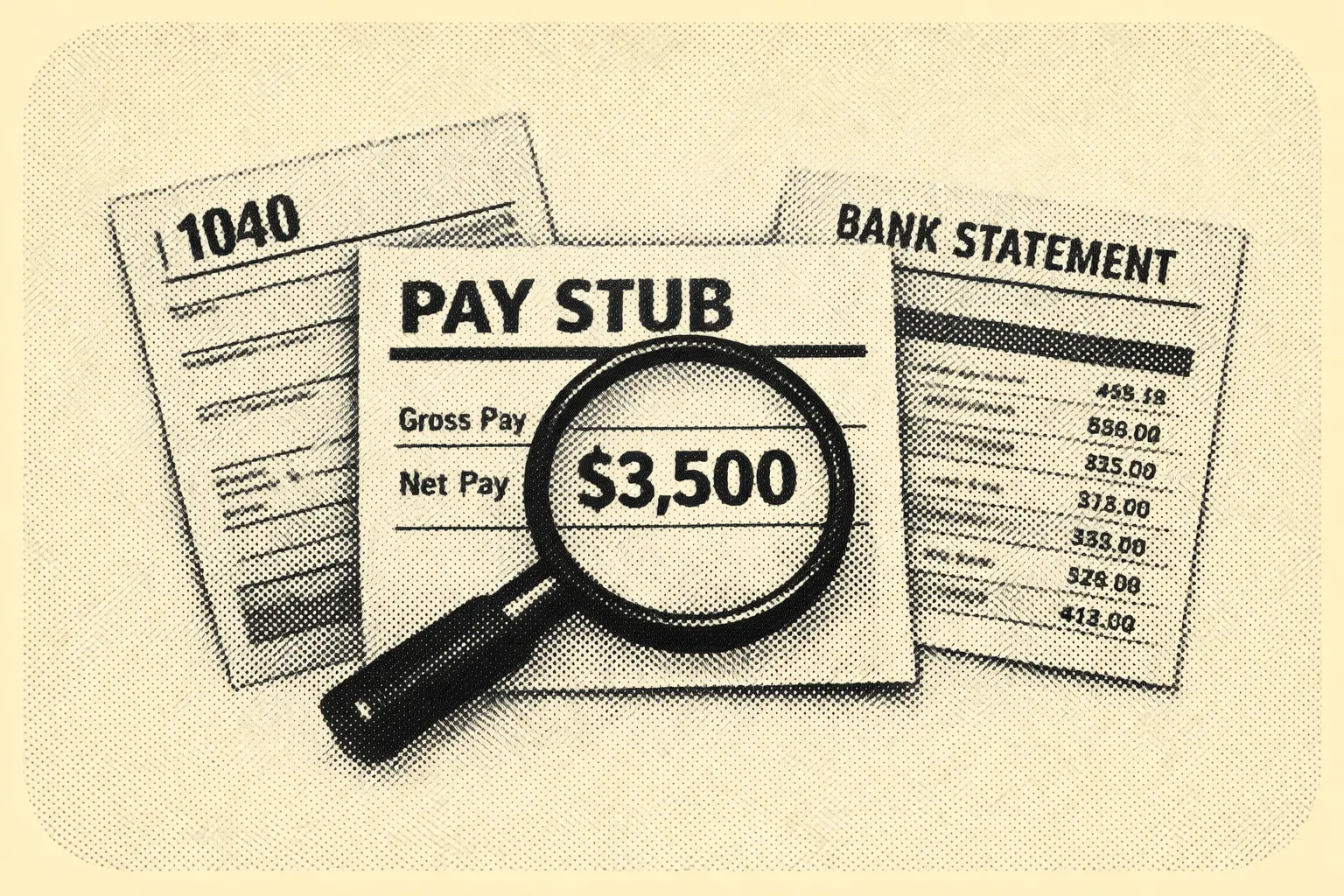
Income verification determines whether an applicant can afford the rent consistently, not just on the day they apply. The goal is triangulation: verified income from a primary source, cross-checked against bank deposits or a secondary source, calculated against a consistent rent-to-income standard applied to every applicant equally. Manual document review alone is no longer sufficient as fraud involving edited pay stubs and falsified employment letters has become more common.
Background and rental history review provides the evidence about whether an applicant will pay reliably, follow lease terms, and care for the property. Eviction history, credit patterns, and rental references all contribute to this picture. Criminal history screening requires a different approach: individualized assessment rather than blanket exclusions, with documentation of the specific factors considered.
Documentation and decision is the discipline most landlords underinvest in. A well-executed screening process that produces an undocumented decision is a compliance liability. Every approval, conditional approval, and denial should be tied to written criteria with the specific basis recorded. This is the file that protects you if a decision is ever challenged.
A rental application checklist is the first line of defense against fraud and wasted screening costs. Before ordering credit or background reports, a completeness and consistency check can identify the majority of high-risk applications: missing fields, date discrepancies, implausible income claims, and unverifiable references that suggest the applicant is obscuring their history.
This guide provides a step-by-step application review process covering identity verification, completeness auditing, income plausibility checks, and the specific inconsistencies that most frequently predict screening failures downstream. It includes a copy-and-use checklist organized by review stage and guidance on how to handle common applicant responses to follow-up requests.
A background check is only as useful as the framework used to interpret what it returns. Eviction history, credit patterns, and criminal records all require context to produce decisions that are both operationally sound and legally defensible. The most common background check failures are not missing information but misinterpreted information: treating an eviction filing the same as a judgment, using an arrest record without a conviction as a denial basis, or applying a blanket criminal history exclusion that creates fair housing exposure.
This guide covers how to order and interpret background reports, what to look for in eviction history, how to evaluate credit patterns rather than single scores, and how to apply HUD-aligned individualized assessment for criminal history. It includes a complete background check checklist and guidance on handling the most common result scenarios including wrong-person matches, dismissed eviction filings, and old convictions without subsequent issues.
Income verification is where fraud most commonly slips through and where screening most commonly becomes inconsistent. Accepting a single pay stub at face value, applying different documentation standards to different applicants, or failing to cross-check stated income against independent sources are the most frequent income verification failures among independent landlords.
This guide covers the seven-step income verification workflow: setting written standards before taking applications, building a document package that enables cross-validation, calculating rent-to-income ratios consistently, verifying employment through independently sourced contacts, spotting red flags in documents including YTD inconsistencies and formatting anomalies, and documenting the income decision in a format that can be produced if a decision is challenged.
A tenant interview is not a social call. It is a structured risk assessment that allows a landlord to evaluate financial stability, rental history patterns, maintenance habits, and communication style in real time before the application is complete. The landlords who benefit most from interviews are those who use a scripted set of questions applied consistently to every applicant rather than improvising based on first impressions.
This guide covers 22 structured interview questions organized into five categories: financial stability, rental history and rule-following, lifestyle fit, maintenance habits, and communication style. Each question includes the specific risk it is designed to surface, recommended follow-up probes, what ideal and concerning answers look like, and the next verification step triggered by concerning responses.
Tenant screening red flags are the warning signs that appear in application data, income documents, background reports, communication behavior, and identity verification that predict high-risk placements before a lease is signed. Recognizing these signals systematically and responding to them with documented verification steps rather than gut-feel decisions is what separates a reliable screening process from one that produces expensive surprises.
This guide covers ten categories of red flags: application inconsistencies, income-to-rent stress, falsified pay stubs, employment verification failures, credit anomalies, background check mismatches, eviction history patterns, rental reference verification gaps, communication behavior indicators, and document and identity anomalies. It includes a copy-and-use red flag screening worksheet organized by category.
Fair housing compliance in tenant screening governs how landlords advertise vacancies, conduct pre-screening conversations, collect applications, apply selection criteria, and document decisions. The Fair Housing Act prohibits discrimination based on seven federally protected classes, and HUD's restored discriminatory effects standard means that facially neutral policies can create liability if they produce disproportionate outcomes for a protected group without sufficient justification.
This spoke addresses fair housing compliance specifically from the screening context: what advertising language creates risk, how pre-screening conversations and scripts should be structured, how application criteria must be applied consistently, how criminal history screening must use individualized assessment rather than blanket exclusions, and what documentation must be maintained to defend decisions.
Screening conditions for independent landlords have changed in ways that make the informal approach increasingly expensive.
Application fraud has become significantly more common. Industry data shows fraud rates in submitted applications have risen measurably, with document forensics showing that a meaningful percentage of rental application submissions contain edited files. Pay stubs, employment letters, and bank statements are the most frequently falsified documents. A landlord relying on a visual document review without cross-checks against independent sources is operating with a gap that fraud exploits directly.
Eviction filing volumes have risen in many markets following the end of pandemic-era protections. The practical consequence for screening is that the cost of a misplaced tenant, which commonly runs from $3,500 to $10,000 when legal fees, lost rent, and turnover are included, is a more likely outcome than it was during years when filings were suppressed.
Fair housing enforcement has intensified, particularly around screening practices. HUD's restored discriminatory effects standard, criminal history screening guidance, and 2024 guidance on algorithmic screening tools all create specific obligations for how criteria must be structured and documented. Landlords applying informal, undocumented screening standards face compliance exposure that a written, consistently applied process eliminates.
The landlords performing well in this environment share three screening disciplines: they use written criteria applied uniformly to every applicant, they verify income and identity through multiple sources rather than single documents, and they document every decision with the specific policy basis recorded in the file.
{
"@context": "https://schema.org",
"@type": "FAQPage",
"mainEntity": [
{
"@type": "Question",
"name": "What is the most important step in tenant screening for landlords?",
"acceptedAnswer": {
"@type": "Answer",
"text": "The most important single step is establishing written selection criteria before taking any applications and applying those criteria in the same sequence for every applicant. Written criteria transform screening from a judgment call into a documented process. They protect against fair housing claims by demonstrating consistent application, protect against fraud by defining what documentation is required, and protect against costly placements by requiring verification rather than accepting self-reported information at face value."
}
},
{
"@type": "Question",
"name": "How long should the tenant screening process take?",
"acceptedAnswer": {
"@type": "Answer",
"text": "A complete screening process typically takes five to fourteen days from application submission to decision, depending largely on how quickly applicants provide required documents and how efficiently verification steps are completed. The biggest source of delay is incomplete applications. Requiring a complete application package including all authorizations and income documentation before ordering reports compresses the timeline significantly."
}
},
{
"@type": "Question",
"name": "What documents should a landlord require from every applicant?",
"acceptedAnswer": {
"@type": "Answer",
"text": "At minimum, every applicant should provide government-issued photo identification, income documentation for the applicable employment type, written authorization for consumer reports, and prior landlord contact information with permission to reach out. The specific income documents vary: recent pay stubs for W-2 employees, tax returns and bank statements for self-employed applicants, and benefit award letters for fixed-income applicants. Requiring the same documents for the same income type applied equally to every applicant satisfies both the verification goal and the consistency requirement."
}
},
{
"@type": "Question",
"name": "How does fair housing law affect tenant screening criteria?",
"acceptedAnswer": {
"@type": "Answer",
"text": "Fair housing law requires that screening criteria be applied consistently and without discrimination based on federally protected classes: race, color, national origin, religion, sex, familial status, and disability. Many states and cities add protected classes including source of income. HUD's restored discriminatory effects standard means that policies producing disproportionate outcomes for protected groups can create liability even without discriminatory intent. Criminal history blanket bans are the highest-risk example for most independent landlords."
}
},
{
"@type": "Question",
"name": "What should a landlord do if a screening report contains an error?",
"acceptedAnswer": {
"@type": "Answer",
"text": "If a consumer report contains potentially inaccurate information, pause the decision and give the applicant an opportunity to dispute the accuracy through the reporting agency. Proceeding with a denial based on a report that may be wrong creates legal exposure. Document the dispute, the verification steps taken, and the outcome regardless of the final decision."
}
}
]
}
Shuk helps landlords and property managers get ahead of vacancies, improve renewal visibility, and bring more predictability to every lease cycle.
Book a demo to get started with a free trial.
The following guides cover every dimension of screening rental applicants: application review and completeness auditing, background check interpretation, income verification workflows, structured tenant interview questions, warning signs to watch across applications and documents, and the fair housing compliance framework that governs every screening decision. Together they give independent landlords a repeatable, legally defensible process for selecting qualified tenants consistently and efficiently.

A tenant background check is a structured review of consumer reports covering credit, eviction history, and criminal records used to evaluate an applicant's rental risk before a lease is signed. For independent landlords, a background check is most useful when it is interpreted in context rather than applied mechanically: an eviction filing is not the same as an eviction judgment, a thin credit file is not the same as a derogatory credit history, and an arrest record without a conviction is not a legitimate basis for denial under HUD guidance. The background check process that protects cash flow and legal standing is one where written criteria define what each report element means for a decision, individualized review applies when results are ambiguous, and adverse action notices are sent whenever a report influences a denial or less favorable terms.
Running a background check and interpreting a background check are two different skills. The failures that produce expensive outcomes, whether the wrong denial that triggers a fair housing complaint or the wrong approval that leads to a costly eviction, come from interpreting results without a defined framework.
The most common background check interpretation failures are treating all eviction history as equivalent regardless of whether the case was a filing or a judgment; applying blanket criminal history exclusions that HUD has identified as likely to produce discriminatory effects; using credit scores as the primary or sole indicator of rental risk rather than evaluating the payment patterns that actually predict housing behavior; and failing to resolve identity mismatches before making a decision on a report that may belong to a different person.
Every element of a background check should have a defined evaluation standard before any applicant's report is reviewed. This prevents the most common fair housing failure in background check interpretation: making up the standard after seeing the result.
Credit criteria should specify what patterns you evaluate, how you treat specific derogatory items, and what compensating factors allow approval despite a concerning profile. Eviction criteria should specify what distinguishes a disqualifying eviction outcome from a reviewable one. Criminal history criteria should specify which offense categories are relevant to housing safety, what lookback period applies, and what individualized assessment factors are considered.
The Fair Credit Reporting Act requires written authorization from the applicant before obtaining a consumer report. Permissible purpose exists when the report is being used to evaluate an actual housing application. Pulling a report on a prospect who toured but never submitted an application does not satisfy this standard. The authorization must be captured in writing and retained in the application file tied to the application date.
A complete background check typically includes credit with tradeline detail, eviction and civil court records, and criminal records where permitted by local law. Some jurisdictions impose restrictions on when criminal history can be considered. New York City's Fair Chance for Housing law restricts criminal history inquiries until after a conditional offer is made. Cook County, Illinois requires a two-step process with limits on lookback periods. Seattle's fair chance framework has its own parameters. Confirm what your jurisdiction permits before ordering a criminal background check.
Credit screening should answer two questions: does the applicant have the capacity to pay the rent, and do their payment patterns suggest they prioritize housing obligations? Evaluate the payment pattern across the tradelines in the report. Repeated 30 to 60-day late payments across multiple accounts are a stronger risk signal than a single isolated late. Housing-related tradelines and recent stability in the last 12 to 24 months are directly relevant to rental risk. Avoid inferring anything about protected class characteristics from credit data.
The distinction between a filing and a judgment matters significantly for risk assessment. An eviction filing shows that a landlord initiated court proceedings. Filings do not always result in removal: many are dismissed, settled, or withdrawn. A filing from five years ago that was dismissed and followed by four years of stable tenancy is a different risk signal than a judgment from 12 months ago.
When an eviction record appears, ask the applicant for documentation of the outcome and the circumstances. Multiple eviction filings in a short timeframe, even if some were dismissed, indicate a chronic payment conflict pattern that is a legitimate basis for concern. Document the specific outcome identified, the applicant's explanation, any supporting documentation, and the decision rationale.
HUD has explicitly cautioned that blanket criminal history exclusions are likely to produce discriminatory effects and has recommended individualized assessment. An individualized assessment considers the nature and severity of the offense and its relevance to housing safety, the recency of the offense and any evidence of rehabilitation, and whether the specific conduct creates a demonstrable nexus to the risk being evaluated. Arrests without convictions should not be used as a basis for denial.
Build an individualized assessment form that captures these factors for every applicant whose background check returns a reportable criminal record. Store the completed form in the applicant file.
Once all reports have been reviewed against your written criteria, record the decision with the specific basis. If the decision was influenced in whole or in part by information in a consumer report, FCRA adverse action requirements apply. The adverse action notice must include the name and contact information of the reporting agency, a statement that the agency did not make the decision, and the applicant's right to obtain a free copy of the report within 60 days and to dispute inaccuracies. Send the notice promptly and retain proof of delivery.
Before ordering any report: Written criteria established for each report element. FCRA authorization obtained. Jurisdiction-specific criminal history rules confirmed. Application completeness verified.
Report ordering: Permissible purpose confirmed. Report bundle appropriate for property type and jurisdiction. Authorization and report stored together.
Credit interpretation: Payment patterns evaluated rather than single score. Recent stability reviewed. No inferences about protected class characteristics.
Eviction interpretation: Filing vs. judgment distinguished. Disposition and recency evaluated. Applicant provided opportunity to explain and document.
Criminal history: Arrest-only records excluded. Offense category, recency, and housing relevance evaluated. Individualized assessment form completed and stored.
Decision and notices: Decision recorded with specific criteria basis. Adverse action notice sent promptly when report influenced decision. Complete file retained.
What does a tenant background check include?
A complete tenant background check typically includes a credit report with tradeline detail, eviction and civil court records, and criminal records where permitted by local law. Credit shows payment patterns and derogatory history. Eviction records show court filings and judgments. Criminal records show convictions and pending cases. The specific combination should match the risks you are evaluating and comply with the restrictions that apply in your jurisdiction.
What is the difference between an eviction filing and an eviction judgment?
An eviction filing is a court case initiated by a landlord that does not establish the tenant was removed. Many filings are dismissed, settled, or withdrawn. An eviction judgment is a court finding that the landlord was entitled to possession. Judgments carry significantly more weight as a risk signal. When an eviction record appears, determining whether it was a filing or a judgment and what the disposition was is the most important interpretive step before using it in a decision.
Can a landlord deny an applicant based on a criminal background check?
Yes, with a documented individualized assessment. HUD has cautioned that blanket exclusions are likely to produce discriminatory effects and recommends evaluating the nature, severity, and recency of convictions and their relevance to housing safety. Arrests without convictions should not be used as a basis for denial. A written policy specifying offense categories, lookback periods, and the individualized assessment process applied consistently to every applicant is significantly more defensible than an informal standard.
When is an adverse action notice required after a background check?
An adverse action notice is required any time a consumer report contributes to a denial or to less favorable terms. The notice must include the reporting agency's contact information, a statement that the agency did not make the decision, and the applicant's right to dispute the report's accuracy. Send it promptly and retain proof of delivery in the application file.
How do landlords handle a background check that may contain an error?
Pause the decision when a report contains results that may be inaccurate. Give the applicant a consistent opportunity to provide clarification and documentation. Contact the screening vendor about a reinvestigation if the applicant disputes the record. Document all steps taken and the final resolution before making the decision.
Schedule a quick demo to receive a free trial and see how data-driven tools make rental management easier.

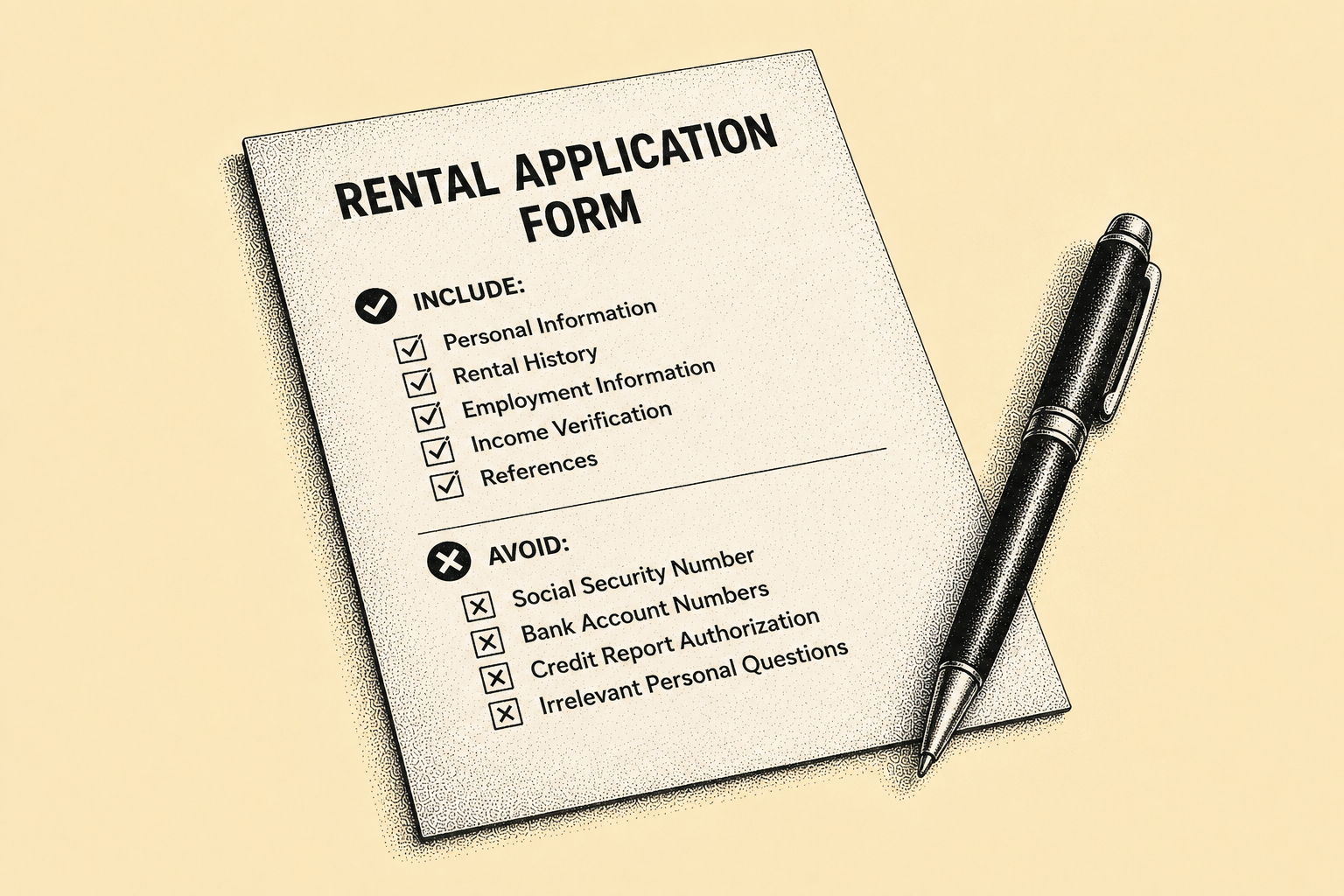
A rental application checklist for landlords is a structured workflow that evaluates every submitted application for completeness, internal consistency, and plausibility before any screening reports are ordered. For independent landlords, the application review stage is both the fastest and least expensive opportunity to identify high-risk placements: inconsistent dates, unverifiable employer contacts, income claims that do not pencil out against the rent, and missing fields that suggest an applicant is obscuring their history are all detectable before a screening fee is spent. A consistent completeness standard applied to every applicant also satisfies the fair housing requirement of equal treatment at the first gate of the screening process.
A rental application review is not a formality before the real screening begins. It is the first substantive risk filter in the process and the one most commonly skipped or rushed. Application fraud has become significantly more common in recent years, with industry data showing that a meaningful percentage of rental application submissions contain edited or fabricated documents. The most frequently falsified items are pay stubs, employment letters, and bank statements, all of which should be flagged and cross-checked at the application review stage before they are treated as verified income.
Beyond fraud, the application review identifies operational mismatches: a desired move-in date that does not align with the unit's availability, an occupancy request that exceeds the lawful maximum, a rental history with gaps that need explanation, or a household composition that requires all adults to be included on the application. Catching these issues at the completeness stage prevents incomplete applications from moving through the screening pipeline and consuming verification resources before basic questions are answered.
The most reliable protection against inconsistency and fair housing complaints is criteria documented before any specific applicant is evaluated. Written selection criteria should specify the income standard and what counts as qualifying income, credit evaluation approach, rental history requirements, occupancy limits, and the policy for handling criminal history if background checks are part of the process.
Put the criteria in a one-page document, make it available to applicants before or with the application, and save a version-controlled copy so that the standard in effect on any decision date is identifiable. Apply the criteria in the same sequence for every applicant. Any exception to the standard requires a documented justification and manager approval.
Written criteria also protect against the most common fair housing failure in application review: accepting one applicant under an informal standard while holding another to the written one. That inconsistency, even when unintentional, is exactly the pattern that complaint investigations identify first.
Before spending money on credit or background reports, run a logic check on every submitted application. Many problems are detectable as contradictions in the application data itself.
Check timeline alignment: employment start dates should correspond to pay stubs, address history should connect to landlord references without unexplained gaps, and prior residence dates should not overlap in implausible ways. Check reasonableness: income claims that are unusually high relative to the stated job title, rental history at rent levels significantly below the new rent without explanation, or employer information that lacks a verifiable contact method all warrant a pause before proceeding.
Check for missing fields: a blank Social Security number or ITIN, no prior landlord contact listed, no employer phone number, or a missing authorization signature are all completeness failures that should be resolved before the application is treated as submitted. Define complete in writing and do not begin screening until the application meets that definition.
Identity is foundational. If the applicant's identity cannot be confirmed with confidence, every downstream check is potentially compromised. Collect government-issued photo ID and verify that the legal name, date of birth, and current address on the ID match the application exactly. Discrepancies in name formatting, mismatched dates, or addresses that differ across documents are all flags that require clarification before proceeding.
Require the applicant to complete screening steps themselves through a secure workflow rather than allowing documents to be submitted on their behalf. This is a basic fraud-resistance practice that catches the most common manipulation approach: a third party submitting documentation on behalf of an unqualified applicant.
Income verification begins at the application stage with a plausibility check: does the stated income, multiplied against the income standard you have published, support the rent? The common benchmark is gross monthly income of at least three times the monthly rent, though your specific standard should reflect your market and be applied consistently.
The plausibility check does not replace formal income verification, but it prevents obviously unqualified applications from advancing through the pipeline before the issue is caught. An applicant claiming $3,000 per month in gross income for a $1,500 per month unit that requires three times rent should be identified as not meeting the income standard at this stage rather than after a background report has been ordered.
The rental history section of the application is the starting point for verification, not the endpoint. What the applicant discloses about prior addresses, landlord contact information, and reasons for leaving each residence creates the baseline against which verification will later confirm or contradict.
At the application review stage, look for completeness: every address for the prior two to three years should have a corresponding landlord contact with independently verifiable information. Look for reasonableness: a move-out reason of "building sold" or "relocated for work" is different from "disputes with management," which warrants a follow-up question. Look for gaps: a period without a listed address explained only as "staying with friends" should trigger a request for documentation or explanation before the application advances.
The application review stage ends with a decision about whether to proceed to screening reports. That decision should be documented in the file. If the application meets the completeness standard, passes the logic check, and plausibly meets the income and rental history criteria, proceed to the next stage. If any element fails, follow up in writing with a specific request for clarification and a defined deadline. Document what you asked, when you asked it, and what response was received.
Every screening decision should be tied to the specific criteria applied and the evidence relied on. If a consumer report contributed to a denial or to less favorable terms, FCRA requires an adverse action notice that includes the reporting agency's name and contact information, a statement that the agency did not make the decision, and the applicant's right to dispute the accuracy of the report.
Retain the complete application file: the application, identity verification, income documents, landlord references, criteria version, follow-up communications, screening reports, decision notes, and any notices sent. A baseline retention period of three to five years covers most regulatory and legal timelines for screening-related claims.
Pre-screen setup: Written criteria saved and dated. Local fee cap and disclosure requirements confirmed. Applicant has provided signed authorization for consumer reports.
Completeness audit: All required fields complete including name, date of birth, identification, current and prior addresses, employment, and landlord history. All adult occupants listed. Authorization signature present.
Logic and consistency check: Employment start dates consistent with income documentation. Address history without unexplained gaps. Income claim plausible against the stated occupation and rent standard. Employer contact independently verifiable.
Identity verification: Government ID collected and matches application data exactly. Any discrepancy resolved before proceeding.
Income plausibility: Stated income meets the written rent-to-income standard. Income type documented for the verification stage.
Rental history review: Prior landlord contacts listed for all addresses in the lookback period. Move-out reasons documented. Any gap flagged for follow-up.
Decision to proceed: Completeness determination documented. Any follow-up request sent in writing with a deadline and response retained.
Decision and notices: Decision recorded with the specific criterion applied. Adverse action notice sent when required. Records retained per retention policy.
Shuk's lease management and tenant communication platform creates a centralized record of every application-related communication, allowing landlords to document follow-up requests and responses in the same system as the lease and payment history. For landlords using Shuk's integration with RentPrep for tenant screening, reports are ordered and stored within the platform workflow rather than through separate tools, reducing the risk that authorization records and screening outputs are stored in different places when they need to be produced together.
What should be on a rental application checklist for landlords?
A rental application checklist should cover identity verification, income documentation for the applicable employment type, written authorization for consumer reports, prior landlord contact information with permission to contact, a completeness check for all required fields, and a logic review for internal consistency across dates and employment history. The checklist should be the same for every applicant and should define what constitutes a complete application before screening reports are ordered.
How do I review a rental application for red flags without violating fair housing law?
Focus exclusively on objective, verifiable criteria tied to rental performance: income against the stated standard, rental history completeness, employment verification, and identity consistency. Document what you evaluated and the specific criterion applied. Avoid noting anything that references protected class characteristics. The consistency of the review process is the fair housing protection.
What happens if a rental application is incomplete?
Send a written request specifying exactly what is missing and a defined deadline for the applicant to provide it. Document the request, the deadline, and the response or non-response. An application that remains incomplete after a defined deadline can be treated as withdrawn under a consistently applied policy. Do not proceed to screening reports based on a partial application.
How much can a landlord charge for a rental application fee?
Application fee rules vary significantly by state and city. New York generally caps fees at $20 or the actual cost of screening and requires an itemized receipt. Washington requires disclosure of screening criteria before any fee is charged and limits the fee to actual cost. California updates its maximum fee annually. Always confirm the current rule for each market before setting a fee, issue a receipt, and apply the same fee structure to every applicant.
How long should a landlord keep rental application records?
A baseline retention period of three to five years covers most regulatory and legal timelines for fair housing investigations and FCRA disputes. Records connected to an active or threatened complaint should be held under a legal hold regardless of the standard schedule. Store all records in a searchable, access-controlled system rather than email archives or paper files.
Find answers to common questions about our products and services
What is the most important step in tenant screening for landlords?
What documents should a landlord require from every applicant?
What should a landlord do if a screening report contains an error?
How long should the tenant screening process take?
How does fair housing law affect tenant screening criteria?
The screening decisions that matter most are made before a lease is signed: verifying income from independent sources, interpreting background data in context, documenting the basis for every decision, and applying the same criteria to every applicant without exception. Platforms like Shuk Rentals support post-screening operations by bringing lease management, rent collection, maintenance tracking, and tenant communication into one connected system so the tenant relationship that starts with a clean screening process continues with the same operational consistency.