
Payments
Applicants pay for their own screening reports. Credit, criminal, eviction and rental history come back as one screening package inside Shuk - so you judge every applicant against the same criteria and decide with confidence, not a gut feeling.
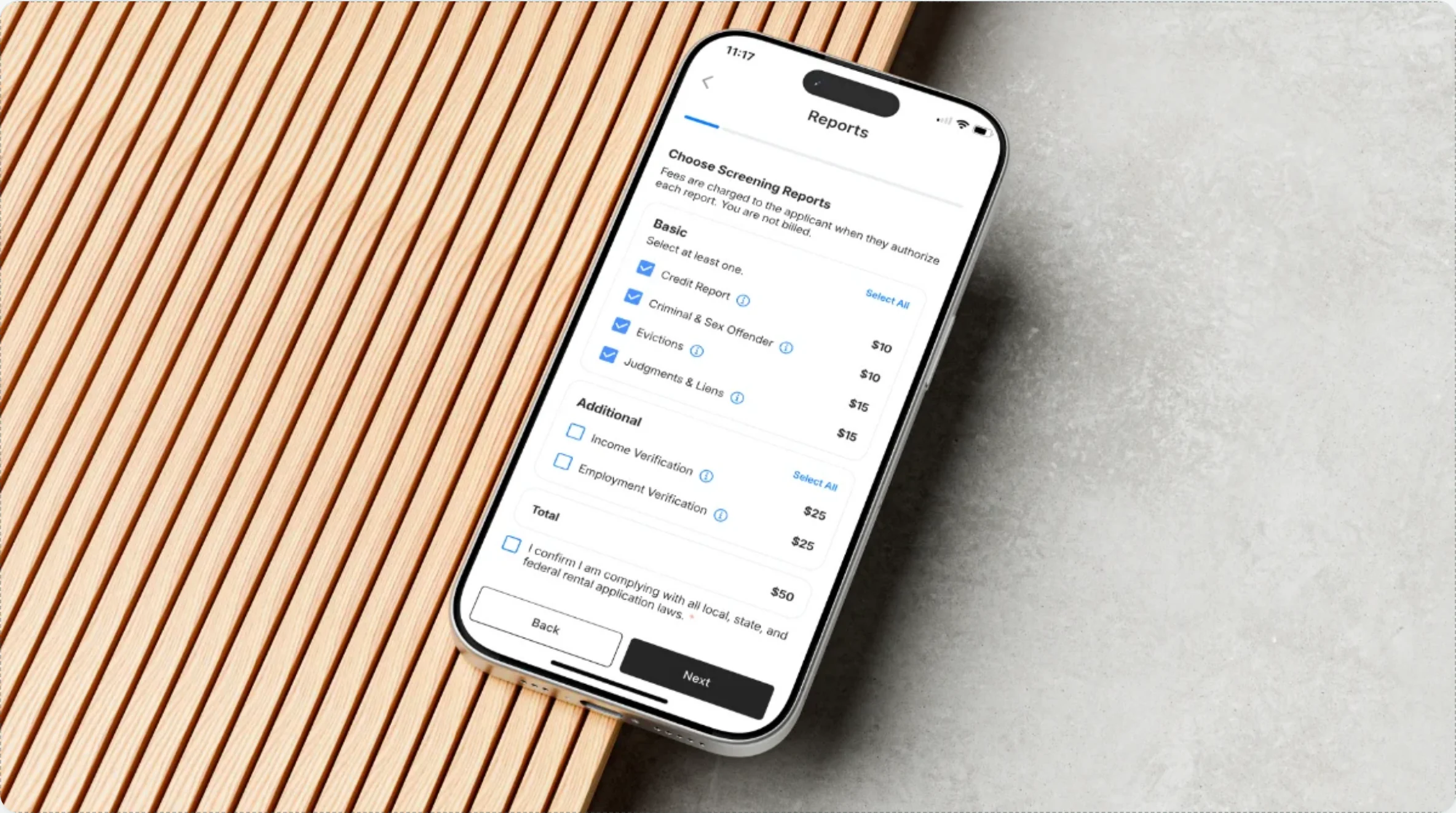
A bad placement costs months of rent and a turnover. Shuk puts the application, the reports and your criteria in one place, so the decision is made on evidence you can point to.
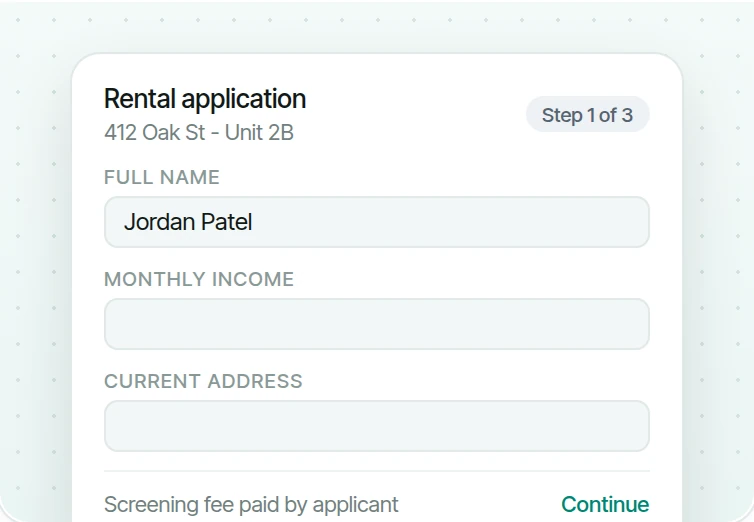
Applicants pay for their reports. Invite an applicant by email. They fill in their details and pay for the screening reports you choose - nothing to chase.
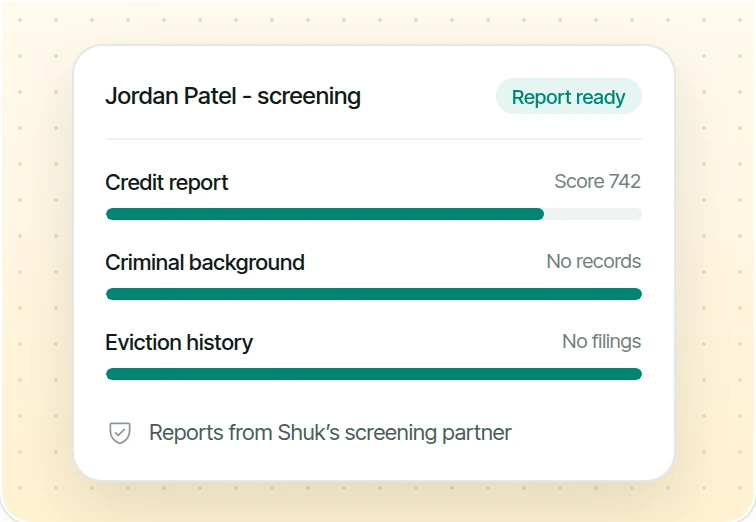
One package. Credit, criminal, eviction. The reports land together as one screening package in Shuk - no logging into a bureau, no PDFs in your inbox.
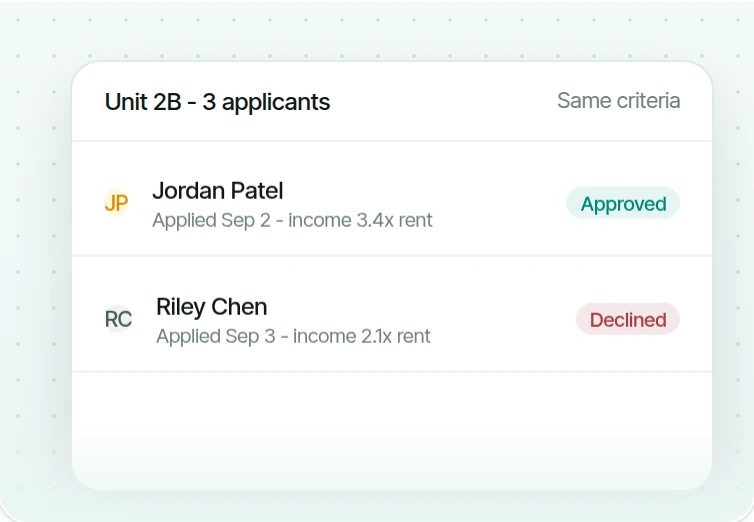
Your criteria, every applicant. Set a minimum credit score, a rent-to-income ratio and rules on evictions, pets and smoking, and apply them to everyone.
Request the documents you need with the application, and add income or employment verification when you want it.
Ask for a photo ID, proof of income, a landlord letter of reference or any other document you name.
Add optional income and employment verification reports, also paid by the applicant.
You make the final call. When you decline, the applicant is told the reasons you select.
The applicant covers the report fees at application time, so there is no cost to you for running every candidate through the same checks.
Screening reports are charged to the applicant. You never front the cost of a report for someone who walks away.
Credit, criminal background, eviction and rental-history reports arrive together, in the same format for every applicant.
Set your rent-to-income and history thresholds once and apply them to every applicant. You make the final decision.
What the big platforms charge for the same basics Shuk includes, as low as $2 per unit.
"Recently started using Shuk and it makes my experience as a renter so smooth and easy! Easy to get set up and super convenient to have access to everything in one place."

"Shuk Rentals has helped me receive tenant payments faster than competing platforms. The built-in service provider feature also gives landlords access to reliable, high-quality professionals, making maintenance and repairs easier and more efficient."

"Shuk allowed me to secure trustworthy tenants more than 60 days prior to lease end date. Tenants searched for my property based on lease dates. For a small property owner, any vacancy is a huge hit, so this feature gave me incredible peace of mind."

"The Lease Indication Tool is a standout-it helps me predict which tenants are likely to renew, so I can plan ahead, avoid vacancies, and keep providing great places to live. It's smart, intuitive, and makes property management easier and more rewarding than ever!"

"I love the lease renewal indicator tool. That is super cool."

The Lease Indication Tool polls renters at 6, 5, 4 and 3 months, so renewals never catch you at 60 days.
Learn MoreTwo-Way Reviews let landlords and renters rate each other at 3, 6, 9 and 12 months into the lease.
Learn MoreListings stay current and ready while units are occupied, so you never start from zero when a renter gives notice.
Learn MoreFind answers to common questions about rental screening on Shuk
The most important single step is establishing written selection criteria before taking any applications and applying those criteria in the same sequence for every applicant. Written criteria transform screening from a judgment call into a documented process. They protect against fair housing claims by demonstrating consistent application, protect against fraud by defining what documentation is required, and protect against costly placements by requiring verification rather than accepting self-reported information at face value.
A complete screening process typically takes five to fourteen days from application submission to decision, depending largely on how quickly applicants provide required documents and how efficiently verification steps are completed. The biggest source of delay is incomplete applications where the landlord is chasing missing documents rather than working from a defined completeness standard. Requiring a complete application package including all authorizations and income documentation before ordering reports compresses the timeline significantly.
At minimum, every applicant should provide government-issued photo identification, income documentation for the applicable type of employment or benefits, written authorization for consumer reports, and prior landlord contact information with permission to reach out. The specific income documents vary by employment type: recent pay stubs for W-2 employees, tax returns and bank statements for self-employed applicants, and benefit award letters for fixed-income applicants. Requiring the same documents for the same income type applied equally to every applicant satisfies both the verification goal and the consistency requirement.
If a consumer report contains potentially inaccurate information, pause the decision and give the applicant an opportunity to dispute the accuracy through the reporting agency. This is both good practice and a compliance expectation. Proceeding with a denial based on a report that may be wrong creates legal exposure. Document the dispute, the verification steps taken, and the outcome regardless of the final decision.
See applications and screening reports running on one of your own listings in a free 20-minute demo.
Book a Demo