
Tenant Screening Hub
Screen Consistently. Verify Thoroughly. Decide Defensibly.
A single bad placement costs more than a year of careful screening. This hub covers application review, income verification, background checks, structured interviews, red flags, and the fair housing rules that govern every decision.
Tenant Screening Hub
Tenant screening for landlords is the process of evaluating rental applicants through a consistent, documented workflow that protects cash flow, reduces eviction risk, and keeps the leasing process legally defensible. For independent landlords and property managers overseeing 1 to 100 units, disciplined screening comes down to four disciplines applied in sequence: reviewing the application for completeness and consistency, verifying income and employment, evaluating background and rental history, and making documented decisions under a written standard applied equally to every applicant. Getting any one of these wrong creates compounding risk: a placement decision made on incomplete information, or an inconsistent exception made under pressure, can produce months of lost rent, legal fees, and operational disruption that far exceeds the original vacancy cost.
This hub connects to six focused resources covering every dimension of the screening process. Use them to build a workflow you can repeat with confidence at every vacancy.
Four Disciplines Every Screening Decision Requires
Most landlords think about screening as a single event. In practice it is four disciplines that interact and reinforce each other. A consistent application review that reveals a red flag means nothing if income is never verified. A clean background check means nothing if the decision is made casually and undocumented.
Deal evaluation is where the process begins and where most fraud enters the pipeline. Incomplete applications, inconsistent dates, unverifiable employer contacts, and mismatched household information are all detectable before a single report is ordered. A structured completeness check catches these issues early and prevents wasted screening fees on applications that should have been paused.
Income verification determines whether an applicant can afford the rent consistently, not just on the day they apply. The goal is triangulation: verified income from a primary source, cross-checked against bank deposits or a secondary source, calculated against a consistent rent-to-income standard applied to every applicant equally. Manual document review alone is no longer sufficient as fraud involving edited pay stubs and falsified employment letters has become more common.
Background and rental history review provides the evidence about whether an applicant will pay reliably, follow lease terms, and care for the property. Eviction history, credit patterns, and rental references all contribute to this picture. Criminal history screening requires a different approach: individualized assessment rather than blanket exclusions, with documentation of the specific factors considered.
Documentation and decision is the discipline most landlords underinvest in. A well-executed screening process that produces an undocumented decision is a compliance liability. Every approval, conditional approval, and denial should be tied to written criteria with the specific basis recorded. This is the file that protects you if a decision is ever challenged.
Curated Resources: Tenant Screening Guides
1. Application Review Checklist: The First Gate Before Any Report Is Ordered
A rental application checklist is the first line of defense against fraud and wasted screening costs. Before ordering credit or background reports, a completeness and consistency check can identify the majority of high-risk applications: missing fields, date discrepancies, implausible income claims, and unverifiable references that suggest the applicant is obscuring their history.
This guide provides a step-by-step application review process covering identity verification, completeness auditing, income plausibility checks, and the specific inconsistencies that most frequently predict screening failures downstream. It includes a copy-and-use checklist organized by review stage and guidance on how to handle common applicant responses to follow-up requests.
2. Background Check Guide: Running Reports That Produce Defensible Decisions
A background check is only as useful as the framework used to interpret what it returns. Eviction history, credit patterns, and criminal records all require context to produce decisions that are both operationally sound and legally defensible. The most common background check failures are not missing information but misinterpreted information: treating an eviction filing the same as a judgment, using an arrest record without a conviction as a denial basis, or applying a blanket criminal history exclusion that creates fair housing exposure.
This guide covers how to order and interpret background reports, what to look for in eviction history, how to evaluate credit patterns rather than single scores, and how to apply HUD-aligned individualized assessment for criminal history. It includes a complete background check checklist and guidance on handling the most common result scenarios including wrong-person matches, dismissed eviction filings, and old convictions without subsequent issues.
3. Income Verification Best Practices: Confirming the Ability to Pay Before the Lease Is Signed
Income verification is where fraud most commonly slips through and where screening most commonly becomes inconsistent. Accepting a single pay stub at face value, applying different documentation standards to different applicants, or failing to cross-check stated income against independent sources are the most frequent income verification failures among independent landlords.
This guide covers the seven-step income verification workflow: setting written standards before taking applications, building a document package that enables cross-validation, calculating rent-to-income ratios consistently, verifying employment through independently sourced contacts, spotting red flags in documents including YTD inconsistencies and formatting anomalies, and documenting the income decision in a format that can be produced if a decision is challenged.
4. Tenant Interview Questions: A Structured Conversation That Tests Reliability Before Placement
A tenant interview is not a social call. It is a structured risk assessment that allows a landlord to evaluate financial stability, rental history patterns, maintenance habits, and communication style in real time before the application is complete. The landlords who benefit most from interviews are those who use a scripted set of questions applied consistently to every applicant rather than improvising based on first impressions.
This guide covers 22 structured interview questions organized into five categories: financial stability, rental history and rule-following, lifestyle fit, maintenance habits, and communication style. Each question includes the specific risk it is designed to surface, recommended follow-up probes, what ideal and concerning answers look like, and the next verification step triggered by concerning responses.
5. Red Flags to Watch: Identifying Warning Signs Across Applications, Documents, and Communication
Tenant screening red flags are the warning signs that appear in application data, income documents, background reports, communication behavior, and identity verification that predict high-risk placements before a lease is signed. Recognizing these signals systematically and responding to them with documented verification steps rather than gut-feel decisions is what separates a reliable screening process from one that produces expensive surprises.
This guide covers ten categories of red flags: application inconsistencies, income-to-rent stress, falsified pay stubs, employment verification failures, credit anomalies, background check mismatches, eviction history patterns, rental reference verification gaps, communication behavior indicators, and document and identity anomalies. It includes a copy-and-use red flag screening worksheet organized by category.
6. Fair Housing Compliance: The Legal Framework That Governs Every Screening Decision
Fair housing compliance in tenant screening governs how landlords advertise vacancies, conduct pre-screening conversations, collect applications, apply selection criteria, and document decisions. The Fair Housing Act prohibits discrimination based on seven federally protected classes, and HUD's restored discriminatory effects standard means that facially neutral policies can create liability if they produce disproportionate outcomes for a protected group without sufficient justification.
This spoke addresses fair housing compliance specifically from the screening context: what advertising language creates risk, how pre-screening conversations and scripts should be structured, how application criteria must be applied consistently, how criminal history screening must use individualized assessment rather than blanket exclusions, and what documentation must be maintained to defend decisions.
What Screening Requires in the Current Environment
Screening conditions for independent landlords have changed in ways that make the informal approach increasingly expensive.
Application fraud has become significantly more common. Industry data shows fraud rates in submitted applications have risen measurably, with document forensics showing that a meaningful percentage of rental application submissions contain edited files. Pay stubs, employment letters, and bank statements are the most frequently falsified documents. A landlord relying on a visual document review without cross-checks against independent sources is operating with a gap that fraud exploits directly.
Eviction filing volumes have risen in many markets following the end of pandemic-era protections. The practical consequence for screening is that the cost of a misplaced tenant, which commonly runs from $3,500 to $10,000 when legal fees, lost rent, and turnover are included, is a more likely outcome than it was during years when filings were suppressed.
Fair housing enforcement has intensified, particularly around screening practices. HUD's restored discriminatory effects standard, criminal history screening guidance, and 2024 guidance on algorithmic screening tools all create specific obligations for how criteria must be structured and documented. Landlords applying informal, undocumented screening standards face compliance exposure that a written, consistently applied process eliminates.
The landlords performing well in this environment share three screening disciplines: they use written criteria applied uniformly to every applicant, they verify income and identity through multiple sources rather than single documents, and they document every decision with the specific policy basis recorded in the file.
{
"@context": "https://schema.org",
"@type": "FAQPage",
"mainEntity": [
{
"@type": "Question",
"name": "What is the most important step in tenant screening for landlords?",
"acceptedAnswer": {
"@type": "Answer",
"text": "The most important single step is establishing written selection criteria before taking any applications and applying those criteria in the same sequence for every applicant. Written criteria transform screening from a judgment call into a documented process. They protect against fair housing claims by demonstrating consistent application, protect against fraud by defining what documentation is required, and protect against costly placements by requiring verification rather than accepting self-reported information at face value."
}
},
{
"@type": "Question",
"name": "How long should the tenant screening process take?",
"acceptedAnswer": {
"@type": "Answer",
"text": "A complete screening process typically takes five to fourteen days from application submission to decision, depending largely on how quickly applicants provide required documents and how efficiently verification steps are completed. The biggest source of delay is incomplete applications. Requiring a complete application package including all authorizations and income documentation before ordering reports compresses the timeline significantly."
}
},
{
"@type": "Question",
"name": "What documents should a landlord require from every applicant?",
"acceptedAnswer": {
"@type": "Answer",
"text": "At minimum, every applicant should provide government-issued photo identification, income documentation for the applicable employment type, written authorization for consumer reports, and prior landlord contact information with permission to reach out. The specific income documents vary: recent pay stubs for W-2 employees, tax returns and bank statements for self-employed applicants, and benefit award letters for fixed-income applicants. Requiring the same documents for the same income type applied equally to every applicant satisfies both the verification goal and the consistency requirement."
}
},
{
"@type": "Question",
"name": "How does fair housing law affect tenant screening criteria?",
"acceptedAnswer": {
"@type": "Answer",
"text": "Fair housing law requires that screening criteria be applied consistently and without discrimination based on federally protected classes: race, color, national origin, religion, sex, familial status, and disability. Many states and cities add protected classes including source of income. HUD's restored discriminatory effects standard means that policies producing disproportionate outcomes for protected groups can create liability even without discriminatory intent. Criminal history blanket bans are the highest-risk example for most independent landlords."
}
},
{
"@type": "Question",
"name": "What should a landlord do if a screening report contains an error?",
"acceptedAnswer": {
"@type": "Answer",
"text": "If a consumer report contains potentially inaccurate information, pause the decision and give the applicant an opportunity to dispute the accuracy through the reporting agency. Proceeding with a denial based on a report that may be wrong creates legal exposure. Document the dispute, the verification steps taken, and the outcome regardless of the final decision."
}
}
]
}
Shuk helps landlords and property managers get ahead of vacancies, improve renewal visibility, and bring more predictability to every lease cycle.
Book a demo to get started with a free trial.
The following guides cover every dimension of screening rental applicants: application review and completeness auditing, background check interpretation, income verification workflows, structured tenant interview questions, warning signs to watch across applications and documents, and the fair housing compliance framework that governs every screening decision. Together they give independent landlords a repeatable, legally defensible process for selecting qualified tenants consistently and efficiently.

Beyond Credit Scores: The Complete Tenant Screening Checklist for Independent Landlords
The Problem With Credit-Only Screening
If you are an independent landlord, you have probably felt pressure to pick "the safest applicant" fast, and the easiest shortcut has been a credit score cutoff. But here is the issue. Credit scores predict how someone repays lenders, not how they will care for your property, communicate when problems arise, or follow lease terms.
Even more concerning, many screening reports miss the most relevant behavior: verified on-time rent payments. The CFPB has repeatedly flagged this gap in its review of the tenant screening market.
The stakes are real. Eviction Lab's tracking shows over 1.115 million eviction cases filed in 2023. The U.S. Census Bureau's Household Pulse Survey estimated 3.8 million residents were likely to face eviction soon in 2024. For landlords, one bad placement can be financially brutal. Industry estimates commonly put the cost of an eviction at $3,500 to $10,000 once you add legal costs, lost rent, and turnover repairs.
That range gets worse when fraud is involved. A Snappt survey found 66% of property managers encountered fraudulent rental applications.
Independent landlords do not have a corporate risk team. You have a spreadsheet, a gut feeling, and maybe a credit and background report. This guide is designed to upgrade that system so you can screen more accurately, faster, and more fairly.
Replace single-metric decisions (like "700+ only") with a documented, repeatable screening checklist that evaluates payment ability, payment behavior, honesty, and fit, while staying compliant.
Why Holistic Screening Works
A holistic tenant screening process is not about collecting more data for its own sake. It is about collecting the right data and weighting it consistently. Done well, holistic screening can lower eviction risk, reduce property damage, and make your decisions easier to defend if challenged.
Here is why moving beyond credit score is practical.
Credit scores can mislead. Multiple landlord stories show applicants with excellent credit and high income still caused severe property damage. In one Reddit thread, a landlord described tenants with 700+ credit who badly damaged the unit, with repairs reportedly exceeding $30,000, including pet-related carpet destruction. Another investor forum story described a tenant with 750+ credit and $150k income leaving extensive damage and disputes behind. Credit did not predict behavior.
Screening data is not always accurate. The CFPB's tenant screening market report outlines issues like ambiguous records, data matching problems, and outdated or incomplete reporting, especially when proprietary risk scores are used without transparency.
Fraud is now a mainstream risk. Industry surveys and coverage point to rising document forgery and identity manipulation in rental applications. If your "proof" is a PDF paystub or a screenshot of a bank balance, you are operating in a high-fraud environment.
A better model is to treat screening like underwriting. Validate identity, verify income and stability, confirm rental history with reliable sources, and watch for honesty and responsiveness signals throughout the process.
Decide up front what "approval" means (income, rental history, identity, fraud checks, and behavior) and document it, then apply it consistently to every applicant.
Step-by-Step: How to Screen Holistically
1) Non-Traditional Signals That Predict Tenant Success Better Than Credit Alone
Traditional screening focuses on financial history. Holistic screening adds behavioral and operational indicators. How someone acts in real time during your process.
High-signal non-traditional indicators
Responsiveness and follow-through. Do they answer within a reasonable timeframe? Do they complete steps without repeated reminders? Chronic delays can predict late rent and maintenance miscommunication.
Consistency across documents. Names, addresses, employer info, dates, and income should align between application, ID, and supporting docs. Inconsistencies are a top-tier fraud indicator.
Stability markers beyond the score. Length at current job, time at current residence, and reason for moving are often more relevant than a 20-point score difference, especially if the score is driven by medical debt or thin credit. The CFPB notes tenant screening reports may not reliably predict rental behavior.
What to do next. Add a "process behavior" section to your screening notes (responsiveness, completeness, consistency). It is free, immediate, and often revealing.
2) Rental-History Verification That Goes Beyond "Call the Current Landlord"
Rental history is where many independent landlords get burned. Not because they ignore it, but because they verify it in the weakest way.
Why "current landlord reference" can fail
- The current landlord may give a glowing reference just to move a problem tenant out.
- Contact info may be fake, or the "landlord" may be a friend.
Better approaches
Verify ownership independently. Cross-check the address and property owner via public records where available (county assessor sites vary). If the "landlord" does not match ownership, ask clarifying questions.
Ask for proof of rent payment history, not just opinions. For example: tenant-provided bank statements showing recurring rent payments (with sensitive items redacted) or ledger screenshots from a legitimate portal. Fraud risk exists, so corroborate.
Call the previous landlord, not only the current. A prior landlord has less incentive to "pass the problem along."
In the Reddit story about 700+ credit tenants causing $30k+ damage, the failure was not money. It was behavior and property care. Asking prior landlords specifically about unit condition, pet compliance, and inspection results might have raised flags.
What to do next. Treat rental history like a three-part check. Verify landlord identity, verify payment pattern, verify property care.
3) "Social Proof" That Is Helpful (and What to Avoid)
Landlords often ask for references, but not all references are useful, and some can create fair housing risk if handled inconsistently.
What tends to be useful
Employer or supervisor verification (where allowed and with applicant consent) confirms ongoing employment and sometimes work stability.
Professional references (manager, coach, clergy) can provide character context but should never replace objective checks.
Co-signer or guarantor strength when the applicant has limited credit history (common in student or immigrant cases).
What to avoid
Social media "screening." It can expose you to protected-class information (religion, disability, family status, national origin), increasing fair housing risk.
Informal neighborhood gossip. Not reliable, and can be biased.
What to do next. If you use references, standardize the same reference type for every applicant and keep the questions strictly rental-relevant (reliability, responsibility, rule-following).
4) Income Stability Beyond Pay Stubs: Modern Verification Methods
Pay stubs are easy to fake in today's fraud environment. With 66% of property managers reporting they have encountered fraudulent applications, you need a "trust but verify" stance.
Better income verification options
Bank-activity verification. Look for consistent deposits that match stated income (not just a single large transfer). Even when tenant-provided, bank activity is harder to forge than a paystub. Still possible, so corroborate.
Tax documents for self-employed and gig workers. Prior-year tax returns or 1099s can show income pattern. For gig workers, consistency and cash reserves matter as much as monthly average.
Stability buffer checks. Savings reserves or an emergency buffer can reduce late-payment risk even with variable income.
Why this matters. If an eviction and turnover costs $3,500 to $10,000, then preventing even one bad placement every few years can justify spending extra time on verification and using a structured tool to keep it efficient.
What to do next. Require two independent proofs for income when fraud risk is higher (for example, paystub plus bank deposits, or offer letter plus bank deposits).
5) Application Behavior Red Flags (the "Process Tells on People" Principle)
How an applicant behaves during screening is often predictive, especially around honesty and respect for boundaries.
Common red flags
Rush pressure. "I can move in tonight if you skip the screening." In a high-fraud market, urgency can be a tactic.
Inconsistent story. Different move-in dates, job details, or roommate counts across conversations and forms.
Reluctance to provide standard documentation (ID, income proof, rental history verification) while demanding exceptions.
Many landlords describe that the applicants who argue with screening steps often become the tenants who argue about lease enforcement later.
What to do next. Write your screening steps into your listing: "Application, then ID plus income verification, then rental history verification, then background check, then decision within X hours." Applicants self-select out if they plan to manipulate.
6) Revealing Interview Questions (That Stay Legal and Useful)
A short, consistent pre-screen call can save hours. The key is to ask the same questions of everyone and keep them tied to lease performance, not personal characteristics.
High-signal questions
"What is your reason for moving?" You are listening for stability vs. recurring conflict. Follow-up: "What would your current landlord say about your tenancy?"
"What is your monthly income source, and is it steady or variable?" For variable income: "What is your average month over the last 6 to 12 months?"
"How many occupants will live in the home, and do you have pets?" This ties to occupancy limits and pet policies. Apply uniformly.
How to make answers more verifiable. If they say "always pay early," ask: "Can you show a rent payment history or bank pattern for the last 6 months?"
What to do next. Use a standardized script and score the answers for clarity and consistency, not charm.
7) Fair-Housing Balance: Data-Driven and Still Fair
"Holistic screening" must not become "subjective screening." The more discretion you add, the more important consistency becomes.
Key compliance principles
Use objective, written criteria and apply them consistently to every applicant.
Avoid proxies that can create disparate impact. Over-reliance on credit or criminal history can disproportionately exclude some groups. Research and policy commentary have raised concerns that screening systems can amplify inequities.
Keep an audit trail. Document why you accepted or denied based on your criteria, especially if you use a scorecard.
Why this matters. Eviction data shows stark disparities. Eviction Lab reports that Black renters account for nearly half of eviction filings while being less than a third of renters, and 60% of eviction defendants were women. Those disparities do not mean landlords should stop screening. They mean landlords should screen in ways that are consistent, evidence-based, and defensible.
What to do next. Build your process so that if you had to explain a decision later, you could point to a checklist and documented criteria, not a feeling.
8) Build a Holistic Scorecard (Simple, Repeatable, Defensible)
A scorecard prevents you from overweighting a single factor (like credit) and helps you decide consistently.
Traditional vs. non-traditional screening signals
Category
Traditional signals
Non-traditional (high-signal) additions
Ability to pay
Credit score, debt
Deposit patterns, reserves buffer, income consistency
Willingness to pay
Collections history
Verified rent-payment history (bank pattern or ledger)
Honesty and fraud risk
Basic identity info
Consistency checks, document authenticity concerns
Property care
Often ignored
Prior landlord unit-condition feedback, pet compliance
Operational fit
Not measured
Responsiveness, rule-following during screening
Example scorecard weights (adjust to your market)
- Income and stability: 30%
- Rental history and payment pattern: 30%
- Background, identity, and fraud checks: 20%
- Application behavior and responsiveness: 10%
- Fit with occupancy and pet policy: 10%
What to do next. Use a scorecard with weights and thresholds (for example, "must pass identity verification," "no evictions within X years where legally permissible," "income at or above 3x rent or acceptable guarantor").
9) Instincts vs. Data: When to Trust Your Gut (and When Not To)
"Gut feel" is often pattern recognition. Sometimes valuable, sometimes biased.
When instincts can help
- Inconsistencies you cannot explain even after clarifying questions.
- Boundary testing ("Can I pay cash only?" "Can I move in without the deposit?") that signals future friction.
When instincts can hurt
- Vibes-based decisions that are not tied to objective criteria.
- Unequal conversations with different applicants that create inconsistent evaluation.
A practical rule. If your instinct says "no," write down the objective reason tied to your criteria. If you cannot, you probably should not act on it.
What to do next. Use instinct as a prompt to verify, not as the deciding factor.
The Complete Screening Checklist
Below is a step-by-step tenant screening checklist for independent landlords. Use it as-is, or adapt it into your property's written criteria.
Pre-screen (before showing)
- Share written rental criteria (income target, occupancy limit, pet policy, move-in timeline)
- Confirm move-in date and household size match your limits
- Confirm they understand application fee and screening steps (where permitted)
Application intake
- Completed application for every adult occupant
- Government ID collected and matches application identity
- Consent for screening (credit and background where used)
Income and stability verification
- Primary income proof (pay stubs, offer letter, 1099 or tax documents)
- Secondary proof (bank deposit pattern or additional documentation) to reduce fraud risk
- Income-to-rent ratio meets your standard or guarantor meets your guarantor standard
Rental history verification
- Verify landlord identity and ownership (as available via public records)
- Contact prior landlord (not only current)
- Verify payment pattern (ledger or bank pattern) where possible
- Ask about unit condition, notices, lease violations, and pet compliance
Fraud and consistency checks
- Names, addresses, and employer info consistent across all documents
- Watch for rush pressure, refusal to provide standard docs, or changing stories
Decision and documentation
- Scorecard completed with the same weights for every applicant
- Approval, conditional approval, or denial documented against written criteria
- Store documentation securely (retain only what you need)
FAQ
Should I charge an application fee?
Application fees are commonly used to cover screening costs, but rules vary by state and city. The safest approach is to disclose the fee clearly before collecting it, apply it consistently, and document what it covers. Keep your process efficient so you are not collecting fees from applicants you will not seriously consider. A quick pre-screen call before collecting the fee saves you and the applicant time.
What if an applicant has little or no credit history?
"No credit" is not the same as "bad credit." The CFPB notes that tenant screening data may be incomplete and not always predictive of rental behavior. Consider alternative pathways: stronger income verification, a qualified guarantor, higher deposit where legal, or verified rent-payment history through bank deposit patterns. Many excellent tenants, especially younger renters and recent immigrants, have thin credit files but strong rental and employment track records. Your screening process should be structured to evaluate those tenants fairly.
How should I think about criminal history in screening?
This is a high-risk area legally and ethically. Policies must be consistent and tied to legitimate safety and property concerns. Avoid blanket rules that are not connected to current risk, and document your rationale. Because screening systems can amplify inequities, be careful with automated deny lists. Individual assessment, documented criteria, and legal review of your policy are all recommended. This is an area where a quick consultation with a qualified attorney is worth the investment.
How fast should I make a decision after receiving an application?
Speed matters because good applicants have options, but accuracy matters because evictions are expensive. With eviction costs commonly estimated at $3,500 to $10,000, it is usually worth taking an extra day to verify rental history and income stability. A well-organized workflow can help you decide in 24 to 72 hours without skipping steps. The landlords who consistently make good placements are the ones whose process is fast because it is structured, not because they cut corners.
Your Next Step
Credit scores are a useful input, but they are not a tenant selection system. In today's market, where eviction filings remain high and application fraud is widespread, independent landlords need a screening process that is holistic, consistent, and documented. The goal is not to make renting harder. It is to make your decisions more accurate, your process more fair, and your business more resilient.
Your next best action is to operationalize this checklist so it runs the same way every time. Even one prevented bad placement can pay for the time you invest, especially when a single eviction can cost thousands in lost rent, legal fees, and turnover.
This is exactly where Shuk fits into the screening workflow. Shuk provides tenant screening through our partner (RentPrep/TransUnion), so you get credit, criminal, and eviction reports as part of your screening process without shopping for a separate screening vendor. Around the screening report, Shuk's centralized in-app messaging with email and push notifications gives you a time-stamped record of every applicant conversation, scheduling exchange, and verification follow-up, so nothing falls through the cracks and the communication trail is documented. Document storage keeps the application, ID, income verification, landlord-reference notes, and screening report organized in one place per applicant. And when you make a decision, the record of what you collected and how you evaluated it is already organized, making your process easier to defend if a decision is ever questioned.
Once you make a placement, the same Shuk subscription gives you the rest of the rental operating stack. E-signature for leases through our Adobe-powered integration. Online rent collection with zero ACH transaction fees and configurable late fees applied automatically. Maintenance request tracking with photos, documents, and a complete history per property. Schedule E-aligned expense organization with digital receipts. The Lease Indication Tool for predictive lease renewal insights through monthly tenant polling starting six months before lease end. Two-Way Reviews between landlords and tenants that build verifiable rental reputations (which means your next screening decision can start from a verified rental track record, not just a credit report). And Year-Round Marketing.
At $5 per unit per month with no setup fees, and with White Glove Onboarding included at no additional cost (where the Shuk team handles property setup, account preparation, and renter onboarding for you), Shuk makes structured, documented screening feasible for landlords and property managers running 1 to 100 units. Shuk now supports third-party management with multi-user workflows and role-based access, so a property management team can run consistent screening standards across an entire portfolio.
Book a demo at shukrentals.com/book-a-demo to see how Shuk's tenant screening through our partner, centralized in-app messaging, document storage, e-signature, online rent collection with zero ACH fees, automated late fees, maintenance request tracking, Schedule E-aligned expense organization, the Lease Indication Tool, Two-Way Reviews, and Year-Round Marketing work together so screening becomes a repeatable system instead of a gut call.

Two-Way Review Systems: How Landlords and Tenants Both Win
The Real Cost of "I Don't Trust You," and Why Reviews Change the Math
Independent landlords and property managers track late payments and repair bills. But there is a quieter leak. Mistrust. Extra screening calls. Defensive email threads. Disputes that escalate. Vacancies that stretch from "just a few days" into weeks.
Vacancy is unforgiving because it compounds. You lose rent and keep paying carrying costs. Utilities, marketing, admin time, re-ready work. Industry guidance on vacancy loss consistently emphasizes that every vacant day includes more than rent. The full cost stack keeps running even when income stops. A 30-day gap is rarely a rounding error. It is a meaningful hit to annual performance.
At the same time, renters are shopping for reputation, not just square footage. In a large renter survey conducted by NMHC and Grace Hill, "management reputation" was rated very important by 45% of renters and absolutely essential by another 24%. Nearly 7 in 10 renters said reputation is a deciding factor. Separate rental-search reporting has found that a large share of renters actively check ratings and reviews as part of the housing hunt.
Two-way review systems, where landlord reviews and tenant reviews both matter, turn mistrust into a measurable advantage. They create transparency and accountability at the relationship level, not just the unit level, helping both sides reduce disputes, shorten vacancy time, and avoid repeat mistakes.
What this looks like in practice
A 12-unit landlord started requesting reviews at move-out and saw fewer surprise conflicts over cleaning because expectations became explicit in the next lease cycle.
A tenant comparing two listings chose a smaller landlord after reading consistent feedback about fast maintenance follow-through. He applied faster and signed sooner because the perceived risk was lower.
A 60-unit property manager used two-way feedback trends to standardize move-in instructions, reducing repetitive "where do I" tickets across the portfolio.
If you cannot explain your rental experience in a way strangers trust, you will pay for that uncertainty through longer vacancies and higher friction. Two-way reviews are a practical fix.
Why Two-Way Feedback Matters Now
Two-way review systems are often framed as a nice-to-have feature. In practice, they function more like trust infrastructure. Similar to what peer-to-peer marketplaces used to scale safely. Research on mutual rating systems in marketplaces suggests that reciprocal reputation can reduce adjudication and enforcement burdens by creating clearer norms and incentives for good behavior, though careful design is required to manage bias and power dynamics.
Housing is different from short stays, but the underlying mechanism is familiar. When both sides know feedback is coming, they communicate earlier, document better, and resolve more issues before they become expensive.
The timing also matters. Renter expectations for professionalism are rising, and reputation signals carry increasing weight in leasing decisions. Yet trust is uneven. Advocacy-oriented renter research has highlighted concerns about housing conditions and low confidence that landlords will address them, which underscores the gap between what renters need and what they believe they will receive. That gap fuels disputes, churn, and defensive behavior on both sides.
This guide covers the mutual, measurable advantages of two-way review systems. How tenant reviews help landlords attract quality tenants and validate good screening decisions, how landlord reviews help tenants identify professional rental experiences and reward transparency, how to set up criteria and workflows that strengthen accountability without creating legal risk, and where the ROI shows up. Fewer conflicts, faster leasing, and stronger retention, especially for small portfolios where every turnover hurts.
6 Practical Ways to Build a Two-Way Review System That Reduces Disputes and Vacancy
1) Start at Onboarding. Set "Reviewable Expectations" in Writing
Two-way review systems work best when neither party is surprised by what gets evaluated. At move-in, define a short, neutral set of expectations. Response times, maintenance reporting channels, payment method, noise rules, and how move-out condition will be assessed. Urban Institute research on landlord-tenant communication emphasizes that structured, earlier communication and mediation approaches can prevent issues from escalating and improve outcomes. Your review prompts should mirror these expectations so feedback stays relevant and consistent.
Example. An 8-unit landlord added a "maintenance triage" chart to her welcome packet. Later reviews became specific ("non-emergency fixed within 3 days") instead of vague ("slow maintenance").
Example. A tenant appreciated knowing how to submit requests and what counted as urgent. His landlord review mentioned clarity and professionalism by name.
Example. A 90-unit PM standardized a move-in walkthrough checklist, reducing end-of-lease disputes that often hinge on memory.
What to do next. If a review category is not described at move-in, it becomes subjective at move-out. Define it early.
2) Use Clear Criteria. Short Ratings Plus Evidence-Based Comments
A useful two-way review system balances simplicity with specificity.
- Ratings on a 1-to-5 scale for on-time payments, care for the unit, communication, and respect for policies (tenant reviews).
- Ratings for responsiveness, habitability and maintenance follow-through, fairness of charges, and professionalism (landlord reviews).
- Comment prompts that ask for concrete examples ("What was the typical response time?") rather than personal judgments.
Why so structured? Because reviews influence decisions. Research on online reviews shows they meaningfully affect trust and decision-making, especially when language is clear and the source is credible. In rental housing specifically, renters actively seek ratings and reviews during their search, and management reputation is a major leasing factor. A structured format improves transparency and reduces the odds that feedback devolves into venting.
Example. A 15-unit landlord used a move-out condition rating plus a photo-upload option. It reduced arguments about deposit deductions.
Example. A tenant left a landlord review noting "repaired heater within 24 hours." Future renters could trust that detail more than "great landlord."
Example. A 45-unit PM found that "communication clarity" consistently outscored "speed," signaling tenants valued predictability even when fixes took time.
What to do next. Make your prompts fact-seeking. "What happened?" beats "How did you feel?" for rental credibility.
3) Design for Fairness. Verified Parties, Timing Rules, and Anti-Retaliation Guardrails
Two-way systems fail when users fear retaliation or doubt authenticity. Borrow a proven marketplace concept. Verified reviews from confirmed landlord-tenant relationships, submitted within a set window (for example, 14 to 30 days after move-out or lease renewal). Marketplace ethics research on reputation systems highlights real risks (bias, power dynamics, strategic behavior) when reviews are unmanaged. Guardrails reduce those risks.
Best-practice guardrails
- Double-blind submission. Both parties submit before either is published, reducing retaliatory behavior.
- Content moderation rules that block hate speech, threats, doxxing, or personal health and family details.
- Relevance filtering. Reviews must relate to the rental transaction (payments, upkeep, communication), not protected traits or personal characteristics.
Example. A tenant felt safer reviewing honestly once she learned the landlord would not see her review until both reviews were submitted.
Example. A 22-unit landlord avoided character attacks by enforcing a rule. Comments must reference dates, requests, and outcomes.
Example. A PM team reduced fake reviews by requiring lease verification before publishing.
What to do next. If you want honest transparency, you must design for psychological safety. Verification plus timing rules are non-negotiable.
4) Respond Professionally. Turn Negative Reviews Into Credibility Assets
A two-way review system does not eliminate negative feedback. It prevents feedback from becoming reputation damage. Professional responses demonstrate accountability, set the record straight without escalating, and show future applicants how you operate under pressure.
Why it matters. Renters weigh reputation heavily, and online reviews influence trust broadly. A calm, policy-based reply often builds more confidence than a perfect score.
When responding
- Thank the reviewer.
- State the policy and timeline.
- Share what changed, if anything.
- Invite offline resolution if appropriate.
Tenants can do the same in tenant reviews when responding to feedback from landlords, especially if a late payment had a documented cause and was resolved.
Example. A landlord replied: "We missed the first appointment window. We have since added confirmation texts." Prospective renters saw accountability, not denial.
Example. A tenant responded to a late payment note by clarifying it occurred once during a job transition and was paid within the grace period thereafter.
Example. A 70-unit PM noticed that professional review responses correlated with fewer repetitive applicant questions, because key policies were visible.
What to do next. Draft two response templates now. One for maintenance complaints, one for deposit disputes. So you do not improvise when emotions are high.
5) Put Reviews to Work in Marketing. Reduce Vacancy by Reducing Uncertainty
Vacancy costs are not just lost rent. They include carrying and turnover costs and managerial time. The fastest way to reduce vacancy is often to reduce uncertainty for qualified prospects so they apply sooner and drop off less.
Two-way review systems create credible proof. Landlords can showcase landlord reviews that highlight responsiveness and fairness. Tenants with strong tenant reviews can stand out, shortening the trust ramp for approval. Both benefit from fewer "are you legit?" conversations.
Evidence that renters rely on reviews in their search is strong. Renters explicitly rate management reputation as critical. So do not hide your reputation. Surface it in listings, pre-screen messages, and renewal conversations.
Example. A 10-unit landlord added a "what past residents say" section to listings and saw more completed applications versus casual inquiries.
Example. A tenant used his strong tenant reviews to secure a competitive unit without multiple co-signers.
Example. A 55-unit PM pinned a quarterly "you said, we did" summary, improving renter confidence and lowering complaint temperature.
What to do next. Feature themes (response time, fairness, clarity) rather than cherry-picking praise. Patterns are what create rental credibility.
6) Use Dashboards. Convert Feedback Into Fewer Disputes and Better Retention
The final step is where small operators win. Treat reviews like operational data. Track:
- Average maintenance satisfaction over time
- Top dispute triggers (fees, repairs, noise, move-out)
- Response-time trends
- Review participation rate (a transparency signal)
- Renewal vs. move-out review differences (early warning of churn)
Renter survey work shows that many renters are satisfied overall, which means improvements can be targeted. Often small service gaps rather than total dissatisfaction. Meanwhile, communication-focused housing research suggests that structured dialogue and problem-solving reduce conflict escalation. A dashboard helps you spot the specific friction points that cause disputes and turnover.
Example. An 18-unit landlord learned that move-in cleanliness was his lowest score. After adding a pre-move-in checklist, disputes about condition dropped.
Example. A tenant noticed her landlord improved package handling after multiple reviews mentioned confusion. Her renewal decision became easy.
Example. A PM team flagged one building with repeated "slow responses" and rebalanced vendor coverage. Reviews improved the next quarter.
What to do next. Pick one metric to improve per quarter. Two-way transparency works best with consistent, incremental fixes, not sporadic reputation sprints.
Two-Way Review System Setup Checklist
Use this as a lightweight template to implement two-way review systems without overcomplicating your workflow.
A) Before move-in (shared transparency)
- Publish what will be reviewed (communication, payments, maintenance and responsiveness, unit care, policy adherence).
- Provide a written maintenance process (urgent vs. non-urgent) and expected timelines.
- Confirm review rules. Verified relationship only, respectful language, no personal or protected-trait commentary.
B) Review timing (reduce retaliatory reviews)
Collect reviews at one of these triggers:
- 30 days after move-in (onboarding quality)
- At renewal offer (relationship health)
- Within 14 to 30 days after move-out (full-cycle feedback)
- Quarterly during tenancy for ongoing relationship feedback
Use double-blind publication where possible. Both submit before either is shown.
C) Landlord review prompts (tenant-to-landlord)
- Responsiveness. "Typical time to acknowledge a request?"
- Maintenance follow-through. "Was the issue resolved? In how many days?"
- Fairness. "Were charges and policies explained upfront?"
- Professionalism. "How respectful and clear was communication?"
D) Tenant review prompts (landlord-to-tenant)
- Payment reliability. "On-time rate across lease?"
- Unit care. "Move-out condition vs. move-in condition?"
- Communication. "Did they report issues promptly and follow process?"
- Community impact. "Noise and rule compliance?"
E) Responding and learning
- Reply within 72 hours to critical reviews with facts, policy, and next steps.
- Each quarter, choose one improvement based on review trends.
What to do next. Participation rate is a trust signal. Aim for consistency (asking every time), not perfection (only asking when you expect praise).
FAQ
Are two-way reviews legally risky for landlords?
They can be if the system invites discriminatory or irrelevant commentary. Keep reviews tied to business conduct (responsiveness, payment timeliness, property care) and moderate out protected-class or personal family or medical details. Fair-housing risk and compliance scrutiny remain active topics across the industry, so the safest approach is strict relevance rules, consistent enforcement, and documentation. A platform with built-in moderation and relevance filters reduces the burden of policing every comment manually.
How do we avoid retaliatory reviews?
Use verified relationships and structured timing windows. Consider double-blind submission so neither party can punish the other after seeing a review. Marketplace reputation research has shown this design choice meaningfully reduces retaliatory behavior. Also provide an appeal channel for clear policy violations (threats, doxxing, hate speech) so honest reviewers feel protected and bad-faith reviewers face consequences. The combination of verification, timing, and appeal turns reviews into a fair system rather than a shouting match.
Do renters actually care about reviews and reputation?
Yes. Renter research shows management reputation is highly influential. 45% of renters in the NMHC/Grace Hill survey said it is very important and 24% said it is absolutely essential in leasing decisions. Separate rental-search reporting indicates many renters check property ratings and reviews during their search. This makes transparency a competitive advantage for landlords and a risk-reduction tool for tenants. A landlord with verified reviews can shorten the trust ramp on every application.
What is the ROI for small landlords managing 1 to 100 units?
The ROI shows up where small portfolios are most exposed. Vacancy time, dispute frequency, and turnover friction. Every vacant day includes carrying costs beyond rent, and two-way review systems reduce uncertainty in ways that can speed decisions and discourage behavior that triggers disputes. For a small operator, even one prevented dispute or one shortened vacancy more than covers the operational effort of running the review workflow.
Turn Transparency Into a Repeatable Advantage
If you want a calmer, more profitable rental business, make transparency and accountability part of the product. Not a personal promise you repeat to every new applicant. Two-way review systems create rental credibility that scales. Good tenants can prove they are low-risk, and good landlords can prove they are professional. That reduces disputes, attracts quality tenants, and helps stabilize occupancy when the market gets competitive.
Implement the checklist above on your next lease cycle. Move-in, renewal, or move-out. Then make it operational, not optional.
This is what Shuk's Two-Way Reviews is built for, and it is one of the platform's three flagship differentiators.
Shuk lets landlords and tenants rate each other quarterly on a structured five-point scale, with reviews building verifiable rental reputations on the platform. A good tenant on Shuk has a portable record they can show the next landlord. A responsive landlord on Shuk has a track record prospective applicants can see before they apply. Reviews are tied to verified leases, which removes the credibility problem that plagues anonymous review sites.
Most major property management platforms cannot offer this. AppFolio and similar enterprise-focused systems do have tenant portals, but they cannot run public mutual reviews because their institutional property management clients resist being publicly rated. That is a structural barrier, not a technical one. Shuk's customer base, independent landlords and property managers running 1 to 100 units, does not have that resistance. The market that benefits most from reputation as a competitive advantage is the one Shuk serves.
Around Two-Way Reviews, the same Shuk subscription gives you the rest of the rental operating workflow. The Lease Indication Tool polls tenants monthly starting six months before lease end, surfacing predictive lease renewal insights so you can intervene before a renewal becomes a turnover. Online rent collection with zero ACH transaction fees and configurable late fees applied automatically. Tenant screening through our partner. E-signature for leases through our Adobe-powered integration. Maintenance request tracking with photos, documents, and a complete history per property. Centralized in-app messaging with email and push notifications, creating a time-stamped communication record. And Year-Round Marketing that keeps your listing assets ready year-round so a non-renewal does not stretch into a long vacancy.
At $5 per unit per month with no setup fees, and with White Glove Onboarding included at no additional cost (where the Shuk team handles property setup, account preparation, and renter onboarding for you), Shuk makes verified two-way reputation feasible for landlords and property managers running 1 to 100 units. Shuk now supports third-party management with multi-user workflows and role-based access, so a property management team can run two-way reviews across an entire portfolio.
Book a demo at shukrentals.com/book-a-demo to see how Shuk's Two-Way Reviews, the Lease Indication Tool, online rent collection with zero ACH fees, tenant screening, e-signature, maintenance request tracking, centralized in-app messaging, and Year-Round Marketing work together so transparency becomes a competitive advantage instead of a personal promise.

Tenant Screening 101: How to Find and Select Quality Tenants
Tenant screening is the difference between a stable, predictable rental business and a year of stress you did not budget for. One bad fit can quickly turn into months of unpaid rent, legal headaches, repairs, and a vacancy you cannot refill until the unit is restored.
The financial stakes are real. Industry analyses put the average eviction-related expense around $3,500, with timelines often running three to four weeks and longer in many courts. That figure commonly includes legal costs, court fees, lost rent across two to three months, and turnover expenses. In some markets the range is wider: California eviction costs are often cited from $1,500 to $10,000 or more, and contested cases in Florida can exceed $5,000. Evictions also happen at scale, with estimates suggesting roughly 2.7 million eviction filings annually in the United States. And even without an eviction, cash flow can wobble: one dataset showed on-time rent payment rates dropping to 82.1% in a single month.
Three quick scenarios that mirror what independent landlords face: A duplex owner selects the nicest applicant without verifying income, and two months later rent becomes sporadic, not fraud, just instability that screening would have revealed. A small property management firm files for eviction but loses time because paperwork is incomplete, and procedural errors contribute to a dismissal. A tenant leaves suddenly and the security deposit does not cover cleaning, repairs, and vacancy, with turnover costs commonly cited in the $1,000 to $5,000 range.
Treat screening like a repeatable system rather than a gut call. A consistent workflow helps you choose better tenants and protects you under Fair Housing rules.
What Tenant Screening Is and What It Is Not
Tenant screening is a structured process landlords and property managers use to evaluate applicants for risk and fit, typically using a rental application, identity and income verification, credit data, background checks, rental history, and references. It is not about finding perfect people. It is about confirming the applicant can pay consistently, will follow lease terms, and meets pre-set criteria applied equally to every applicant.
A strong screening process does two things simultaneously. It reduces financial risk from non-payment, eviction costs, damage, and turnover. And it reduces legal risk by creating consistent, documented decision-making. Those two outcomes are connected. When landlords screen informally, they often change standards midstream, overlooking a credit score because someone seems nice, which leads to inconsistent outcomes that are harder to defend if ever challenged under Fair Housing.
Rent payment performance has shown stress in recent years. The NMHC Rent Payment Tracker marks rent late if unpaid by the sixth of the month, a methodology that standardizes on-time reporting across large samples. Meanwhile, some regions have seen increased eviction activity: reporting noted a 42% increase in eviction filings in Texas in 2024. Even if your property is outside those areas, rising costs and thinner margins mean one non-paying tenancy can hit harder than it would have several years ago.
Most high-quality screening systems include five core checks: credit covering payment patterns, collections, and debt load; background covering criminal history evaluated under HUD guidance and eviction-related data; income verification through pay stubs, bank statements, or employer verification; rental history through prior landlord verification and lease compliance; and references from employers and prior landlords used carefully and consistently.
TransUnion has noted that resident-focused risk models can outperform traditional credit scoring for rental outcomes, identifying more evictions and skips compared with general credit score approaches. That matters because good credit and good renter do not always overlap.
Write your screening criteria before you list the unit. Consistency is your compliance foundation.
Six Steps to a Consistent, Documented Screening Workflow
Step 1. Set Written Screening Criteria and Apply It Consistently
Before you accept applications, define and document the standards you will use to approve, deny, or require a qualified co-signer. This is the simplest way to avoid inconsistent decision-making and reduce Fair Housing exposure.
A practical criteria set includes: Minimum income-to-rent ratio, often 2.5 to 3 times rent with local norms varying. Credit or rental risk score threshold with tiered outcomes for approve, conditional, and deny. Maximum past-due housing events such as unpaid rent to a prior landlord or repeated late payments. Background screening policy aligned with HUD guidance including no arrest-only denials and individualized assessment. Occupancy standards consistent with local law. Required documentation including IDs, income documents, and pet information.
Mini-cases: Maria in Arizona used to decide case by case. After one borderline approval turned into months of late payments, she implemented a written rubric with an income minimum, a defined threshold for conditional approval, and standardized verification. Her decisions became faster and easier to explain. Derek in Georgia self-managing three units did not realize that flexing criteria for one applicant but not another creates risk. A written policy helped him keep decisions consistent and avoid ad hoc exceptions.
Build a one-page screening standards document you can share with applicants. Transparency reduces conflict and discourages unqualified applications.
Step 2. Pre-Screen Inquiries to Save Time Without Violating Fair Housing
Pre-screening is the short, consistent set of questions you ask every prospect before scheduling a showing or sending a full application. The goal is to filter for obvious non-matches on move-in date, income range, smoking policy, and pets while avoiding questions that could be discriminatory.
Use the same script for everyone and keep it factual: Desired move-in date and lease term. Number of occupants within lawful occupancy standards. Pets and pet policy acknowledgment. Whether they meet the posted income requirement. Whether they can pass a standard credit and background check phrased carefully and consistently. Confirmation they have read key rules about smoking, parking, and noise.
Mini-cases: John in Ohio, a first-time landlord, hosted two open houses and received 30 inquiries. Adding a consistent pre-screen form reduced full applications to six serious candidates and cut no-show showings dramatically. Lena in Texas managing four doors tightened pre-screening by requiring income and move-in date confirmation after 2024 saw a sharp rise in eviction filings in parts of the state.
Fee compliance matters in some states. California limits screening fees with an updated cap, currently $62.02 as of 2024, and restricts charging fees without available vacancies. New York caps application fees at $20 under N.Y. Real Property Law §238-a with required waivers in certain situations. Colorado restricts how fees are used and includes provisions around portable tenant screening reports.
Put your minimum qualification standards directly in the listing. This improves applicant quality and supports consistent treatment from the first point of contact.
Step 3. Collect Complete Applications and Required Disclosures
A complete application is more than a name and phone number. It should gather what you need to verify identity, evaluate stability, and document your decision while respecting privacy and fair screening laws.
Typical application components: Full legal name, date of birth, SSN or lawful alternative, and prior addresses. Employment and income details. Rental history including past landlords, dates, and reasons for leaving. Consent forms for screening reports covering credit, background, and income. Disclosure of application fee and what it covers where required. Applicant certification of truthfulness and authorization.
Add a "What we verify" section at the top of the application listing credit, background, income, and rental history, and require signatures for consent. It improves applicant understanding and supports FCRA-compliant processing.
Step 4. Run Credit and Rental Risk Scoring and Interpret It Correctly
Credit checks show patterns: delinquencies, collections, high debt load, and how applicants handle obligations over time. But landlords should use credit thoughtfully because rental outcomes do not always map directly to a generic credit score. Resident-focused scoring can better predict rental outcomes than traditional credit scoring, identifying more evictions and skips in comparative assessments.
How to interpret results: Look for recent late payments, collections, and charge-offs, since timing matters more than old issues. Consider debt-to-income strain and the number of open tradelines. Watch for identity mismatches and thin files. Use tiered decisions: approve when the applicant meets the score threshold with no major red flags, conditional for a higher deposit where lawful or a guarantor or shorter lease term where permitted, and deny for clear pre-defined reasons such as unpaid housing debt.
Mini-cases: Sam in North Carolina screened two applicants. One had a mid-range credit score but stable income and clean rental history. Another had a higher score but a recent unpaid landlord balance. Sam's rubric weighted housing-related delinquencies heavily, which prevented a likely repeat problem.
Decide in advance what you do with medical collections, student loans, or thin credit files. Then apply it consistently to avoid subjective calls that can look discriminatory.
Step 5. Background Checks and Criminal History: Follow HUD's Guidance
Background screening commonly includes criminal records and eviction-related reporting where available. This is one of the most legally sensitive parts of tenant screening.
HUD's April 4, 2016 guidance warns that blanket bans on criminal records can create Fair Housing Act risk due to disparate impact. It emphasizes three key points: avoid denial based solely on arrest records as this is generally unjustified; consider individualized assessment covering the nature and severity of the conduct, time elapsed, and relevance to housing safety; and ensure policies are narrowly tailored to a substantial, legitimate, nondiscriminatory interest.
Practical process: Use a written criminal screening policy. Focus on convictions relevant to resident and property safety. Apply a lookback period that is reasonable and consistent, confirming state and local limits. Offer an opportunity for explanation where appropriate as part of individualized assessment. Document the reason for the decision based on the policy.
Mini-cases: A landlord in Illinois had a no-felonies-ever rule. After reviewing HUD guidance, they replaced it with a matrix covering violent and property crimes within a defined time window with individualized review. A property manager in California received an application with an old conviction. Their policy allowed an individualized review, the applicant provided evidence of rehabilitation and stable rental history, and they were approved with standard terms. An owner-operator who denied an applicant based on an arrest record found in a public search exposed themselves to the exact risk HUD's guidance warns against.
Never improvise criminal history decisions. If you do not have a written, consistent approach, create one before you run any checks.
Step 6. Verify Income, Rental History, and References, Then Document the Decision
Income verification is where many small landlords get tripped up, especially with self-employed applicants, gig workers, or falsified documents.
Income verification methods: Pay stubs and W-2s for employees. Bank statements for self-employed applicants, watching for consistency across months. An offer letter with a first paycheck for new employment. Written employer verification using a consistent format. Automated verification tools to reduce fraud risk and speed decisions.
Rental history verification: Call or email prior landlords, not just the current one since the current landlord may want to move a problem tenant along. Confirm payment timeliness, lease violations, property condition, and notice given. Watch for fake references by verifying ownership or management records.
Then document the decision. This is critical for Fair Housing consistency, defending decisions if challenged, and reducing eviction risk through better initial selection. If you deny or conditionally approve based on consumer report information, follow FCRA adverse action practices and ensure your notices include required elements.
Mini-cases: Nina in Florida screened a high-income applicant whose pay stubs looked perfect but employer verification revealed the company did not exist. She avoided what could have become a costly eviction. A small property management team implemented a two-landlord rule after a tenant with a clean current reference left $4,000 in damages at move-out. Rob in California accepted a tenant quickly to avoid vacancy, skipped rental verification, and later faced a turnover cycle that cost thousands. He adopted a no-verification, no-approval rule.
Create a decision log for every applicant: criteria met or not met, notes, and date and time. Consistent documentation is a major risk reducer.
Tenant Screening Workflow: Copy-and-Use Template
Before you list: Write your screening standards covering income, credit and risk score tiers, rental history, and background policy, and commit to applying them consistently. Prepare disclosures covering application fee amount, what it covers, and refund rules where required by your state. Create a document retention plan.
Pre-screen, asking the same questions for everyone: Move-in date and lease term. Number of occupants within lawful standards. Pets, smoking, and parking rules acknowledgment. Confirmation they meet the posted income requirement.
Application intake: Completed application with signed consent for screening. Government ID verified and stored securely. Income documents or authorization for automated verification.
Run screening checks in one platform where possible: Credit and rental risk scoring using resident-focused scores where available. Background check aligned with HUD guidance including no arrest-only denials and individualized assessment. Income verification to reduce fraud and confirm stability. Rental verification from at least the last two landlords when possible. References with consistent questions for every applicant.
Make and document the decision: Approve, conditional, or deny based on pre-set criteria. Record decision rationale in a decision log. Send adverse action notice when required by FCRA.
The checklist is only valuable if it is mandatory. If you find yourself skipping steps, that is a signal to consolidate into an integrated screening workflow so the process is harder to complete partially.
Frequently Asked Questions
What credit score should I require for a rental?
There is no universal number that fits every market, property class, or rent level. Traditional credit scores do not always predict rental outcomes as well as rental-focused scoring. Set a threshold range with a conditional tier rather than a single cutoff number. A high-score applicant with unpaid housing debt is often riskier than a mid-score applicant with stable rent history. A thin-file applicant may need alternative proof through higher verified income or longer employment history rather than an automatic denial. Consider resident-focused scoring alongside traditional credit data.
Can I deny someone for a criminal record?
You can screen criminal history, but HUD guidance warns against blanket bans and arrest-only denials because of potential Fair Housing Act disparate impact concerns. HUD encourages individualized assessment considering the nature, severity, and recency of the conduct and its relevance to housing safety. Denying solely for an arrest record is generally hard to justify under HUD's guidance. Two applicants with similar convictions must be evaluated using the same standards. Put your criminal screening policy in writing, tailor it to safety-relevant criteria, and document the individualized review.
Are application fees regulated?
Often yes, especially in certain states and cities. California caps screening fees at $62.02 in 2024 with rules about vacancies and refunds if the application is not processed. New York caps application fees at $20 with required waivers in certain situations. Colorado limits how fees can be used and allows portable tenant screening reports under specific conditions. Check your state and local rules before collecting any fee and disclose it clearly in writing before you accept payment.
How do I avoid claims of discrimination during screening?
Fair Housing compliance starts with consistency and documentation. Use the same criteria, the same process, and the same questions for every applicant. Making an exception for one applicant's income but not another's creates a consistency problem that is difficult to explain. Asking different pre-screen questions based on applicant characteristics is a red flag. If you deny based on a consumer report, provide appropriate adverse action documentation and keep a decision log. The easiest compliance strategy is a written rubric combined with a standardized workflow and careful records.
A strong tenant screening process does not have to be complicated. It has to be consistent, complete, and documented. If you want the simplest next step, run your current process against the checklist above. Wherever you see manual chasing across separate credit pulls, separate background checks, emailed pay stubs, and spreadsheet decision logs, that is where delays, missed steps, and inconsistent decisions accumulate.
Book a demo to see how Shuk's integrated screening workflow combines credit insights, background screening, and income verification in one place, keeping consent, reports, and verification together so every decision is faster and every file is complete.

Beyond Credit Scores: A Complete Tenant Screening Checklist for Independent Landlords
If you have ever rented to a perfect-on-paper applicant who later paid late, caused repeated neighbor complaints, or forced an eviction, you already know the hard truth: a credit score alone is not a tenant screening checklist. It is a narrow snapshot of one piece of risk.
Credit scores can be useful, but they often miss the behaviors that matter most in housing: consistent rent payment, respect for lease terms, and whether the applicant will be a reliable, low-conflict resident. Many rent payments simply do not appear on traditional credit files unless rent-reporting services are used, and housing subsidies like vouchers can further distort what ability to pay looks like on a standard report. Meanwhile, a meaningful portion of the population is still credit invisible or has a thin file, approximately 5.8% of Americans according to CFPB research, making a credit-score-only process both operationally risky and potentially exclusionary.
Even when the credit score is accurate, it may not predict rental outcomes as well as rental-specific data. TransUnion has highlighted that rental and eviction histories are strong predictors of future eviction risk and that rental-focused scores can outperform general credit scores for housing decisions. At the same time, fraud has become more sophisticated: synthetic identity fraud and AI-driven application manipulation have been flagged as growing concerns for housing providers, increasing the chance that a clean credit profile hides a fake identity or altered documents.
Independent landlords and property managers feel these failures most acutely because one bad placement can consume months of rent, thousands in repairs, and countless hours of stress. The goal of modern tenant screening is not to reject more people. It is to screen smarter: consistently, fairly, and in a way you can defend under the Fair Housing Act and consumer-reporting rules.
Seven Screening Dimensions That Cover What Credit Scores Miss
This guide provides a step-by-step framework for screening tenants beyond credit scores using seven dimensions: income verification covering ability to pay, rental history covering willingness to pay and property care patterns, behavioral cues covering how applicants act during the process, criminal background handled carefully under FHA and HUD guidance, social and online research for fraud and consistency checks done ethically, structured interview questions, and documentation and compliance covering criteria, adverse action, and record-keeping.
Each dimension catches a different category of risk that a credit score commonly misses: unreported rent arrears, repeat lease violations, identity fraud, or criminal history policies that unintentionally create fair-housing exposure when applied as blanket bans.
HUD's 2016 Office of General Counsel guidance warns that overly broad criminal record screens can create disparate impact under the FHA, especially when they rely on arrests or use blanket exclusions that are not tied to real safety or property risk. Several enforcement actions and settlements have centered on inconsistent or overly broad no-felons policies and long look-back periods. For independent landlords, the takeaway is direct: your screening process must be both effective and defensible, with written criteria and documented decisions.
Step 1. Income Verification: Ability to Pay, Not Just Income Stated
A strong tenant screening checklist starts with proving the applicant can pay rent reliably, not just on move-in day. The common three-times-rent benchmark is widely used in practice, but it is only meaningful if the documents are real and the income is stable.
What to verify: Gross monthly income and whether it is stable. Employment status and start date. Pay frequency and consistency. For self-employed applicants, business revenue stability rather than one-time spikes. For subsidy holders, the subsidy amount and tenant portion since subsidy realities may not appear in credit files.
W-2 employee with stable income: Applicant shows two recent pay stubs and a W-2 that match the employer letter and deposit amounts. This is low-friction approval assuming other factors check out.
High income with unstable pattern: Applicant earns four times rent but is a commission-heavy salesperson. Pay stubs show large swings and recent draw advances. Verify a longer history of three to six months of deposits and confirm employment status directly rather than relying on one or two recent stubs.
Voucher household: Applicant has modest earned income but a voucher covers most rent. The credit score looks weak and does not reflect subsidy stability. Screen on tenant portion affordability and verified program documentation rather than assuming low credit means inability to pay.
Use a consistent document list for every applicant: pay stubs plus employer verification, bank statements for self-employed applicants. Cross-check names, addresses, and employer details for consistency as a fraud defense, since synthetic identity risks are rising in rental applications.
Step 2. Rental History: The Best Predictor of Rental Behavior
If you want to find quality tenants, rental history is the behavioral resume. TransUnion's analysis has emphasized that rental and eviction histories are strong predictors of future eviction risk, which is exactly why a tenant background check should include landlord references and rental-specific records rather than relying on a credit score alone.
What to verify: Last two to three rental addresses with dates. On-time payment patterns, not just "paid eventually." Lease violations covering noise, unauthorized occupants, pets, and smoking. Condition at move-out beyond normal wear. Any eviction filings or judgments where legally reportable.
Great credit, poor rental history: Applicant has a high score, but the prior landlord confirms frequent late rent and repeated cure-or-quit notices. This is the classic failure mode of credit-only screening: rent behavior may not appear on credit reports unless reported via rent bureaus or collections. Treat landlord verification as a gate, not a formality.
Thin credit file, excellent rental record: Applicant is credit invisible but provides strong landlord references and a clean payment ledger. Build an alternative approval pathway based on rental history and income stability rather than automatically denying.
Inconsistent address story: Application lists one prior address, but pay stubs show a different city and the ID address does not match. This can be a fraud signal, particularly in an era of synthetic identities. Pause, verify, and require clarifying documentation.
Ask prior landlords two specific questions: "Would you rent to them again?" and "Any notices served during the tenancy?" Verify that the person you are calling actually owns or manages the reference property so you are not accepting a friend posing as a landlord. Keep a consistent rental application evaluation rubric so each applicant is assessed the same way.
Step 3. Behavioral Cues: Patterns That Predict Conflict
Behavioral screening is not about judging personality. It is about identifying patterns that correlate with future management burden: chronic lateness, boundary-pushing, or dishonesty. This dimension is frequently overlooked in tenant screening guides but can prevent the most common headache tenants.
What to observe consistently for every applicant: Responsiveness and follow-through on document submission. Respect for process including showing up to showings and not pressuring for exceptions. Consistency between verbal answers and submitted documents. Communication style including whether the applicant is aggressive, evasive, or cooperative.
Boundary-pushing early: Applicant repeatedly asks to move in before the lease is signed, wants to pay cash only, and resists standard verification. Treat early boundary-pushing as a predictive signal. Stick to written criteria and standard steps without making exceptions.
Over-sharing and blame patterns: Applicant describes multiple past landlord conflicts and frames each one as the landlord being unreasonable. Ask a neutral follow-up question: "What would your prior landlord say you could improve?" The answer provides useful information regardless of direction.
Fast, polished, but inconsistent: Applicant is extremely polished and insists on immediate approval, but the employer contact email uses a generic domain and pay stubs look templated. With fraud rising in rental applications, behavioral cues can be an early warning that warrants independent verification through contact information you source yourself rather than what the applicant provides.
Keep behavioral observations fair-housing safe by using them as prompts to verify facts rather than as subjective denial reasons. Never make decisions based on protected traits.
Step 4. Criminal Background: The HUD-Compliant Approach
Criminal screening is where landlords face some of the highest fair-housing risk. HUD's 2016 guidance makes several points every independent landlord should operationalize.
Arrests alone are not proof of misconduct and should not be the basis for denial. Criminal policies must be narrowly tailored to a substantial, legitimate, and non-discriminatory interest such as resident safety or property protection. Landlords should consider nature and severity, time since the offense, and ideally conduct an individualized assessment where applicants can share mitigating evidence.
A safer two-step workflow: HUD-aligned best practice is to evaluate income, credit, and rental history first, then run criminal screening after conditional approval. This reduces the chance that criminal history becomes a proxy screen and protects against fair-housing exposure.
Blanket ban applied inconsistently: A landlord uses a no-felonies-in-ten-years rule and applies it inconsistently. This mirrors patterns in enforcement and settlements where broad bans and inconsistent application triggered liability and required policy rewrites and training.
Old, non-violent conviction: Applicant has a non-violent conviction from many years ago with strong rental references since. Under HUD's framework, denying automatically without assessing time passed and evidence of rehabilitation increases fair-housing exposure. Document your individualized assessment and why the conviction is or is not relevant to housing risk.
Arrest record only: A report shows arrests but no convictions. HUD guidance is clear that arrest-only records should not be the basis for denial. Remove arrest-only triggers from your decision matrix entirely.
Some jurisdictions restrict when and how you can consider criminal history under fair chance rules. Keep a location-based addendum to your screening policy and store it with each applicant file.
Step 5. Social and Online Research: Consistency and Fraud Checks, Not Snooping
Social and online research should be used sparingly and consistently. Done right, it supports identity consistency and fraud prevention. Done wrong, it risks fair-housing problems if landlords view protected-class information and allow it to influence decisions they cannot document otherwise.
Use online research to confirm identity consistency including name, employer existence, and basic professional presence. Use it to spot obvious fraud patterns such as fake properties or fake employers. Use it to validate that the applicant is a real person connected to the submitted documents.
Employer verification: Applicant claims employment at a company with no web presence, no state registration, and no matching phone listing. That is a verification failure. Require additional proof through tax documents or bank deposit history, or deny based on inability to verify income, documented consistently.
Synthetic identity signal: An applicant's profile appears new with minimal history, and the application contains small inconsistencies across SSN trace and address history. Synthetic identity fraud has been flagged as a growing risk for housing providers. Use screening tools with identity verification signals and require in-person ID validation at signing.
Apply the same online check to every applicant or to none. Document only objective mismatches such as "employer cannot be verified" rather than subjective judgments. Avoid browsing that reveals protected traits. If you inadvertently see them, do not record them.
Step 6. Interview Questions: Structured, Repeatable, and Defensible
A quick phone or in-person screening interview can save hours and prevent bad placements if you keep it standardized. The goal is to collect consistent facts that support your tenant screening checklist and rental application evaluation.
Use a script and ask everyone the same questions: What is your target move-in date and why? How many occupants will live in the home and are there any regular guests? Do you have pets, and what type and size? Have you ever broken a lease and what happened? What is your monthly income source and how long have you had it? Can you authorize a background check and provide documents to verify income and rental history?
Unauthorized occupant risk: Applicant says just me but later mentions a partner and two kids visiting most of the time. Clarify occupancy rules and require all adults to apply. Consistency in this conversation reduces disputes at move-in and throughout the tenancy.
Timeline pressure: Applicant insists on moving in tomorrow and refuses standard verification steps. This can indicate a prior eviction, fraud, or financial instability. Keep your process timeline firm. Quality tenants generally accept normal verification timelines without significant resistance.
No-credit applicant who is stable: Applicant has no credit score but explains they use debit and cash and can show bank statements with a strong landlord reference. CFPB research confirms credit invisibility exists at meaningful scale. Create a written alternative standard such as a higher deposit where legal, a co-signer, or additional proof of reserves, and apply it consistently rather than making case-by-case exceptions.
Step 7. Documentation and Compliance: Where Good Screening Becomes Defensible Screening
A screening process is only as strong as your paperwork. Documentation protects you in disputes, fair-housing complaints, and consumer-reporting issues, especially when automated screening reports can contain errors, a recurring enforcement theme in the tenant screening industry.
What compliance looks like for independent landlords: Written screening criteria covering income, rental history, credit and rental score factors, and a HUD-aligned criminal screening policy with no arrest-only denials. A standard application package and disclosures. Consistent record-keeping covering applications, notes, and decision worksheets. Proper adverse action notices when you deny or require extra conditions based on a consumer report.
Denied applicant challenges your decision: If you can produce your written criteria, the report, and a decision worksheet showing the same thresholds applied to every applicant, you are in a substantially stronger position. Without that documentation, decisions can look arbitrary regardless of whether they were based on legitimate factors.
Criminal-history policy audit: If your file shows you used a tiered look-back, considered time since offense, and allowed mitigating information, your process is defensible under HUD's framework. If your file shows a blanket rule applied inconsistently, it is not.
Keep a screening decision worksheet in every applicant file. Retain records consistently and consult local counsel on retention periods since fair-housing practitioners commonly recommend multiple years. Use a system that preserves communication history and criteria versions so you can demonstrate what you relied on at the time of the decision.
The Complete Tenant Screening Checklist
Pre-screen before tour or application: Share written rental criteria identical for all applicants. Confirm move-in date, occupants, pets, and smoking policy fit. Explain application fee and required documents, confirming state rules on fees.
Application completeness: Government ID collected with name and photo verified. SSN and identity information collected for background check as permitted. Prior addresses for two to three properties, employment, references, and signed consent.
Income verification: Two to three pay stubs and offer letter or employer verification using an independently sourced contact method. For self-employed applicants, bank statements plus tax documentation. For subsidy holders, documentation of tenant portion versus program portion.
Rental history verification: Contact prior landlords and verify they are real property owners or managers. Ask about late payments, notices, damages, and lease violations. Confirm move-in and move-out dates and rent amount.
Consumer report review: Review credit and tradelines as one factor among several rather than the deciding factor. Look for collections and judgments relevant to housing. Use rental-specific risk indicators when available.
Criminal screening in two steps: Run only after conditional approval based on income and rental fit. No arrest-only denials. Apply look-back periods tied to the nature and severity of the offense rather than blanket bans. Offer individualized assessment and document the evaluation.
Interview: Ask the same questions for every applicant. Note objective inconsistencies and request clarifications before making a decision.
Decision and documentation: Complete decision worksheet and file all supporting documents. If adverse action is based on a consumer report, send the proper notice. Store communication history and the final decision with the rationale.
Frequently Asked Questions
How much can I charge for an application fee?
Application fee rules vary widely by state and city. Some jurisdictions cap fees, restrict what they can cover, or require itemized receipts. Disclose the fee in writing before collecting it, apply it consistently across all applicants, and keep documentation of what it covers. If you use third-party screening, retain the invoice or cost record in the file.
How do I screen tenants with no credit score or thin credit?
Credit invisibility is real. CFPB research estimates approximately 5.8% of Americans are credit invisible. Treat no credit score differently than a bad credit score. Rely more heavily on verified rental history and income stability and document the rationale. Request additional proof of reserves or a longer employment history. Consider a qualified co-signer where legal and applied consistently. Write an alternative standard into your screening criteria so the rental application evaluation remains consistent and fair rather than discretionary.
Can I deny an applicant for a criminal record?
Sometimes, but proceed carefully. HUD guidance warns against blanket exclusions and arrest-based denials. Do not deny based on arrests alone. Use a policy based on offense type, severity, and time elapsed. Consider an individualized assessment and allow the applicant to share mitigating information. Also check local fair chance rules, which may restrict timing or categories you can consider and are often stricter than federal guidance.
Should I run social media checks on applicants?
If you do, apply it consistently and narrowly. The primary safe use is fraud and consistency verification, particularly as synthetic identity fraud increases in rental applications. Avoid collecting protected-class information and avoid subjective judgments based on what you find. Many landlords choose to rely on structured verification and identity tools rather than social media checks to minimize fair-housing risk.
A better tenant screening checklist is not about adding busywork. It is about building a process you can run quickly, consistently, and confidently for every applicant. Write or update your screening criteria in plain language covering your income standard, rental history requirements, credit and rental score factors, and a HUD-aligned criminal screening policy with no arrest-only denials. Convert the checklist above into a one-page decision worksheet required for every applicant. Use a tool that keeps your screening data, decisions, and communications in one place so documentation is available when you need it most.
Book a demo to see how Shuk's integrated screening workflow helps independent landlords and property managers centralize tenant background check results, apply consistent criteria, and preserve a complete communication history so every lease decision is repeatable, transparent, and easier to defend.
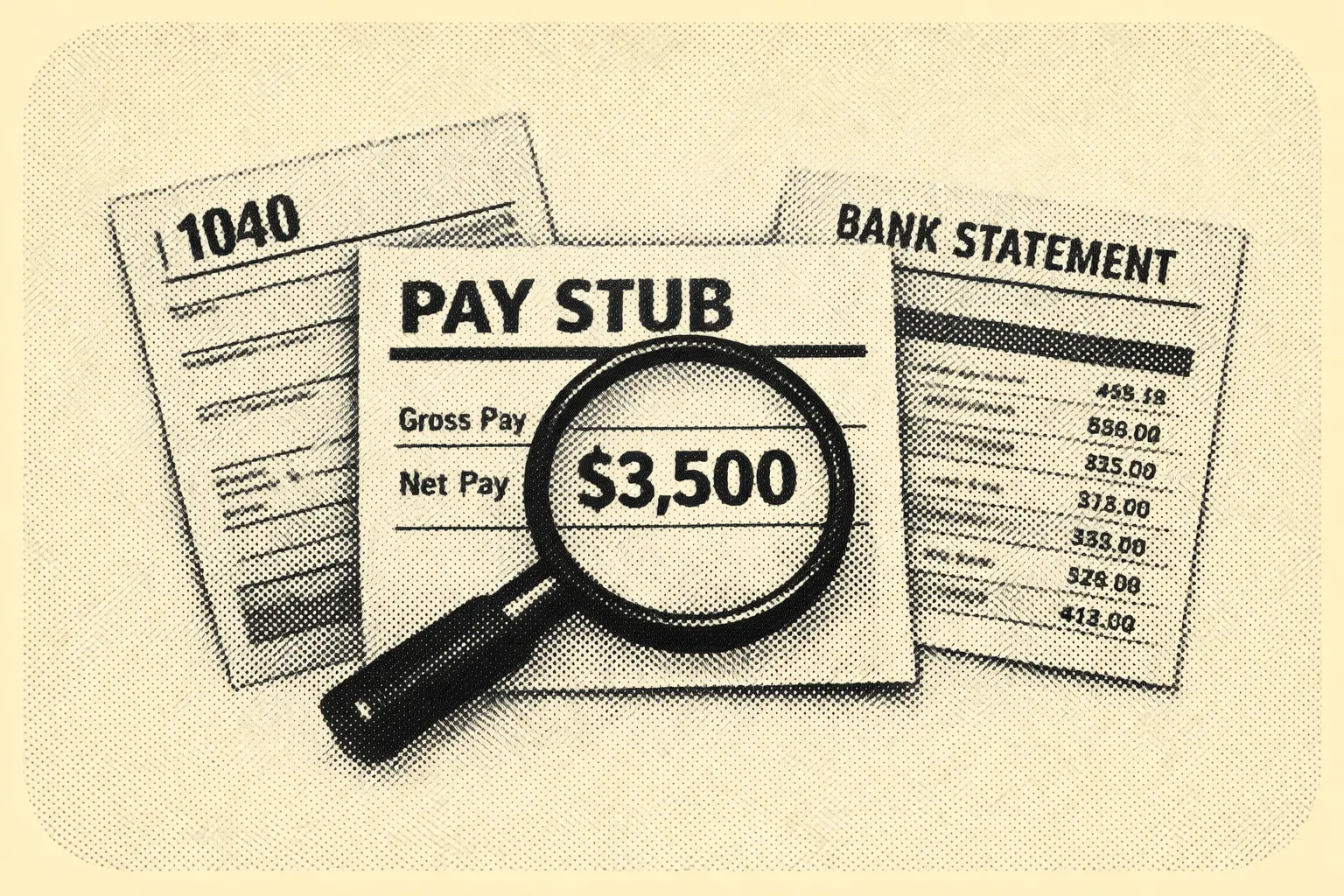
Income Verification Best Practices
Income verification for rental applications is the process of confirming that an applicant earns enough to pay the rent reliably, that the income claimed is genuine and stable, and that the documentation provided accurately represents actual earnings. For independent landlords, income verification is both the most critical screening step for predicting long-term payment behavior and the step most commonly weakened by accepting a single document at face value. Application fraud involving edited pay stubs, falsified employment letters, and manipulated bank statements has become significantly more common, making a multi-source verification approach the functional standard rather than a precaution reserved for suspicious applications.
What Good Income Verification Accomplishes
Effective income verification answers three questions: Is the income real? Is the income stable? And is the income sufficient against the written standard applied to every applicant?
Answering all three requires more than reviewing a single pay stub. It requires a document package that can be cross-validated, an employment or income source confirmation through an independently obtained contact, and a calculation that applies the stated standard consistently regardless of employment type.
Step-by-Step Income Verification Workflow
Step 1. Define the Income Standard in Writing Before Taking Applications
The income standard must be established before any specific applicant's information is reviewed. The most common benchmark is gross monthly income of at least three times the monthly rent. Your specific standard may differ but must be documented and applied equally to every applicant.
The written standard should also specify how you treat different income types, what documentation is required for W-2 employment versus self-employment versus benefits, and what compensating factors allow approval despite income that falls below the standard. Apply the standard to the tenant-paid portion of rent for applicants using housing vouchers rather than the full contract rent. Many jurisdictions protect source of income as a class, and applying the income ratio inconsistently between voucher holders and other applicants creates discriminatory exposure.
Step 2. Collect a Document Package That Enables Cross-Validation
For W-2 employees, the standard package is two to three consecutive recent pay stubs and two months of bank statements showing payroll deposits at the corresponding frequency and net pay amount. An offer letter confirming the employment status and compensation rate is useful as a third source.
For self-employed applicants, the most reliable combination is the prior year tax return with all schedules and three months of business and personal bank statements showing consistent deposits.
For fixed-income applicants receiving Social Security, pension payments, or disability benefits, a benefit award letter downloaded directly from the agency's online portal combined with bank statements showing matching deposits provides reliable verification.
Step 3. Calculate the Rent-to-Income Ratio Using a Consistent Method
Apply the income standard using the same calculation method for every applicant. For employees with variable income components, use a conservative average of the trailing three to six months rather than a peak period. Document the specific income figure used, how it was calculated, and the resulting rent-to-income ratio.
Step 4. Verify Employment and Income Source Through an Independently Obtained Contact
For W-2 employees, verify employment through the main phone number of the employer obtained from a publicly listed source such as the company website rather than from the employment letter or pay stub. Confirm that the applicant is an active employee in the stated role. Log every verification attempt: the date, who was contacted, how, and what was confirmed.
For self-employed applicants, verify through a third source such as a business registration confirmation, client letters, or relevant licensing.
Step 5. Identify and Evaluate Document Red Flags
Pay stubs with identical net pay in every period despite variable hours are a common fraud signal. A calculation of whether the YTD earnings figure is mathematically consistent with the period earnings is one of the fastest fraud detection checks available. Bank statements with formatting inconsistencies across pages or deposit entries that do not correspond to the pay frequency described in the pay stubs warrant a pause and a request for clarification.
Step 6. Document the Decision and Apply the Standard Consistently
Complete the verification with a written record showing the income figure verified, the method of verification, the rent-to-income ratio calculated, whether the standard was met, any compensating factors applied, and the resulting decision. This record should be the same format for every applicant. If a consumer report contributed to the decision, FCRA adverse action requirements apply.
Income Verification Checklist
Pre-screen criteria: Written income standard documented. Income types accepted defined. Variable income averaging method defined. Treatment of voucher and subsidy income documented.
Document collection (W-2 employment): Two to three consecutive pay stubs. Two months of bank statements showing payroll deposits. Offer letter or employment confirmation.
Document collection (self-employed): Prior year tax return with all schedules. Three months of bank and business statements.
Document collection (fixed income): Benefit award letter from agency source. Bank statements showing matching deposits.
Calculation: Verified gross monthly income documented. Variable income calculated using defined averaging method. Rent-to-income ratio calculated and compared to written standard. Result documented in file.
Employment verification: Employer contacted through independently obtained contact. Confirmation documented with date, method, and outcome.
Document authenticity review: YTD figures mathematically checked. Pay frequency consistent with bank deposit pattern. Any anomaly documented and followed up.
Decision: Income standard met or not met documented. Compensating factor applied or not applied documented. File retained per retention policy.
Frequently Asked Questions
What is the standard rent-to-income ratio for rental applications?
The most commonly applied benchmark is gross monthly income of at least three times the monthly rent, corresponding to housing costs of approximately 30% of gross income. Your specific standard may vary but must be documented and applied equally to every applicant. For applicants using housing vouchers, apply the ratio to the tenant-paid portion of rent rather than the full contract rent to avoid source-of-income discrimination in jurisdictions that protect it.
What proof of income should a landlord accept for rental applications?
Acceptable proof depends on employment type. W-2 employees should provide consecutive pay stubs and bank statements showing corresponding deposits. Self-employed applicants should provide tax returns with all schedules and bank statements. Fixed-income applicants should provide benefit award letters and bank statements. Requiring the same documents for the same income type applied equally to every applicant satisfies both the verification goal and the fair housing consistency requirement.
How do landlords verify income for self-employed applicants?
Self-employed income verification relies on the prior year tax return with all schedules for an annual baseline and three months of bank statements showing recent cash flow. A conservative approach averages trailing six to twelve months of deposits rather than using a peak period. When additional confidence is needed, an IRS Form 4506-C authorizing transcript access can corroborate reported tax figures through official records.
What are the biggest income verification red flags to watch for?
The most reliable fraud indicators are YTD figures mathematically inconsistent with period earnings, identical net pay figures in every period despite variable hours, pay frequency that does not match bank deposit patterns, missing standard fields such as employer address or pay period identifiers, and bank statement formatting inconsistencies. Require consecutive documents and verify the basic arithmetic before treating any document as confirmed.
Can a landlord deny an applicant solely because of income?
Yes, if the denial is based on a consistently applied, written income standard supported by a documented calculation. The risk arises when the standard is applied selectively, when different documentation requirements are imposed on different applicants for the same income type, or when the income standard functions as discrimination based on source of income in jurisdictions that protect it.
Book a demo to see how Shuk helps landlords stay ahead of vacancies and keep units filled.

Background Check Guide
A tenant background check is a structured review of consumer reports covering credit, eviction history, and criminal records used to evaluate an applicant's rental risk before a lease is signed. For independent landlords, a background check is most useful when it is interpreted in context rather than applied mechanically: an eviction filing is not the same as an eviction judgment, a thin credit file is not the same as a derogatory credit history, and an arrest record without a conviction is not a legitimate basis for denial under HUD guidance. The background check process that protects cash flow and legal standing is one where written criteria define what each report element means for a decision, individualized review applies when results are ambiguous, and adverse action notices are sent whenever a report influences a denial or less favorable terms.
This guide is part of the Tenant Screening Hub for independent landlords building a compliant, fraud-resistant screening process.
Why Background Check Interpretation Matters as Much as the Report Itself
Running a background check and interpreting a background check are two different skills. The failures that produce expensive outcomes, whether the wrong denial that triggers a fair housing complaint or the wrong approval that leads to a costly eviction, come from interpreting results without a defined framework.
The most common background check interpretation failures are treating all eviction history as equivalent regardless of whether the case was a filing or a judgment; applying blanket criminal history exclusions that HUD has identified as likely to produce discriminatory effects; using credit scores as the primary or sole indicator of rental risk rather than evaluating the payment patterns that actually predict housing behavior; and failing to resolve identity mismatches before making a decision on a report that may belong to a different person.
Step-by-Step: How to Run and Interpret a Tenant Background Check
Step 1. Write Criteria for Each Report Element Before Ordering Reports
Every element of a background check should have a defined evaluation standard before any applicant's report is reviewed. This prevents the most common fair housing failure in background check interpretation: making up the standard after seeing the result.
For the complete seven-step FCRA-compliant screening workflow including how to structure written criteria, obtain authorizations, and send adverse action notices, see the tenant screening compliance requirements guide.
Credit criteria should specify what patterns you evaluate, how you treat specific derogatory items, and what compensating factors allow approval despite a concerning profile. Eviction criteria should specify what distinguishes a disqualifying eviction outcome from a reviewable one. Criminal history criteria should specify which offense categories are relevant to housing safety, what lookback period applies, and what individualized assessment factors are considered.
Step 2. Obtain FCRA Authorization Before Ordering Any Consumer Report
The Fair Credit Reporting Act requires written authorization from the applicant before obtaining a consumer report. Permissible purpose exists when the report is being used to evaluate an actual housing application. Pulling a report on a prospect who toured but never submitted an application does not satisfy this standard. The authorization must be captured in writing and retained in the application file tied to the application date.
Fair housing obligations apply from the moment an application is received — for the full overview of protected classes and compliance requirements across the application stage, see the fair housing overview guide.
Step 3. Order the Appropriate Report Bundle for Your Property and Jurisdiction
A complete background check typically includes credit with tradeline detail, eviction and civil court records, and criminal records where permitted by local law. Some jurisdictions impose restrictions on when criminal history can be considered. New York City's Fair Chance for Housing law restricts criminal history inquiries until after a conditional offer is made. Cook County, Illinois requires a two-step process with limits on lookback periods. Seattle's fair chance framework has its own parameters. Confirm what your jurisdiction permits before ordering a criminal background check.
Step 4. Interpret Credit as a Pattern, Not a Single Number
Credit screening should answer two questions: does the applicant have the capacity to pay the rent, and do their payment patterns suggest they prioritize housing obligations? Evaluate the payment pattern across the tradelines in the report. Repeated 30 to 60-day late payments across multiple accounts are a stronger risk signal than a single isolated late. Housing-related tradelines and recent stability in the last 12 to 24 months are directly relevant to rental risk. Avoid inferring anything about protected class characteristics from credit data.
Step 5. Interpret Eviction History with Context: Filings, Judgments, Dismissals
The distinction between a filing and a judgment matters significantly for risk assessment. An eviction filing shows that a landlord initiated court proceedings. Filings do not always result in removal: many are dismissed, settled, or withdrawn. A filing from five years ago that was dismissed and followed by four years of stable tenancy is a different risk signal than a judgment from 12 months ago.
When an eviction record appears, ask the applicant for documentation of the outcome and the circumstances. Multiple eviction filings in a short timeframe, even if some were dismissed, indicate a chronic payment conflict pattern that is a legitimate basis for concern. Document the specific outcome identified, the applicant's explanation, any supporting documentation, and the decision rationale.
Step 6. Apply Individualized Assessment for Criminal History
HUD has explicitly cautioned that blanket criminal history exclusions are likely to produce discriminatory effects and has recommended individualized assessment. An individualized assessment considers the nature and severity of the offense and its relevance to housing safety, the recency of the offense and any evidence of rehabilitation, and whether the specific conduct creates a demonstrable nexus to the risk being evaluated. Arrests without convictions should not be used as a basis for denial.
For the complete eight-step operational blueprint for reducing discrimination risk including the individualized criminal history assessment framework, see the fair housing compliance guide.
Build an individualized assessment form that captures these factors for every applicant whose background check returns a reportable criminal record. Store the completed form in the applicant file.
Step 7. Make the Decision and Complete the Adverse Action Process
Once all reports have been reviewed against your written criteria, record the decision with the specific basis. If the decision was influenced in whole or in part by information in a consumer report, FCRA adverse action requirements apply. The adverse action notice must include the name and contact information of the reporting agency, a statement that the agency did not make the decision, and the applicant's right to obtain a free copy of the report within 60 days and to dispute inaccuracies. Send the notice promptly and retain proof of delivery.
For the complete framework covering how to structure, store, and retain screening files including retention schedules and access controls, see the landlord documentation best practices guide.
For a breakdown of the most costly screening process errors including missing adverse action notices and inconsistent criteria application, see the common tenant screening mistakes guide.
Background Check Compliance Checklist
Before ordering any report: Written criteria established for each report element. FCRA authorization obtained. Jurisdiction-specific criminal history rules confirmed. Application completeness verified.
Report ordering: Permissible purpose confirmed. Report bundle appropriate for property type and jurisdiction. Authorization and report stored together.
Credit interpretation: Payment patterns evaluated rather than single score. Recent stability reviewed. No inferences about protected class characteristics.
Eviction interpretation: Filing vs. judgment distinguished. Disposition and recency evaluated. Applicant provided opportunity to explain and document.
Criminal history: Arrest-only records excluded. Offense category, recency, and housing relevance evaluated. Individualized assessment form completed and stored.
Decision and notices: Decision recorded with specific criteria basis. Adverse action notice sent promptly when report influenced decision. Complete file retained.
Frequently Asked Questions
What does a tenant background check include?
A complete tenant background check typically includes a credit report with tradeline detail, eviction and civil court records, and criminal records where permitted by local law. Credit shows payment patterns and derogatory history. Eviction records show court filings and judgments. Criminal records show convictions and pending cases. The specific combination should match the risks you are evaluating and comply with the restrictions that apply in your jurisdiction.
What is the difference between an eviction filing and an eviction judgment?
An eviction filing is a court case initiated by a landlord that does not establish the tenant was removed. Many filings are dismissed, settled, or withdrawn. An eviction judgment is a court finding that the landlord was entitled to possession. Judgments carry significantly more weight as a risk signal. When an eviction record appears, determining whether it was a filing or a judgment and what the disposition was is the most important interpretive step before using it in a decision.
Can a landlord deny an applicant based on a criminal background check?
Yes, with a documented individualized assessment. HUD has cautioned that blanket exclusions are likely to produce discriminatory effects and recommends evaluating the nature, severity, and recency of convictions and their relevance to housing safety. Arrests without convictions should not be used as a basis for denial. A written policy specifying offense categories, lookback periods, and the individualized assessment process applied consistently to every applicant is significantly more defensible than an informal standard.
When is an adverse action notice required after a background check?
An adverse action notice is required any time a consumer report contributes to a denial or to less favorable terms. The notice must include the reporting agency's contact information, a statement that the agency did not make the decision, and the applicant's right to dispute the report's accuracy. Send it promptly and retain proof of delivery in the application file.
How do landlords handle a background check that may contain an error?
Pause the decision when a report contains results that may be inaccurate. Give the applicant a consistent opportunity to provide clarification and documentation. Contact the screening vendor about a reinvestigation if the applicant disputes the record. Document all steps taken and the final resolution before making the decision.
Book a demo to see how Shuk helps landlords stay ahead of vacancies and keep units filled.
Once a background check clears and the applicant is approved, the next compliance obligation is executing a legally complete lease — see the lease agreement legal requirements guide for required federal disclosures, state-specific addenda, and e-signature standards.
Frequently Asked Questions
Find answers to common questions about our products and services
What is the most important step in tenant screening for landlords?
What documents should a landlord require from every applicant?
What should a landlord do if a screening report contains an error?
How long should the tenant screening process take?
How does fair housing law affect tenant screening criteria?
The screening decisions that matter most are made before a lease is signed: verifying income from independent sources, interpreting background data in context, documenting the basis for every decision, and applying the same criteria to every applicant without exception. Platforms like Shuk Rentals support post-screening operations by bringing lease management, rent collection, maintenance tracking, and tenant communication into one connected system so the tenant relationship that starts with a clean screening process continues with the same operational consistency.