Rent Collection Hub

Collect Rent on Time, Reduce Late Payments, and Keep Clean Books Without Becoming a Finance Expert

Rent collection looks straightforward until you are managing multiple units with different lease start dates, texts about bank outages, partial payment requests, and month-end bookkeeping that does not quite reconcile. The goal of this hub is to help you build a rent collection system that is predictable for your cash flow, clear for your residents, defensible when enforced, and efficient enough that rent week does not become a second job. The industry direction is unambiguous: the share of renters using online rent payments rose from approximately 50% in 2020 to 60% in 2023, and broader data shows digital payment adoption growing from 4% in 2014 to 51% by 2025. When digital tools include autopay and reminders, on-time outcomes improve dramatically. One large survey-based dataset reported 99% on-time rent among residents using autopay and reminders. This hub covers the three areas where most rent collection systems break down: payment policies that prevent problems before they start, late-payment handling that is consistent without damaging the landlord-tenant relationship, and accounting fundamentals that keep your records clean enough to hold up at tax time, during a refinance, or in a dispute.

QUICK VIEW
Stay in the Shuk Loop
Stop Reacting to Vacancies. Start Seeing Them Coming.

Shuk helps landlords and property managers get ahead of vacancies, improve renewal visibility, and bring more predictability to every lease cycle.

Book a demo to get started with a free trial.

Rent Collection: Build a System That Pays You Reliably Every Month

Rent collection is one of those landlord workflows that looks simple until you are juggling multiple doors, different lease start dates, "my bank is down" texts, partial payment requests, and month-end bookkeeping that does not tie out. A well-designed rent collection system is predictable for your cash flow, clear for your residents, defensible when enforced consistently, and efficient enough that it does not consume your evenings.

The market direction is clear. The share of renters using online rent payments has risen steadily, and when digital tools include autopay and reminders, on-time performance can reach 99% among enrolled residents. The question for independent landlords is not whether to go digital. It is how to design the system so residents adopt it and it actually holds up under the pressure of real operating conditions.

Payment Policies: Set Expectations That Prevent Problems

Strong rent collection starts before the first payment is due. Your lease and house rules should make the payment experience unambiguous: due date, grace period if any, acceptable payment methods, how to set up recurring payments, and what happens when rent arrives late.

A few policy principles that hold up well across small portfolios:

One primary method, preferably digital bank transfer, combined with one backup such as money order or cashier's check is simpler than accepting anything and everything. When you offer too many options, you create inconsistent records and more opportunities for disputes about timing and method.

Standardizing the due date, most landlords use the first of the month, makes your accounting and mortgage timing predictable. When lease start dates vary, pro-rate the first partial month and then move everyone to a uniform cycle rather than tracking individualized due dates indefinitely.

Defining what counts as paid matters more than most landlords realize. Bank transfers take time to settle, and your policy should specify whether paid means initiated or successfully received and cleared. From an accounting and enforcement standpoint, treating rent as paid when funds are successfully received is typically cleaner because it aligns with cash actually available and reduces edge-case disputes.

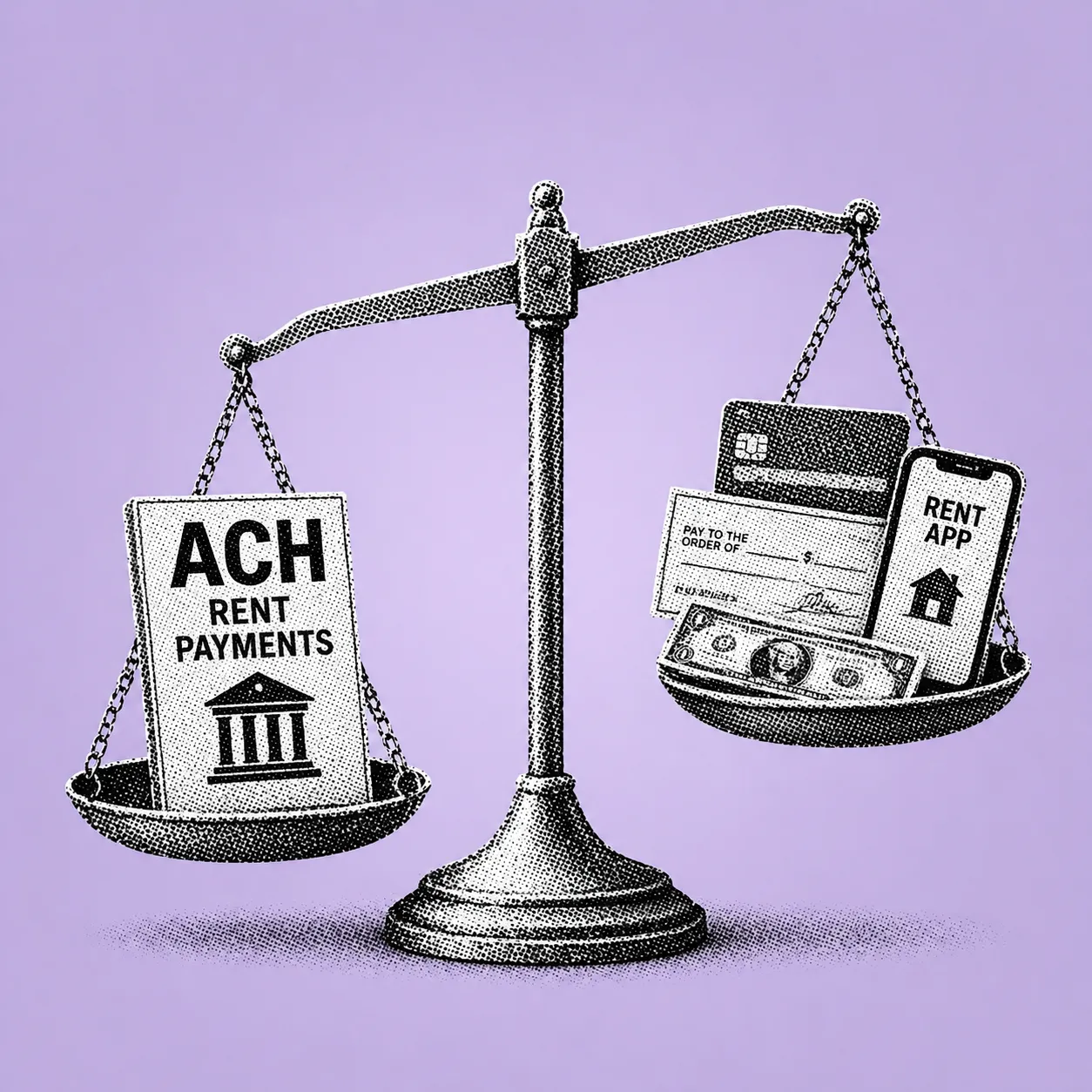
Transparency about fees builds trust and reduces friction. Card processing commonly runs around 2.9% plus $0.30 per transaction, which on a $2,000 rent payment is approximately $58 every month per unit. ACH can be far cheaper and may be capped or waived depending on your platform. Designing your workflow to default to bank transfer while offering card as an opt-in at the resident's cost, where legally permitted, protects your net operating income without eliminating payment flexibility.

Late Payments: Reduce Delinquency Without Damaging Relationships

Late rent is rarely just a tenant problem. It is also a systems problem: unclear policies, inconsistent enforcement, no reminders, no autopay option, or too many payment channels creating confusion about what the right path is.

A modern late-payment plan for small landlords includes pre-due reminders sent three to five days before the due date, a friendly automated reminder on the due date itself, a post-due sequence covering a late notice, a late fee if allowed by lease and local law, and documented escalation steps if payment does not arrive. Having a consistent rule for partial payments in place before a situation arises matters significantly. Ambiguity about whether you accept partial payments and under what conditions creates disputes that are difficult to resolve cleanly.

Renter financial stress is a real and persistent backdrop for late payment situations. Research has reported renters spending approximately 38.6% of income on rent, a pressure point that can increase late payments when unexpected expenses hit. The operational takeaway is not to be lax about enforcement. It is to be systematic. A consistent plan paired with automation lets you act early, document everything, and reduce the emotional back-and-forth that consumes time and strains relationships.

Accounting Basics: Keep Records That Match Reality

Rent collection is not finished when money hits your account. If your records are messy, you will feel it at tax time, during a refinance, or when you need to prove a delinquency timeline in a dispute.

For small landlords, a clean-books baseline typically includes a separate bank account for rental income and expenses even if you operate as a sole proprietor, a consistent chart of expense categories covering repairs, maintenance, utilities, insurance, taxes, and management, monthly reconciliation matching bank activity to rent rolls and receipts, and a clear rule for income timing. Cash-basis accounting recognizes rent when it is received, which is the standard approach for most small landlords and aligns with IRS guidance on rental income reporting.

The practical payoff of good records is significant even if accounting is not your favorite activity. Good records reduce disputes by providing a documented timeline of what was owed, what was paid, and when. They speed up owner reporting if you manage properties for others. And they let you see property-level performance clearly rather than relying on memory or rough estimates.

What Changes When You Standardize Rent Collection

Case study, 12-unit portfolio: An independent landlord shifted from mostly checks and informal payment apps to a structured digital process with rent due on the first, automated reminders, and autopay as the default option introduced during tenant onboarding. Late-payment steps were standardized as reminder, then late notice, then fee per the lease, then written payment plan only when documented in advance.

Within 90 days, on-time payments improved from an estimated 82% to 97%, and time spent chasing rent dropped by approximately six to eight hours per month through fewer texts, bank runs, and confirmation calls. The insight is that consistency combined with automation reduces both delinquency and administrative drag simultaneously, which aligns with broader findings that autopay and reminders can drive significantly higher on-time performance.

Case study, 28-unit portfolio: A manager who allowed card payments by default found that processing costs were quietly draining net operating income. Updating the payment policy so ACH was the recommended method with clear setup instructions, while still offering card for residents who insisted at the resident's expense where permitted, produced a significant shift.

On $1,500 rent, card fees at 2.9% plus $0.30 equal approximately $43.80 per payment. If ACH is offered at low or no cost, savings run approximately $43.80 per unit per month. Across 28 units, that is over $1,200 per month or roughly $14,700 per year returned to the portfolio without raising rent. ACH adoption rose from approximately 25% to 78% within six months, and estimated annual processing costs dropped by over $10,000 while maintaining full resident payment flexibility.

Frequently Asked Questions

Should I allow credit card rent payments, or only ACH?

Offering cards can improve convenience, but it is typically the most expensive payment method. Standard card processing commonly runs approximately 2.9% plus $0.30 per transaction. On a $2,000 payment that is approximately $58.30 every month per unit. ACH can be significantly cheaper and may be capped or waived depending on your plan. The recommended approach is to offer both but design your workflow to default to ACH with clear setup steps and autopay, while treating cards as an opt-in convenience at the resident's cost where legally permitted.

How do I set late fees and grace periods without creating legal exposure?

Late fees must be specified in the lease, communicated upfront, and applied consistently to every resident under the same conditions. Treating a grace period as a policy choice rather than an expectation or entitlement keeps enforcement cleaner. The defensible baseline is written terms, reasonable amounts, and consistent application supported by clean records showing when rent was due, when it was received, and when notices were sent. Verify your jurisdiction's specific requirements before finalizing any late fee policy.

How do I handle partial payments without creating a precedent?

Partial payments can complicate eviction timelines and create confusion about remaining balances and when fees apply. The safest operational approach is to decide in advance: either you do not accept partial payments unless there is a signed payment plan, or you accept them only under a written agreement specifying the remaining balance, due dates, and consequences. If you accept a partial payment, require a written payment plan every time rather than handling it informally.

When is rent considered paid: when submitted or when it clears?

This is a common source of conflict with digital payments. ACH transfers take time to settle, and failed payments occur when account numbers are wrong, funds are insufficient, or accounts have been closed. Your lease and payment policy should clearly define whether paid means initiated or successfully received and cleared. From an accounting and enforcement standpoint, treating rent as paid when funds are successfully received is typically cleaner because it aligns with cash actually available and eliminates edge-case disputes about timing.

What records do I need to keep for rent collection and taxes?

At minimum, maintain a rent ledger tracking charges, payments, and balances, proof of payment through transaction confirmations, and documentation for any fees, credits, or payment plans. For taxes, organized income and expense records that match bank activity and support deductions are the baseline expectation. IRS guidance on rental income reporting is the reliable anchor for what must be tracked and how. Reconcile monthly and store everything in a single system so you can quickly answer: what was owed, what was paid, and what remains outstanding.

If you want to see how automated rent collection, reminders, and reporting fit together in one workflow for portfolios of 1 to 100 units, book a demo and walk through how Shuk's rent collection system applies to your specific unit count and lease calendar.

{

  "@context": "https://schema.org",

  "@type": "FAQPage",

  "mainEntity": [

    {

      "@type": "Question",

      "name": "Should I allow credit card rent payments, or only ACH?",

      "acceptedAnswer": {

        "@type": "Answer",

        "text": "Offering cards improves convenience but is typically the most expensive method, running approximately 2.9% plus $0.30 per transaction. On a $2,000 payment that is approximately $58.30 every month per unit. ACH can be significantly cheaper and may be capped or waived depending on your plan. Design your workflow to default to ACH while offering card as an opt-in convenience at the resident's cost where legally permitted."

      }

    },

    {

      "@type": "Question",

      "name": "How do I set late fees and grace periods without creating legal exposure?",

      "acceptedAnswer": {

        "@type": "Answer",

        "text": "Late fees must be specified in the lease, communicated upfront, and applied consistently to every resident. Treat a grace period as a policy choice rather than an entitlement. The defensible baseline is written terms, reasonable amounts, consistent application, and clean records showing when rent was due, when it was received, and when notices were sent. Verify your jurisdiction's specific requirements before finalizing any late fee policy."

      }

    },

    {

      "@type": "Question",

      "name": "How do I handle partial rent payments without creating a precedent?",

      "acceptedAnswer": {

        "@type": "Answer",

        "text": "Decide in advance: either you do not accept partial payments unless there is a signed payment plan, or you accept them only under a written agreement specifying the remaining balance, due dates, and consequences. If you accept a partial payment, require a written payment plan every time rather than handling it informally to avoid ambiguity about remaining balances and fee timing."

      }

    },

    {

      "@type": "Question",

      "name": "When is rent considered paid: when the tenant submits it or when it clears?",

      "acceptedAnswer": {

        "@type": "Answer",

        "text": "Your lease and payment policy should clearly define whether paid means initiated or successfully received and cleared. Treating rent as paid when funds are successfully received is typically cleaner from an accounting and enforcement standpoint because it aligns with cash actually available and eliminates edge-case disputes about timing with ACH transfers."

      }

    },

    {

      "@type": "Question",

      "name": "What records do I need to keep for rent collection and taxes?",

      "acceptedAnswer": {

        "@type": "Answer",

        "text": "At minimum, maintain a rent ledger tracking charges, payments, and balances, proof of payment through transaction confirmations, and documentation for any fees, credits, or payment plans. Reconcile monthly and store everything in a single system so you can quickly answer what was owed, what was paid, and what remains outstanding."

      }

    }

  ]

}

Stay in the Shuk Loop
Stop Reacting to Vacancies. Start Seeing Them Coming.

Shuk helps landlords and property managers get ahead of vacancies, improve renewal visibility, and bring more predictability to every lease cycle.

Book a demo to get started with a free trial.

Learn Hub: Rent Collection Hub Guides

The following guides cover every dimension of a modern rent collection workflow: how to structure payment policies from lease signing through move-in, how to handle late payments and partial payments systematically rather than reactively, how to use autopay and reminders to lift on-time rates, and how to keep income and expense records that match reality and survive scrutiny. Together they give independent landlords and small property managers a repeatable system that reduces manual chasing, lowers processing costs, and produces clean books without requiring a background in finance or accounting.

Rent Collection Hub
Rent Payment Policies: How to Draft, Communicate, and Enforce a System That Gets You Paid on Time

Rent Payment Policies: How to Draft, Communicate, and Enforce a System That Gets You Paid on Time

Rent collection is the backbone of your rental business and the system most likely to fail when you need it most. Vague policies invite improvisation. Strict rules enforced inconsistently trigger disputes, accusations of unfair treatment, and delayed payments next month. And when you rely on checks, cash, or ad-hoc payment links, you inherit avoidable friction: missed due dates, lost envelopes, partial payments without clear rules, and time-consuming follow-ups.

The stakes are real. National survey data shows a meaningful share of renters fall behind at any given time. In March 2023, 13.8% of renters reported being behind on rent, fluctuating between 12.4% and 14.2% since September 2022. Separate reporting estimated more than 5 million households owed nearly $11 billion in rent arrears, averaging $2,094 per renter, and the CFPB has noted median outstanding balances rising to over $3,200 in newer payment data. For an independent landlord, a few late or missing payments can quickly become a cash-flow crisis.

This guide shows you how to draft, communicate, and enforce a clear rent payment policy that protects your income while staying compliant and tenant-friendly. You will learn how to operationalize it with fee-free ACH, automated reminders, integrated payment requests, and fewer back-and-forth tenant interactions. The goal is fewer late payments, fewer disputes, and a process you can run consistently whether you have one unit or fifty.

Your policy should be written so a third party could predict exactly what happens on Day 1, Day 2, Day 5, and Day 10 after a missed payment, without asking you.

What Goes Wrong Without a Clear Policy

Two units, self-managed: A tenant pays when payroll clears and you accept it, until you need to pay your mortgage on the fifth. Now late becomes personal and every month is a negotiation.

Twelve units: You accept Zelle for some tenants, checks for others, and cash for one. When a tenant claims they paid but you cannot match it to a ledger, you lose hours reconstructing a timeline.

Eighty units, small property manager: You have a late fee clause but only enforce it sometimes. Tenants compare notes, complain, and inconsistent enforcement becomes a Fair Housing risk.

What a Rent Payment Policy Does and Why You Need One

A rent payment policy is the practical rulebook that sits underneath your lease. The lease is the contract. The policy is how you run it day to day: accepted payment methods, where and how payments are delivered, when rent is due, whether you offer a grace period, how late fees are calculated, what happens if a payment bounces, and what notices you send when rent is unpaid.

A clear policy reduces late rent by design. Digital payment adoption has climbed dramatically. One dataset shows online rent payments rising from 4% in 2014 to 51% in 2025, and other summaries report that 61% or more of renters pay online and 73% prefer digital methods. Digital-first policy choices meet tenants where they are and remove friction.

A clear policy protects you legally and operationally. Many states regulate grace periods and late fees. Texas requires at least two full days after the due date before you can charge a late fee. New York requires a minimum five-business-day grace period and caps late fees at the lesser of $50 or 5% of monthly rent. California has no statutory grace period but late fees must be reasonable estimates of damages and typically cannot be compounded daily. Illinois has no statewide numeric cap but local ordinances in Chicago, Cook County, and Evanston can impose specific limits and grace periods. Your policy must be written to adapt to where the property is located, especially if you operate across city or state lines.

A clear policy saves time and improves cash flow. Late rent is an administrative tax. Industry commentary estimates property managers can spend 8 to 12 hours weekly per 100 units addressing late rent issues, and late payments can reduce net operating income by 3% to 7% annually when you account for admin overhead and cash-flow timing. Automation through autopay enrollment, reminders, and standardized notices removes the manual chasing that burns your week.

Treat rent collection like a workflow, not a conversation. The less custom handling you do, the fewer disputes you invite.

Seven Steps to Build a Rent Payment Policy That Holds Up

Step 1. Define Rent, Due Date, and What Counts as Paid

Start by removing ambiguity. Your lease might say rent is due on the first, but your policy must define what due means in practice: time of day, payment channel, and when a payment is considered received.

What to specify: Due date and time, for example rent is due on the first of each month by 11:59 p.m. local time. What counts as paid: rent is paid when the full amount posts successfully through an approved method. This matters when tenants initiate a transfer on the first but it settles later. Partial payment rules: decide whether you accept them and under what conditions, such as written agreement only. If you accept partial payments informally, you can accidentally train chronic delinquency. Application order: if a tenant owes rent plus late fees plus other charges, define how payments are applied. Rent first is common, but verify local rules with your counsel.

Compliance note: Some jurisdictions restrict how fees interact with eviction notices. California guidance emphasizes that late fees generally cannot be included in a three-day notice to pay or quit, with notices typically based on unpaid rent only. New York similarly indicates late fees cannot form the basis for eviction proceedings. Your policy should keep rent enforcement and fee enforcement clearly separated where required.

What this fixes: A tenant who claims they slipped cash under the door is resolved quickly when your policy bans cash and requires digital receipts. A tenant who initiates a bank transfer at 11:50 p.m. on the first is handled consistently when your policy clarifies paid means successful settlement and your dashboard shows timestamps. A tenant who pays $800 of a $1,500 rent informally is stopped from repeating the pattern by a written partial-payment agreement rule.

Step 2. Choose Accepted Payment Methods and Be Explicit About Fees and Receipts

Payment methods are not a tenant preference issue. They are a risk-management decision. Your policy should list what you accept, what you do not, and why. The best method is trackable, easy for tenants, and easy for you to reconcile.

Fee-free ACH is the recommended default. It creates a clear audit trail, fewer processing surprises, and predictable settlement. Make it your primary method and strongly encourage autopay enrollment at move-in.

Card payments are optional. Convenient but may create higher tenant costs through processing fees. If offered, disclose fees clearly and decide whether they are tenant-paid or owner-paid.

Checks and money orders are a fallback. If you accept them, define where they should be delivered, the payable-to line, and what happens if a check is returned NSF.

Cash should generally be avoided. If you must accept it, require receipts and limit where and how it is accepted to protect both parties.

Fee-free ACH removes a major tenant objection: not wanting to pay extra fees to pay their rent. Automated reminders and integrated payment requests turn rent collection into a consistent system rather than a monthly chase.

Offer one primary method and one backup for exceptions. Too many methods increases reconciliation errors. Put receipts on autopilot with a policy line that reads: receipt is issued automatically upon successful payment.

What this fixes: A tenant whose check bounces twice is required to use ACH only going forward, with your dashboard enforcing the method restriction. Tenants who refuse online payment because of fees adopt ACH when it is fee-free. With forty units, integrated payment requests tie payments to the correct ledger entry automatically rather than requiring hours of manual matching.

Step 3. Set a Grace Period That Matches the Law and Your Business Reality

Grace periods are where many landlords get into trouble: either they promise one informally and cannot enforce later, or they charge fees too early and risk legal pushback. Your policy must reflect your jurisdiction and be consistent across every tenant.

Representative legal norms to verify locally: Texas does not permit late fees until rent is unpaid for at least two full days after the due date, and the code provides safe-harbor late-fee thresholds. New York requires a minimum five-business-day grace period before charging any late fee. California has no statutory grace period, so if you want one you must write it into the lease and policy, and late fees must still be reasonable and non-punitive. Illinois has no statewide rule, but local ordinances in Chicago and Cook County may require a five-day grace period and cap fees.

A grace period is not the same as a rent due date. Rent can be due on the first with a grace period through the third or fifth, or whatever is required by law. Your policy should state when rent is due, when it is considered late, and when late fees are assessed, which may be later than late due to state law.

Automated reminders let you be generous without losing control. A practical reminder sequence runs a friendly notice three days before the first, a due-date notice on the first, a grace-period-ends reminder on day two, three, or five depending on jurisdiction, and a late fee assessed with a payment request on day six where legal.

Put the grace period in writing. If it is informal, tenants will treat it as permanent. Use business days only when legally required, as in New York. Otherwise stick to calendar days for clarity.

What this fixes: A landlord who charges a fee on day three in New York loses the dispute because the law requires five business days. Your policy and automation prevent early-fee assessment. In California, a voluntary three-day grace period assessed once with no daily compounding stays within reasonableness expectations. In Chicago, a local addendum reflecting the city-specific grace and fee limits prevents confusion for a manager who also operates units in a nearby suburb.

Step 4. Build a Late-Fee Policy That Is Legal, Defensible, and Easy to Explain

Late fees should do one job: encourage timely payment and offset real administrative costs without becoming a penalty. The easiest late-fee policies to enforce are the ones tenants can understand in ten seconds and you can apply consistently to every tenant.

Core design decisions: Flat fees are simpler while percentages scale with rent. One-time fees are more defensible in most jurisdictions, since many disfavor daily compounding. California guidance commonly treats compounding daily fees as problematic. Assessment timing should tie to the end of the grace period rather than the due date, and statutory rules must be followed.

Representative legal guardrails: Texas late fees must be in the lease, cannot be charged until at least two full days late, and safe-harbor caps are 12% of monthly rent for one to four units and 10% for five or more. Tenants can request an accounting and penalties apply for overcharging. New York caps late fees at the lesser of $50 or 5% of monthly rent with a five-business-day wait required. California has no numeric cap but fees must be reasonable and reflect estimated damages, with courts often viewing 5% to 7% or modest flat fees as more defensible. Illinois applies a reasonableness standard statewide with local caps potentially applying in Chicago, Cook County, and Evanston.

Put the late-fee calculation in one line, for example $50 on the sixth or 5% of monthly rent on the sixth. Complex formulas create disputes. Keep documentation including a written policy, a ledger, and automated notices to form a defensible record if challenged.

What this fixes: A three-unit Texas landlord who sets a 15% late fee faces statutory exposure. Adjusting to the safe-harbor threshold reduces both risk and tenant disputes. A New York landlord who charges $100 on a $1,600 apartment is capped at $50 under state law. A California landlord charging $25 per day faces a tenant challenge as an unenforceable penalty, resolved by switching to a single reasonable fee stated in the lease.

Step 5. Communicate the Policy So Tenants Actually Follow It

Policies only work if tenants know them, understand them, and can comply without friction. Your communication plan should be multi-touch covering lease signing, move-in, monthly reminders, and when a payment is late.

Where to communicate: Late fees and grace periods must be in writing to be enforceable in many jurisdictions. A move-in Rent Payment Rules one-pager in plain English covering the due date, grace period, how to pay with a link or QR code, what happens if late, and who to contact reduces confusion from day one. Automated reminders reduce the need for personal chasing. Receipts and ledger transparency reduce disputes because tenants can see exactly what was charged and why.

Use consistent, neutral language as a Fair Housing best practice. Avoid judgment language like "you failed" and use process language like "our lease states rent is due." Apply the same timeline to everyone since inconsistent enforcement can create discrimination allegations even when unintentional.

Position digital rent as convenience and reliability in your tenant messaging. You will get a receipt automatically and you can set autopay is a better frame than demanding compliance.

Give tenants a "How to Pay Rent" link and keep it the same every month. Include a "What if I cannot pay on time?" paragraph that directs tenants to contact you before the due date, then define what you will and will not do such as payment plans by written agreement only.

What this fixes: A tenant who pays on the third because their last landlord had a grace period is corrected by your move-in one-pager before the first rent cycle. A neutral reminder that rent is due tomorrow and autopay is available prevents a defensive reaction and gets paid faster than a threatening message. A tenant who claims they paid is resolved in minutes when you point to the receipt and ledger entry.

Step 6. Enforce Consistently With a Documented Escalation Ladder

Enforcement is where most small operators lose leverage. If tenants learn that late does not matter, your policy becomes optional. You need a predictable escalation ladder that starts friendly, becomes firm, and stays compliant.

A practical escalation ladder to adjust to your jurisdiction and counsel: Automated pre-due reminder two to three days before the first. Due-date notice: rent is due today, pay via the ACH link. Grace-period reminder: your grace period ends tomorrow at 11:59 p.m. Late fee assessment applied per lease and law when legal. Formal notice delivered in the legally required format for nonpayment with fees kept separate where required. Payment plan or assistance referral only by written agreement with no informal promises. Formal enforcement following your attorney's process if rent remains unpaid.

Rental delinquency has remained significant, with survey tracking showing 13.8% of renters behind in March 2023 and newer payment data showing rising balances among those behind. A structured ladder helps you act early before small balances become large ones.

Decide your day-X threshold for formal action and write it down. If you wait until you feel frustrated, you have waited too long. Keep all communications in one channel when possible since scattered texts and emails are hard to document.

What this fixes: A tenant who pays late two months in a row enrolls in autopay on the third month after receiving a grace-period-ending reminder that makes the fee consequence real. A tenant who disputes a late fee is shown the lease clause, reminder timestamps, and ledger and pays without further escalation. A property manager with 120 units applies the same ladder across buildings, reducing weekly time spent on late rent follow-ups.

Step 7. Prevent Late Payments With Friction Killers: Autopay, Receipts, and Clear Options

The best enforcement strategy is prevention. You reduce late payments by making on-time payment the easiest path and late payment the hardest path, without becoming punitive.

Friction killers to build into your policy: Recommend autopay enrollment at move-in as a default rather than an option. Offer fee-free ACH as the primary method to remove the most common barrier to digital adoption. Send automated reminders so nudges reduce forgetting without requiring manual effort. Create a clear exceptions workflow so that if a tenant needs a one-time alternative method, they must submit a written request with a deadline.

Industry reporting suggests tenants paying digitally are less likely to pay late, with one dataset noting 23% less likely. Automation and autopay are consistently associated with improved on-time outcomes across multiple sources.

Optional incentive to consider carefully: Rent reporting can motivate on-time payment and may help tenants build credit. HUD has published guidance related to rent reporting practices. If you pursue this, apply it consistently and ensure tenant consent and proper disclosures.

Make autopay part of your move-in checklist, not an afterthought. Track adoption rates. If fewer than half of your tenants use ACH, revise your onboarding script and simplify the how-to-pay steps.

What this fixes: A landlord who sends the payment link only after the first missed payment sees continued late payments. Adding move-in autopay enrollment and reminders changes the pattern before it forms. A tenant who wants to pay by check just this month is allowed once with a written deadline, then returns to ACH so there is no long-term drift back to manual processes. A tenant who receives automatic receipts stops texting "Did you get it?" which reduces admin load significantly.

Rent Payment Policy Template: Copy and Edit

Use this template as a policy addendum you reference in the lease and hand to every tenant at move-in. Then operationalize it with automated reminders and fee-free ACH so the rules run themselves.

1. Payment methods: Primary method is fee-free ACH via the online rent portal with a link provided at move-in. Optional backup methods include money order or check. Not accepted: cash, wire transfers, or third-party payment apps. Receipts are issued automatically upon successful payment.

2. Due date and paid definition: Rent amount is $___ per month. Due date is the ___ of each month by ___ local time. Paid means payment is successfully completed through an approved method and posted to the ledger.

3. Grace period: Rent is considered late on ___ date and time. Late fees are assessed on ___, which must comply with local law including Texas two full days and New York five business days.

4. Late fees, must be in writing: Late fee amount is $___ or ___% of monthly rent capped as required. Late fees are assessed one time with no daily compounding unless clearly permitted locally. New York cap is the lesser of $50 or 5%. Texas safe harbor is 12% for one to four units and 10% for five or more units plus the two-day rule. California applies a reasonableness standard with no punitive or daily compounding permitted. Illinois requires checking local ordinances in Chicago, Cook County, and Evanston.

5. Returned payments and NSF: Returned payment fee where permitted is $___. After ___ returned payments, only ACH or certified funds are accepted as allowed by law.

6. Communication and reminders: Reminder schedule is ___ days before due date, on due date, before grace period ends, and after late fee applies. Communication channel is portal notifications plus email with optional SMS.

7. Enforcement ladder: Day 1 is the due-date reminder. Day ___ the grace period ends. Day ___ the late fee is assessed if legal. Day ___ the formal nonpayment notice is issued in the format required by jurisdiction with rent-only notices where required.

Frequently Asked Questions

What is a reasonable late fee if my state does not specify a cap?

If your state relies on a reasonableness standard, as is common in California and parts of Illinois, design your late fee to reflect real administrative costs and avoid punitive structures such as compounding daily fees. California guidance and case law emphasize late fees should be a reasonable estimate of damages, not a penalty. In Illinois, local ordinances may set hard caps even when the state does not. When in doubt, use a modest one-time fee or a small percentage and confirm local rules before finalizing your policy.

Can I charge late fees immediately after the due date?

Not always. Some states require mandatory grace periods before you can assess any late fee. Texas requires rent to be unpaid for at least two full days before charging late fees. New York requires at least five business days and limits the fee to the lesser of $50 or 5% of monthly rent. Even where no grace period is mandated, as in California, you still need lease language and a reasonable fee structure to withstand a tenant challenge.

Should I accept partial payments when a tenant is behind?

Partial payments can reduce arrears but can also complicate enforcement and create inconsistent expectations. If you allow them, require a written agreement that specifies the amount accepted, the date the balance is due, whether late fees still apply, and what happens if the balance is not paid. Keep the agreement consistent across tenants to reduce dispute risk and Fair Housing exposure.

How do automated rent payments help with late rent in the real world?

Automation reduces the two biggest drivers of late payments you can control: forgetfulness and friction. Online rent payment adoption has grown substantially over the past decade and many renters now prefer digital options. Fee-free ACH removes payment-cost barriers, while automated reminders and integrated payment requests create consistent communication and a cleaner ledger for dispute resolution. The combination of autopay enrollment and reminders is consistently associated with significantly higher on-time payment rates.

Turn your rent payment policy into a repeatable monthly workflow, then automate it so you are not chasing rent unit by unit.

Start by copying the template above into your lease addendum and tailoring it to your state and city rules, especially grace periods and late-fee caps. Then implement fee-free ACH as your primary payment method, enroll tenants in autopay at move-in, and enable automated reminders and integrated payment requests so every tenant gets the same timeline every month.

Book a demo to see how Shuk's fee-free ACH rent collection, automated reminders, integrated payment requests, and ledger tracking work together so your rent collection system runs consistently without chasing.

Frequently Asked Questions

Find answers to common questions about our products and services

Should I allow credit card rent payments, or only ACH?

faq dropdown toggle

How do I handle partial rent payments without creating a precedent?

faq dropdown toggle

What records do I need to keep for rent collection and taxes?

faq dropdown toggle

How do I set late fees and grace periods without creating legal exposure?"

faq dropdown toggle

When is rent considered paid: when the tenant submits it or when it clears?

faq dropdown toggle
Final Note

The most common mistake in rent collection is treating it as a series of one-off conversations rather than a documented system. A consistent policy applied the same way to every resident, paired with digital tools that handle reminders and recurring payments automatically, produces better on-time rates and better relationships than any amount of manual follow-up. Platforms like Shuk are built specifically for independent landlords and small property managers managing 1 to 100 units, with bank transfer rent collection, automated reminders, late fee rules, and expense tracking in one connected system at a predictable per-unit price.