
If you manage rental properties independently or run a small property management business, rent collection sits at an uncomfortable intersection: it is mission-critical, repetitive, and surprisingly risky. One late payment can trigger a chain reaction of a missed mortgage autopay, delayed vendor work, awkward tenant conversations, and time spent reconciling who paid what.
Many rental businesses still rely on methods that make the process harder than it needs to be. Paper checks arrive late or not at all. Cash cannot be tracked cleanly. Card payments feel convenient but quietly drain margins through processing fees. P2P app payments land with the wrong memo or occasionally to the wrong person entirely.
ACH bank-to-bank transfers have become the backbone of recurring payments in the U.S. economy. The ACH Network processed 31.5 billion payments in 2023 and 35.2 billion in 2025, reflecting broad adoption and a mature payment rail trusted at national scale. Same Day ACH alone reached 1.4 billion payments valued at $3.9 trillion in 2025. For rent, that maturity matters: you want a method that is predictable, trackable, and built for recurring drafts.
But ACH can mean very different experiences depending on how you implement it. Some banks charge per-item fees alongside monthly service fees. Meanwhile, card payments can cost approximately 2.5% to 3.5% per transaction at typical convenience fee models in rent collection, and they come with dispute windows often up to 120 days that can claw back funds long after you thought rent was settled.
This guide compares ACH rent payments with credit and debit cards, paper checks, money orders, cash, and P2P apps through the lens that matters for small and mid-sized landlords: cost, funding speed, reliability, fraud and dispute risk, tenant convenience, and automation potential.
Price your current workflow, not just your fees, and include time spent chasing payments and reconciling deposits. Treat reversibility as a risk factor since dispute windows differ dramatically between ACH consumer debits and card chargebacks. Default to a method that supports recurring automation and clean bookkeeping, especially when you manage more than a handful of units.
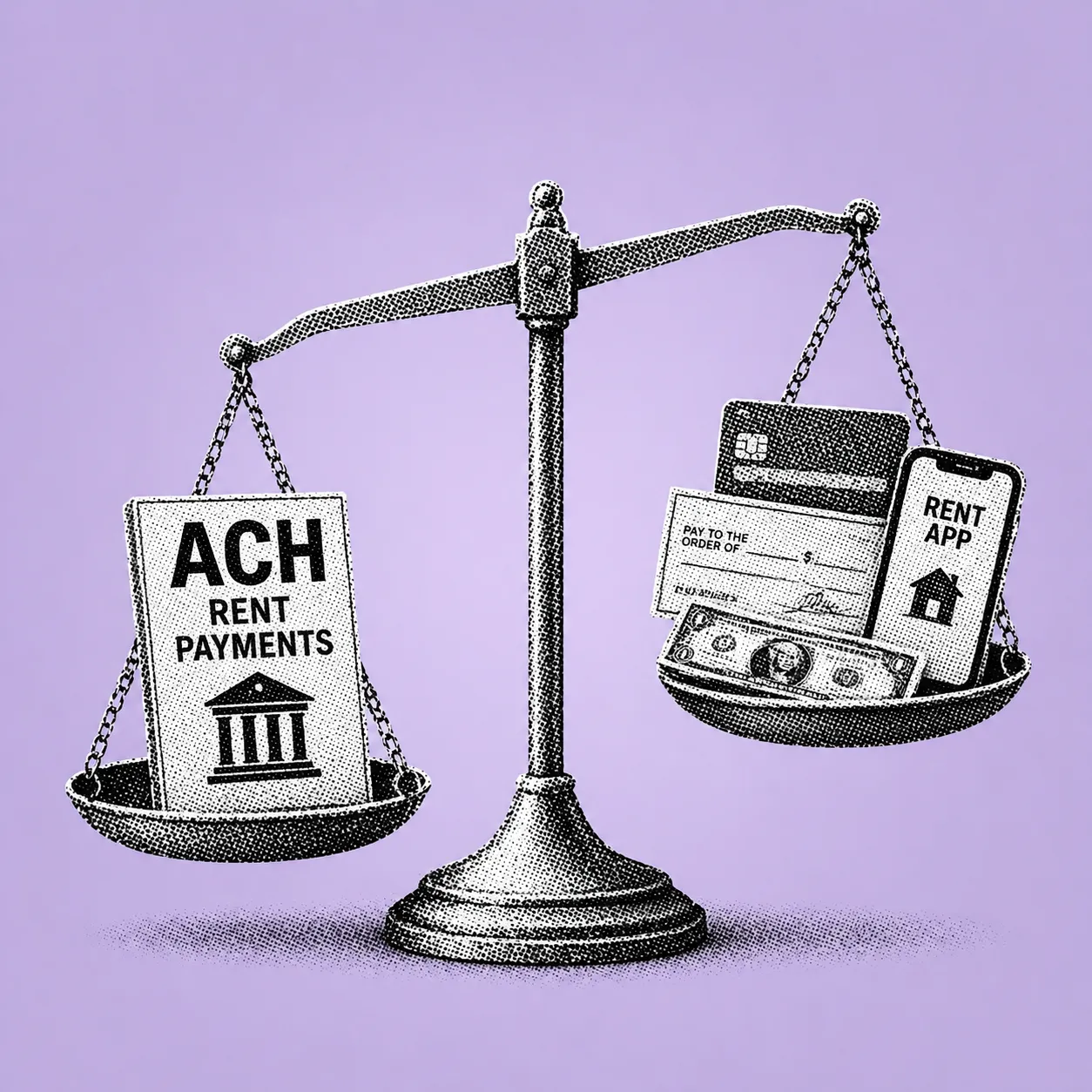
Landlords typically land on one of six rent collection methods: ACH bank transfers, credit and debit cards, paper checks, money orders, cash, or P2P apps. Each has a headline benefit. ACH is cheap, cards are convenient, checks are familiar, cash is immediate, P2P is fast, and money orders feel guaranteed. The real decision is about trade-offs you will live with every month.
ACH is built for recurring transfers. ACH is designed for account-to-account transfers including recurring debits. Standard ACH commonly settles in one to three business days while Same Day ACH can settle by end of day when submission cutoffs are met. Bank ACH origination pricing varies: per-item costs at some institutions run approximately $0.10 to $0.20 for credit items and $0.15 to $0.30 for debit items, with Same Day ACH running approximately $0.75 to $1.25. Some banks package ACH tools into monthly bundles or checking account tiers. Third-party processors may charge flat fees, percentage fees, or monthly fees in addition to per-item costs.
Cards are convenient but expensive. Credit and debit cards are a tenant favorite because they feel instant, but they are usually the most expensive option for the landlord's system. Many rent payment providers charge approximately 2.95% to 3.5% plus a fixed fee per card transaction. Card disputes can also reach far back, with Visa and Mastercard chargeback windows commonly up to 120 days for many dispute types. Even if you win a dispute, you spend time responding, gathering documents, and managing cash-flow uncertainty during the window.
Checks, money orders, cash, and P2P apps are familiar but friction-heavy. Checks and money orders remain common because they require no software and feel familiar to both parties. But they add operational friction through handling, depositing, reconciling, and the risk of loss or delay. Cash is immediate but creates the highest operational risk around safety, documentation, and auditability. P2P apps can be convenient but often lack landlord-grade controls around consistent memos, receipting, and clean export into accounting systems.
A baseline comparison across methods:
ACH standard: typical landlord cost of approximately $0.10 to $0.30 per item at some banks with variation by platform, funding speed of one to three business days, returns exist with consumer unauthorized window tied to Regulation E, and high automation potential through recurring drafts.
Same Day ACH: cost often $0.75 to $1.25 per item at some banks, funding by end of day when cutoffs are met, similar return concepts as standard ACH, and high automation potential.
Credit and debit cards: cost often 2.95% to 3.5% plus a fixed fee, typically fast to receive but provider-dependent, chargebacks can occur up to approximately 120 days, medium to high automation potential.
Paper checks: bank deposit fees and significant time cost, same day after deposit but tenant delivery is slow, bounced checks and loss and theft risk, low automation potential.
Money orders: tenant pays the purchase fee, same day after deposit, lower bounce risk than checks but still subject to loss and counterfeit risk, low automation potential.
Cash: no transaction fee but high operational risk from theft and disputes and a weak audit trail, low automation potential.
P2P apps: often free or low cost, often fast, account and memo errors with varying policy limits, medium automation potential.
If you are under 20 units, the biggest cost is usually time and errors rather than transaction fees. If you allow cards, set clear written rules on who pays fees and how disputes are handled where legally permitted. If you accept offline methods, require a consistent reference format of unit number plus tenant name plus month to reduce misposting.
A practical rent collection decision starts with math. For landlords under 100 units, the most common cost trap is judging methods only by direct fees while ignoring the operational tax: trips to the bank, manual reminders, deposit delays, reconciliation time, and dispute handling.
ACH costs vary by implementation. Some banks publish per-item pricing for ACH credit and debit items with Same Day ACH running higher per transaction. Other banks package ACH functionality into monthly service fees or business checking tiers. Third-party processors may charge a flat fee, a percentage, and a monthly subscription simultaneously, which can reintroduce the cost structure you were trying to avoid.
Card costs function as a margin killer at scale. Many rent payment providers use a tenant-paid convenience fee model around 2.95% to 3.5% plus a fixed amount per transaction. Even when tenants pay those fees, landlords often face indirect costs through more payment exceptions, higher dispute incidence, and tenant frustration in states where surcharging is restricted or prohibited.
Worked example, 12-unit landlord switching from checks to automated ACH: Assume twelve units at $1,500 average rent, previously collected by check requiring two bank deposit trips per month and roughly two hours per month total handling time. After switching to automated ACH drafts, handling time drops to approximately twenty minutes per month for review and exceptions. If you value admin time at $30 per hour, that is approximately $600 per year in recovered time. If your ACH method charges $0.20 per debit item, that is twelve payments times $0.20 times twelve months equals $28.80 per year in transaction fees plus any applicable bank monthly fees. On a platform with no ACH fee built for landlords, even the per-item component disappears.
Build a one-page cost model with three columns: direct fees, time cost, and risk cost covering average late fees lost, disputes, and returned items. Decide based on the total rather than any single line.
Compare percentage-based pricing against per-item pricing using your average rent since percentage fees scale up with every rent increase. Separate tenant-paid fees from landlord impact since even when tenants pay card fees, your dispute and support burden rises. If your bank requires a monthly ACH module, confirm whether your business checking tier can waive it based on balances.
Speed is not just how fast the tenant clicks pay. It is when funds become available for your obligations including mortgage, insurance, utilities, and vendors.
Standard ACH generally settles in one to three business days. Same Day ACH can settle by end of day but submission deadlines and bank processing schedules matter significantly. In rent collection, this means you cannot wait until the first at 11:59 p.m. and expect spendable funds on the second. The operational win comes from moving the trigger earlier and making it recurring rather than waiting for tenant-initiated action each month.
Cash-flow scenario: A small landlord with eighteen units might have a mortgage draft on the fifth. With checks, a cluster of "I'll drop it off this weekend" comments pushes deposits to the sixth or seventh. With ACH, recurring drafts scheduled on the first or even the last business day of the prior month allow standard settlement time while keeping the tenant experience simple.
Same Day ACH is not necessary as a default for rent but is a helpful lever for last-minute move-in payments, curing a pay-or-quit deadline, or handling a tenant who missed the standard draft and needs to correct quickly. Treat it as a premium exception option rather than a universal default to control per-item costs.
Card payments can feel instant at the point of sale, but funding timing depends on the provider's batch and payout schedule. The larger issue is reversibility: a chargeback can occur long after funding, affecting cash flow months later. For rent, fast today but reversible for four months can be worse than settles in two days and stays settled.
Set your rent due date and your draft date deliberately. Many landlords keep the due date as the first but schedule an ACH draft on the 28th through the 30th with tenant opt-in, or early on the first, then treat late fees and reminders as exception handling rather than the main system.
If you must pay bills by the fifth, do not depend on tenant-initiated actions on the first. Use recurring ACH pulls where authorized. Keep Same Day ACH available for exceptions rather than every tenant to control costs. Build a funds-available calendar that maps ACH processing days and weekends to your key payment obligations.
Every payment method has failure modes. The right choice is the one whose failures you can detect quickly and resolve efficiently.
The ACH Network processed 35.2 billion payments in 2025 and Nacha enforces network quality metrics including an unauthorized debit return rate threshold of 0.5% and a total return rate threshold of 15%. For landlords, that translates into a key operational point: implement ACH in a way that keeps return rates low through clear authorizations, accurate bank data capture, and prompt handling of notices of change.
Consumer-initiated unauthorized debit claims are governed by Regulation E error resolution concepts, commonly described as a 60-day window from statement transmission for consumers to report unauthorized electronic fund transfers. Even if rent clears, you need an audit trail: signed authorization or equivalent e-sign consent, documented lease terms, and proof of tenant identity.
Card networks commonly allow chargebacks up to 120 days for many dispute categories. That window is long relative to rent cycles and can complicate eviction timelines, owner distributions, and bookkeeping close periods. It also invites friendly fraud disputes more often in card-not-present environments.
Offline methods carry different fraud profiles. Checks face bounced NSF risk, stop payments, and altered check fraud plus loss or theft in the mail. Cash creates theft risk and payment disputes with documentation entirely on you. Money orders generally carry less bounce risk than checks but are still subject to loss and counterfeit risk. P2P apps create misdirected payment risk from inconsistent identifiers.
Regardless of method, standardize your evidence. For ACH, store authorization language, timestamps, and account verification steps. For checks, photocopy and scan and issue receipts. For cash, always issue serialized receipts and record immediately. Keep ACH return rates low by using consistent authorization flows and verifying bank details at onboarding. If you accept cards, build a dispute-response folder template with lease, ledger, communications, and move-in condition report so you can respond within network timelines.
Small landlords usually do not fail at rent collection because they do not care. They fail because the process is manual and brittle. Automation is where ACH tends to outperform every other method for recurring rent.
Recurring ACH means the tenant does not have to remember to pay and you do not have to chase. It also supports cleaner cash application: when payments arrive with consistent identifiers, you spend less time matching deposits to tenants and more time managing your actual portfolio.
ACH supports addenda records covering structured remittance information attached to a payment. While not every landlord will use addenda directly, platforms built on ACH can use similar concepts to ensure every payment is tagged to a unit, lease, and month. That is the difference between money arrived and ledger is correct.
If you manage thirty to eighty units, month-end close becomes a real operational challenge. Manual methods create multiple deposit sources from some checks, some cash, and some apps, ambiguous memos, and partial payments that do not map cleanly to ledger lines. ACH-based rent collection with a small-landlord-focused platform can automatically post payments, mark late accounts, and export reports for bookkeeping.
Autopay scenario: A tenant paid on the third for months due to payday timing and incurred late fees twice a year. With an automated ACH draft scheduled for the morning after payday with tenant consent, rent is pulled reliably each month. The tenant avoids late fees and the landlord avoids follow-ups and awkward enforcement. Less friction, fewer disputes, better outcome for both parties.
Make automation the default and exceptions the minority. Offer ACH autopay as the primary option but keep one backup method such as tenant-initiated ACH push for edge cases. Set up recurring ACH pulls aligned to lease start and pay cycles rather than defaulting to tenant-remembers-on-the-first. Use standardized payment labels of unit plus month plus tenant and require them across any non-ACH methods you accept.
Tenant convenience is not a nice-to-have. It is a collections strategy. The easier you make it to pay, the fewer exceptions you manage.
Standard ACH settlement in one to three business days is acceptable for most tenants when you design the schedule properly. Same Day ACH helps in emergencies but most tenants just want reliability and a confirmation receipt. Tenants who prefer to set autopay and forget it create the smoothest operating experience for everyone.
Tenants may ask for cards to earn rewards or float cash. The cost is significant: at 2.95% on an $1,800 rent payment, that is $53.10 per month or over $637 per year. Some tenants will pay it. Others will resent it and delay payment. Card surcharging rules also vary by state and are evolving, so confirm local compliance before relying on surcharging as your cost-offset strategy.
A subset of tenants still prefers offline payments and you can accommodate them without letting it dominate your operations. Allow checks for a limited time such as the first sixty days and then encourage ACH. Accept money orders for tenants without bank accounts. Minimize cash acceptance and if you must accept it, require appointments and issue receipts.
P2P apps are familiar to tenants but inconsistent memos and varying transfer policies undermine ledger accuracy. If you accept P2P, treat it as a temporary bridge and require strict memo formats from day one.
Present tenant choices as a tiered menu: free and recommended ACH autopay at the top, backup methods below that, and high-cost convenience options like cards last with clear fee disclosure. Reduce forgetting by making ACH autopay the default enrollment step during lease signing rather than an optional feature introduced after move-in.
Use this checklist to evaluate readiness and execute a smooth transition to ACH-based rent collection.
Cost and policy: You know your current monthly rent collection cost covering fees plus admin time. You have compared per-item ACH pricing against any monthly modules or bundles at your bank. You have a written policy for accepted payment methods, due dates, late fees, and returned-payment fees.
Banking and cash flow: You have mapped your funds-available calendar to ACH settlement of one to three business days. You have identified whether you need Same Day ACH for exceptions and understand it costs more per item. You have confirmed your operating account can receive ACH deposits and that you reconcile deposits weekly.
Authorization and compliance: You have a clear tenant authorization flow for ACH debits covering signed or e-signed consent. You store authorization records and payment confirmations for at least the lease term plus a reasonable dispute buffer. You understand how to handle unauthorized claims and common ACH return scenarios.
Operations and automation: You can set up recurring rent drafts aligned to lease terms. You have a process for exceptions covering failed payments, partial payments, move-in prorations, and move-out charges. You have standardized payment identifiers of unit plus tenant plus month for clean bookkeeping.
Tenant onboarding: You have created a tenant message explaining why ACH, settlement timelines, how autopay works, and how receipts are delivered. You offer at least one backup payment method for edge cases. You have set a transition date and a grace period for onboarding.
Decision checkpoint: If your current method is cards, you have calculated the tenant fee impact at approximately 2.95% to 3.5% plus fixed fees. If your current method is checks or cash, you have estimated time savings from eliminating deposit runs and manual reconciliation.
How long do ACH rent payments take to hit my account?
Standard ACH typically settles in one to three business days. Same Day ACH can settle by end of day if submitted before network and bank cutoff times. In practice, the most reliable approach is not to depend on the tenant paying on the due date. Use recurring drafts scheduled earlier with clear disclosure to the tenant about when the pull will occur.
Can a tenant reverse an ACH rent payment after it clears?
ACH returns do happen. For consumer accounts, unauthorized electronic fund transfer claims follow Regulation E error resolution concepts and are commonly described as a 60-day window from statement transmission. That is why proper authorization records and consistent documentation matter from the start. If you keep authorizations clean and tenant onboarding clear, ACH operates very stably compared to card-based alternatives.
Are credit card payments safer because they are guaranteed?
Cards can be convenient but they are not final in the way landlords often assume. Cardholders can file chargebacks and network time limits are commonly up to 120 days for many dispute types. That is a long window relative to rent cycles. If you accept cards, you need a strong documentation process and cash-flow planning that accounts for potential reversals months after payment appeared to clear.
What about daily limits or caps on ACH?
Limits vary by bank, account type, and whether you are using bank ACH origination tools or a third-party processor. Some banks bundle ACH services into specific business products or impose monthly fees for the capability. Confirm per-transaction and daily limits before moving all tenants over, and keep Same Day ACH or an alternative method available for rare exceptions that exceed standard limits.
If you manage fewer than 100 units, your best rent collection system is the one that protects your margin, reduces exceptions, and runs without constant attention. Across cost, reliability, and automation potential, ACH is usually the most landlord-friendly payment rail. It is built for recurring transfers, scales cleanly as your portfolio grows, and avoids the percentage-based drag that comes with card payments. It is also a proven national network with 35.2 billion payments processed in 2025.
The key is implementation. A basic ACH setup at a bank can still leave you with per-item costs, monthly service modules, and manual reconciliation. Third-party processors can reintroduce fees through percentages or subscriptions. That is why many small landlords are moving to purpose-built rent collection automation where ACH is optimized: no ACH fees, recurring autopay drafts, clear payment labels, and workflows designed to reduce support tickets and bookkeeping cleanup.
Book a demo to see how Shuk's fee-free ACH rent collection, automated reminders, and real-time payment tracking work together so rent arrives on schedule and your NOI stays intact.
If you manage rental properties independently or run a small property management business, rent collection sits at an uncomfortable intersection: it is mission-critical, repetitive, and surprisingly risky. One late payment can trigger a chain reaction of a missed mortgage autopay, delayed vendor work, awkward tenant conversations, and time spent reconciling who paid what.
Many rental businesses still rely on methods that make the process harder than it needs to be. Paper checks arrive late or not at all. Cash cannot be tracked cleanly. Card payments feel convenient but quietly drain margins through processing fees. P2P app payments land with the wrong memo or occasionally to the wrong person entirely.
ACH bank-to-bank transfers have become the backbone of recurring payments in the U.S. economy. The ACH Network processed 31.5 billion payments in 2023 and 35.2 billion in 2025, reflecting broad adoption and a mature payment rail trusted at national scale. Same Day ACH alone reached 1.4 billion payments valued at $3.9 trillion in 2025. For rent, that maturity matters: you want a method that is predictable, trackable, and built for recurring drafts.
But ACH can mean very different experiences depending on how you implement it. Some banks charge per-item fees alongside monthly service fees. Meanwhile, card payments can cost approximately 2.5% to 3.5% per transaction at typical convenience fee models in rent collection, and they come with dispute windows often up to 120 days that can claw back funds long after you thought rent was settled.
This guide compares ACH rent payments with credit and debit cards, paper checks, money orders, cash, and P2P apps through the lens that matters for small and mid-sized landlords: cost, funding speed, reliability, fraud and dispute risk, tenant convenience, and automation potential.
Price your current workflow, not just your fees, and include time spent chasing payments and reconciling deposits. Treat reversibility as a risk factor since dispute windows differ dramatically between ACH consumer debits and card chargebacks. Default to a method that supports recurring automation and clean bookkeeping, especially when you manage more than a handful of units.
Landlords typically land on one of six rent collection methods: ACH bank transfers, credit and debit cards, paper checks, money orders, cash, or P2P apps. Each has a headline benefit. ACH is cheap, cards are convenient, checks are familiar, cash is immediate, P2P is fast, and money orders feel guaranteed. The real decision is about trade-offs you will live with every month.
ACH is built for recurring transfers. ACH is designed for account-to-account transfers including recurring debits. Standard ACH commonly settles in one to three business days while Same Day ACH can settle by end of day when submission cutoffs are met. Bank ACH origination pricing varies: per-item costs at some institutions run approximately $0.10 to $0.20 for credit items and $0.15 to $0.30 for debit items, with Same Day ACH running approximately $0.75 to $1.25. Some banks package ACH tools into monthly bundles or checking account tiers. Third-party processors may charge flat fees, percentage fees, or monthly fees in addition to per-item costs.
Cards are convenient but expensive. Credit and debit cards are a tenant favorite because they feel instant, but they are usually the most expensive option for the landlord's system. Many rent payment providers charge approximately 2.95% to 3.5% plus a fixed fee per card transaction. Card disputes can also reach far back, with Visa and Mastercard chargeback windows commonly up to 120 days for many dispute types. Even if you win a dispute, you spend time responding, gathering documents, and managing cash-flow uncertainty during the window.
Checks, money orders, cash, and P2P apps are familiar but friction-heavy. Checks and money orders remain common because they require no software and feel familiar to both parties. But they add operational friction through handling, depositing, reconciling, and the risk of loss or delay. Cash is immediate but creates the highest operational risk around safety, documentation, and auditability. P2P apps can be convenient but often lack landlord-grade controls around consistent memos, receipting, and clean export into accounting systems.
A baseline comparison across methods:
ACH standard: typical landlord cost of approximately $0.10 to $0.30 per item at some banks with variation by platform, funding speed of one to three business days, returns exist with consumer unauthorized window tied to Regulation E, and high automation potential through recurring drafts.
Same Day ACH: cost often $0.75 to $1.25 per item at some banks, funding by end of day when cutoffs are met, similar return concepts as standard ACH, and high automation potential.
Credit and debit cards: cost often 2.95% to 3.5% plus a fixed fee, typically fast to receive but provider-dependent, chargebacks can occur up to approximately 120 days, medium to high automation potential.
Paper checks: bank deposit fees and significant time cost, same day after deposit but tenant delivery is slow, bounced checks and loss and theft risk, low automation potential.
Money orders: tenant pays the purchase fee, same day after deposit, lower bounce risk than checks but still subject to loss and counterfeit risk, low automation potential.
Cash: no transaction fee but high operational risk from theft and disputes and a weak audit trail, low automation potential.
P2P apps: often free or low cost, often fast, account and memo errors with varying policy limits, medium automation potential.
If you are under 20 units, the biggest cost is usually time and errors rather than transaction fees. If you allow cards, set clear written rules on who pays fees and how disputes are handled where legally permitted. If you accept offline methods, require a consistent reference format of unit number plus tenant name plus month to reduce misposting.
A practical rent collection decision starts with math. For landlords under 100 units, the most common cost trap is judging methods only by direct fees while ignoring the operational tax: trips to the bank, manual reminders, deposit delays, reconciliation time, and dispute handling.
ACH costs vary by implementation. Some banks publish per-item pricing for ACH credit and debit items with Same Day ACH running higher per transaction. Other banks package ACH functionality into monthly service fees or business checking tiers. Third-party processors may charge a flat fee, a percentage, and a monthly subscription simultaneously, which can reintroduce the cost structure you were trying to avoid.
Card costs function as a margin killer at scale. Many rent payment providers use a tenant-paid convenience fee model around 2.95% to 3.5% plus a fixed amount per transaction. Even when tenants pay those fees, landlords often face indirect costs through more payment exceptions, higher dispute incidence, and tenant frustration in states where surcharging is restricted or prohibited.
Worked example, 12-unit landlord switching from checks to automated ACH: Assume twelve units at $1,500 average rent, previously collected by check requiring two bank deposit trips per month and roughly two hours per month total handling time. After switching to automated ACH drafts, handling time drops to approximately twenty minutes per month for review and exceptions. If you value admin time at $30 per hour, that is approximately $600 per year in recovered time. If your ACH method charges $0.20 per debit item, that is twelve payments times $0.20 times twelve months equals $28.80 per year in transaction fees plus any applicable bank monthly fees. On a platform with no ACH fee built for landlords, even the per-item component disappears.
Build a one-page cost model with three columns: direct fees, time cost, and risk cost covering average late fees lost, disputes, and returned items. Decide based on the total rather than any single line.
Compare percentage-based pricing against per-item pricing using your average rent since percentage fees scale up with every rent increase. Separate tenant-paid fees from landlord impact since even when tenants pay card fees, your dispute and support burden rises. If your bank requires a monthly ACH module, confirm whether your business checking tier can waive it based on balances.
Speed is not just how fast the tenant clicks pay. It is when funds become available for your obligations including mortgage, insurance, utilities, and vendors.
Standard ACH generally settles in one to three business days. Same Day ACH can settle by end of day but submission deadlines and bank processing schedules matter significantly. In rent collection, this means you cannot wait until the first at 11:59 p.m. and expect spendable funds on the second. The operational win comes from moving the trigger earlier and making it recurring rather than waiting for tenant-initiated action each month.
Cash-flow scenario: A small landlord with eighteen units might have a mortgage draft on the fifth. With checks, a cluster of "I'll drop it off this weekend" comments pushes deposits to the sixth or seventh. With ACH, recurring drafts scheduled on the first or even the last business day of the prior month allow standard settlement time while keeping the tenant experience simple.
Same Day ACH is not necessary as a default for rent but is a helpful lever for last-minute move-in payments, curing a pay-or-quit deadline, or handling a tenant who missed the standard draft and needs to correct quickly. Treat it as a premium exception option rather than a universal default to control per-item costs.
Card payments can feel instant at the point of sale, but funding timing depends on the provider's batch and payout schedule. The larger issue is reversibility: a chargeback can occur long after funding, affecting cash flow months later. For rent, fast today but reversible for four months can be worse than settles in two days and stays settled.
Set your rent due date and your draft date deliberately. Many landlords keep the due date as the first but schedule an ACH draft on the 28th through the 30th with tenant opt-in, or early on the first, then treat late fees and reminders as exception handling rather than the main system.
If you must pay bills by the fifth, do not depend on tenant-initiated actions on the first. Use recurring ACH pulls where authorized. Keep Same Day ACH available for exceptions rather than every tenant to control costs. Build a funds-available calendar that maps ACH processing days and weekends to your key payment obligations.
Every payment method has failure modes. The right choice is the one whose failures you can detect quickly and resolve efficiently.
The ACH Network processed 35.2 billion payments in 2025 and Nacha enforces network quality metrics including an unauthorized debit return rate threshold of 0.5% and a total return rate threshold of 15%. For landlords, that translates into a key operational point: implement ACH in a way that keeps return rates low through clear authorizations, accurate bank data capture, and prompt handling of notices of change.
Consumer-initiated unauthorized debit claims are governed by Regulation E error resolution concepts, commonly described as a 60-day window from statement transmission for consumers to report unauthorized electronic fund transfers. Even if rent clears, you need an audit trail: signed authorization or equivalent e-sign consent, documented lease terms, and proof of tenant identity.
Card networks commonly allow chargebacks up to 120 days for many dispute categories. That window is long relative to rent cycles and can complicate eviction timelines, owner distributions, and bookkeeping close periods. It also invites friendly fraud disputes more often in card-not-present environments.
Offline methods carry different fraud profiles. Checks face bounced NSF risk, stop payments, and altered check fraud plus loss or theft in the mail. Cash creates theft risk and payment disputes with documentation entirely on you. Money orders generally carry less bounce risk than checks but are still subject to loss and counterfeit risk. P2P apps create misdirected payment risk from inconsistent identifiers.
Regardless of method, standardize your evidence. For ACH, store authorization language, timestamps, and account verification steps. For checks, photocopy and scan and issue receipts. For cash, always issue serialized receipts and record immediately. Keep ACH return rates low by using consistent authorization flows and verifying bank details at onboarding. If you accept cards, build a dispute-response folder template with lease, ledger, communications, and move-in condition report so you can respond within network timelines.
Small landlords usually do not fail at rent collection because they do not care. They fail because the process is manual and brittle. Automation is where ACH tends to outperform every other method for recurring rent.
Recurring ACH means the tenant does not have to remember to pay and you do not have to chase. It also supports cleaner cash application: when payments arrive with consistent identifiers, you spend less time matching deposits to tenants and more time managing your actual portfolio.
ACH supports addenda records covering structured remittance information attached to a payment. While not every landlord will use addenda directly, platforms built on ACH can use similar concepts to ensure every payment is tagged to a unit, lease, and month. That is the difference between money arrived and ledger is correct.
If you manage thirty to eighty units, month-end close becomes a real operational challenge. Manual methods create multiple deposit sources from some checks, some cash, and some apps, ambiguous memos, and partial payments that do not map cleanly to ledger lines. ACH-based rent collection with a small-landlord-focused platform can automatically post payments, mark late accounts, and export reports for bookkeeping.
Autopay scenario: A tenant paid on the third for months due to payday timing and incurred late fees twice a year. With an automated ACH draft scheduled for the morning after payday with tenant consent, rent is pulled reliably each month. The tenant avoids late fees and the landlord avoids follow-ups and awkward enforcement. Less friction, fewer disputes, better outcome for both parties.
Make automation the default and exceptions the minority. Offer ACH autopay as the primary option but keep one backup method such as tenant-initiated ACH push for edge cases. Set up recurring ACH pulls aligned to lease start and pay cycles rather than defaulting to tenant-remembers-on-the-first. Use standardized payment labels of unit plus month plus tenant and require them across any non-ACH methods you accept.
Tenant convenience is not a nice-to-have. It is a collections strategy. The easier you make it to pay, the fewer exceptions you manage.
Standard ACH settlement in one to three business days is acceptable for most tenants when you design the schedule properly. Same Day ACH helps in emergencies but most tenants just want reliability and a confirmation receipt. Tenants who prefer to set autopay and forget it create the smoothest operating experience for everyone.
Tenants may ask for cards to earn rewards or float cash. The cost is significant: at 2.95% on an $1,800 rent payment, that is $53.10 per month or over $637 per year. Some tenants will pay it. Others will resent it and delay payment. Card surcharging rules also vary by state and are evolving, so confirm local compliance before relying on surcharging as your cost-offset strategy.
A subset of tenants still prefers offline payments and you can accommodate them without letting it dominate your operations. Allow checks for a limited time such as the first sixty days and then encourage ACH. Accept money orders for tenants without bank accounts. Minimize cash acceptance and if you must accept it, require appointments and issue receipts.
P2P apps are familiar to tenants but inconsistent memos and varying transfer policies undermine ledger accuracy. If you accept P2P, treat it as a temporary bridge and require strict memo formats from day one.
Present tenant choices as a tiered menu: free and recommended ACH autopay at the top, backup methods below that, and high-cost convenience options like cards last with clear fee disclosure. Reduce forgetting by making ACH autopay the default enrollment step during lease signing rather than an optional feature introduced after move-in.
Use this checklist to evaluate readiness and execute a smooth transition to ACH-based rent collection.
Cost and policy: You know your current monthly rent collection cost covering fees plus admin time. You have compared per-item ACH pricing against any monthly modules or bundles at your bank. You have a written policy for accepted payment methods, due dates, late fees, and returned-payment fees.
Banking and cash flow: You have mapped your funds-available calendar to ACH settlement of one to three business days. You have identified whether you need Same Day ACH for exceptions and understand it costs more per item. You have confirmed your operating account can receive ACH deposits and that you reconcile deposits weekly.
Authorization and compliance: You have a clear tenant authorization flow for ACH debits covering signed or e-signed consent. You store authorization records and payment confirmations for at least the lease term plus a reasonable dispute buffer. You understand how to handle unauthorized claims and common ACH return scenarios.
Operations and automation: You can set up recurring rent drafts aligned to lease terms. You have a process for exceptions covering failed payments, partial payments, move-in prorations, and move-out charges. You have standardized payment identifiers of unit plus tenant plus month for clean bookkeeping.
Tenant onboarding: You have created a tenant message explaining why ACH, settlement timelines, how autopay works, and how receipts are delivered. You offer at least one backup payment method for edge cases. You have set a transition date and a grace period for onboarding.
Decision checkpoint: If your current method is cards, you have calculated the tenant fee impact at approximately 2.95% to 3.5% plus fixed fees. If your current method is checks or cash, you have estimated time savings from eliminating deposit runs and manual reconciliation.
How long do ACH rent payments take to hit my account?
Standard ACH typically settles in one to three business days. Same Day ACH can settle by end of day if submitted before network and bank cutoff times. In practice, the most reliable approach is not to depend on the tenant paying on the due date. Use recurring drafts scheduled earlier with clear disclosure to the tenant about when the pull will occur.
Can a tenant reverse an ACH rent payment after it clears?
ACH returns do happen. For consumer accounts, unauthorized electronic fund transfer claims follow Regulation E error resolution concepts and are commonly described as a 60-day window from statement transmission. That is why proper authorization records and consistent documentation matter from the start. If you keep authorizations clean and tenant onboarding clear, ACH operates very stably compared to card-based alternatives.
Are credit card payments safer because they are guaranteed?
Cards can be convenient but they are not final in the way landlords often assume. Cardholders can file chargebacks and network time limits are commonly up to 120 days for many dispute types. That is a long window relative to rent cycles. If you accept cards, you need a strong documentation process and cash-flow planning that accounts for potential reversals months after payment appeared to clear.
What about daily limits or caps on ACH?
Limits vary by bank, account type, and whether you are using bank ACH origination tools or a third-party processor. Some banks bundle ACH services into specific business products or impose monthly fees for the capability. Confirm per-transaction and daily limits before moving all tenants over, and keep Same Day ACH or an alternative method available for rare exceptions that exceed standard limits.
If you manage fewer than 100 units, your best rent collection system is the one that protects your margin, reduces exceptions, and runs without constant attention. Across cost, reliability, and automation potential, ACH is usually the most landlord-friendly payment rail. It is built for recurring transfers, scales cleanly as your portfolio grows, and avoids the percentage-based drag that comes with card payments. It is also a proven national network with 35.2 billion payments processed in 2025.
The key is implementation. A basic ACH setup at a bank can still leave you with per-item costs, monthly service modules, and manual reconciliation. Third-party processors can reintroduce fees through percentages or subscriptions. That is why many small landlords are moving to purpose-built rent collection automation where ACH is optimized: no ACH fees, recurring autopay drafts, clear payment labels, and workflows designed to reduce support tickets and bookkeeping cleanup.
Book a demo to see how Shuk's fee-free ACH rent collection, automated reminders, and real-time payment tracking work together so rent arrives on schedule and your NOI stays intact.

{
"@context": "https://schema.org",
"@type": "FAQPage",
"mainEntity": [
{
"@type": "Question",
"name": "How long do ACH rent payments take to hit my account?",
"acceptedAnswer": {
"@type": "Answer",
"text": "Standard ACH typically settles in one to three business days. Same Day ACH can settle by end of day if submitted before network and bank cutoff times. The most reliable approach is to use recurring drafts scheduled earlier rather than depending on the tenant paying on the due date, with clear disclosure to the tenant about when the pull will occur."
}
},
{
"@type": "Question",
"name": "Can a tenant reverse an ACH rent payment after it clears?",
"acceptedAnswer": {
"@type": "Answer",
"text": "ACH returns do happen. For consumer accounts, unauthorized electronic fund transfer claims follow Regulation E error resolution concepts with a commonly described 60-day window from statement transmission. Proper authorization records and consistent documentation from the start are essential. With clean authorizations and clear tenant onboarding, ACH operates very stably compared to card-based alternatives."
}
},
{
"@type": "Question",
"name": "Are credit card payments safer for rent collection because they are guaranteed?",
"acceptedAnswer": {
"@type": "Answer",
"text": "Cards are not final in the way landlords often assume. Cardholders can file chargebacks and network time limits are commonly up to 120 days for many dispute types. That is a long window relative to rent cycles. If you accept cards, you need strong documentation and cash-flow planning that accounts for potential reversals months after payment appeared to clear."
}
},
{
"@type": "Question",
"name": "What about daily limits or caps on ACH rent payments?",
"acceptedAnswer": {
"@type": "Answer",
"text": "Limits vary by bank, account type, and whether you are using bank ACH origination tools or a third-party processor. Some banks bundle ACH services into specific business products or impose monthly fees. Confirm per-transaction and daily limits before moving all tenants over, and keep Same Day ACH or an alternative available for rare exceptions."
}
}
]
}
Shuk helps landlords and property managers get ahead of vacancies, improve renewal visibility, and bring more predictability to every lease cycle.
Book a demo to get started with a free trial.

The fastest way to lose money on a rental property is to overpay and hope the rent will make it work. Many independent landlords buy a property because it feels like a deal, only to discover that the mortgage, insurance, taxes, repairs, and vacancy eat up the rent. At that point, you are not building wealth. You are subsidizing a tenant.
That is where the 2% rule comes in: a blunt, back-of-the-napkin screening metric designed to help small investors quickly filter out overpriced deals before spending hours on detailed analysis. In plain terms, it asks one question: does the monthly rent look high enough relative to the all-in purchase price to have a real chance at cash flow? A property passes if its monthly rent is at least 2% of the purchase price or total acquisition cost.
Here is an example. If a home costs $150,000, the 2% rule looks for $3,000 per month in rent. That is intentionally strict, and that is the point. In 2026, it is also harder to hit in many markets, which makes it even more useful as an early reality check before you fall in love with a listing.
The 2% rule is a quick screening heuristic: target monthly rent equal to approximately 2% of purchase price to suggest strong cash-flow potential. It became popular because landlords needed a fast way to compare dozens of listings without building a full spreadsheet for every one. The logic is simple: if rent is high relative to price, there is more room to cover operating costs, vacancy, financing, and still have money left over.
Here is what the rule does not do. It does not estimate your actual profit. It does not account for taxes, insurance, HOA fees, capital expenditures, tenant quality, or financing terms. Even prominent investing educators describe it as a quick guide and caution against relying on it alone. Many sources also note its practicality has declined in recent markets as prices rose faster than rents, pushing many good deals closer to 1% or less in high-cost metros.
If you self-manage or run a small portfolio, time is your most limited resource. The 2% rule helps you avoid overpaying when a property is clearly rent-constrained, compare neighborhoods quickly across different cities, and set a negotiating anchor. If rent comps support $1,200 per month, you can back into a 2% price ceiling of approximately $60,000 before rehab and closing costs.
In Cleveland, rents around $1,108 to $1,180 for a two-bedroom are documented in HUD Fair Market Rent data, while sale prices can be far lower than coastal cities, making high rent-to-price ratios more achievable. In San Francisco, the median sale price near $1.5 million makes 2%, which would require $30,000 per month, unrealistic for typical residential rentals. That gap is exactly what the rule is designed to reveal quickly.
The biggest mistake landlords make is applying the 2% rule to the list price and ignoring the real all-in cost. For practical screening, use:
All-in acquisition cost equals purchase price plus immediate rehab plus closing costs plus initial reserves.
Here is why this matters. Two $150,000 listings can produce very different results if one needs $25,000 in repairs.
Example A, simple calculation: Price $100,000, rent estimate $1,900 per month. Rent divided by price equals $1,900 divided by $100,000, which equals 1.9%. Close but not 2%.
Example B, all-in reality: Price $100,000 plus $15,000 rehab plus $5,000 closing equals $120,000 all-in. Rent divided by all-in cost equals $1,900 divided by $120,000, which equals 1.58%. No longer close.
Method one, the rent test: Monthly rent divided by all-in price must be greater than or equal to 0.02.
Method two, the price ceiling: Maximum all-in price equals monthly rent divided by 0.02, which is the same as monthly rent multiplied by 50.
That times-50 shortcut is useful during showings or calls with agents.
Example C, price ceiling in action: If rent comps support $1,400 per month, the 2% maximum all-in price equals $1,400 multiplied by 50, which equals $70,000. If the seller wants $95,000, you instantly know it fails the 2% screen unless there is a clear path to meaningfully higher rent.
Because the 2% rule depends entirely on the rent input, that number must be conservative. Use currently leased comparable properties when possible rather than active listings. Adjust for bed and bath count, parking, in-unit laundry, pets, and condition. Cross-check against public rent benchmarks such as HUD Fair Market Rent schedules for your area.
Example D, benchmark check: If you are underwriting a Cleveland two-bedroom at $1,450 per month but FMR benchmarks sit closer to $1,108 to $1,180, your 2% pass may be built on an overly aggressive rent assumption. The rule is only as reliable as the rent input supporting it.
Scenario one, a pass with a Cleveland-style yield profile:
Cleveland has documented affordability and rent levels that can support stronger rent-to-price ratios than many high-cost metros.
All-in price: $80,000. Estimated rent: $1,200 per month. The 2% threshold rent needed is $80,000 multiplied by 0.02, which equals $1,600 per month. Actual ratio: $1,200 divided by $80,000 equals 1.5%.
This fails a strict 2% rule, yet many investors still pursue deals like this when expenses and financing are favorable. In today's market, a fail does not automatically mean bad. It means do not assume cash flow. Many sources emphasize pairing this rule with deeper analysis rather than using it as a final answer.
To improve this deal toward 2% without gambling: could you legally add value through an additional bedroom or finished space, reduce insurance and tax exposure, or negotiate a lower price? If not, treat it as a 1% to 1.5% style deal and underwrite accordingly.
Scenario two, borderline in Phoenix:
Phoenix had a median sale price around $461,000 in early 2024 data, with multifamily cap rate estimates around 5.6% in cited reports, suggesting tighter cash-flow conditions than lower-cost regions.
Purchase price: $350,000. Monthly rent estimate: $3,000. Ratio: $3,000 divided by $350,000 equals 0.86%. The 2% target rent for this price would be $7,000 per month.
This clearly fails 2%, but it is still a useful screen. It tells you Phoenix acquisitions may require a different strategy: a larger down payment, a different property type, mid-term rentals where legal, an appreciation focus, or a heavier value-add approach. In submarkets where 1% or less is the norm, pivot to a cap rate and cash-on-cash underwriting model rather than trying to force a 2% outcome.
Scenario three, a hard fail in San Francisco:
San Francisco's median sale price near $1.5 million makes the 2% rule a near-impossibility for conventional rentals.
Purchase price: $1,500,000. The 2% target rent would be $30,000 per month. Even at $7,500 per month in rent, the ratio would be 0.5%.
This is where the 2% rule shines as a screening tool. It prevents you from pretending a high-cost market purchase will cash flow like a Midwest rental. In these markets, you may still invest, but you should do so with eyes open around appreciation, tax strategy, and unique property types. Underwrite based on realistic rent-to-price dynamics rather than working backward from a target ratio that the market cannot support.
Many 2% rule explanations implicitly rely on the idea that operating expenses plus vacancy may consume approximately 50% of rent. That is why investors pair the 2% rule as a rent-to-price screen with the 50% rule as an expense sanity check, then add a profitability metric such as cap rate or gross rent multiplier for comparisons.
The GRM connection is worth understanding. If monthly rent is 2% of price, annual rent is 24% of price, so the GRM equals approximately 4.17. A GRM that low is rare in most modern metro markets, which explains why true 2% deals are harder to find today and why investors who apply this rule strictly are effectively filtering for a shrinking segment of available inventory.
The bottom line strategy: use the 2% rule to discard obvious mismatches, then graduate the survivors into a full underwriting that includes expenses, vacancy, and financing.
Step 1, calculate all-in cost: Purchase price plus estimated closing costs plus immediate rehab and turn costs equals your all-in acquisition cost.
Step 2, estimate market rent conservatively: Check leased comparable properties, not just active listings. Cross-check active listing rents. Verify against a public benchmark such as HUD Fair Market Rent where relevant. Use the lower end of your range as your underwritten monthly rent.
Step 3, compute the ratio: Rent divided by all-in cost. The pass threshold is 2.0% or greater.
Step 4, classify the outcome: At or above 2.0% means a strong cash-flow candidate requiring expense verification. Between 1.0% and 1.99% means borderline, requiring excellent expense control and favorable financing. Below 1.0% means likely appreciation-driven, and you must be honest about the investment strategy before proceeding.
Step 5, add two reality checks before going further: Apply the 50% expense assumption as a rough filter to see whether cash flow is plausible after expenses. Compare using gross rent multiplier or cap rate for a more complete picture.
Two quick examples using the template: If rent is $1,180 and all-in cost is $120,000, the ratio is 0.98%, which is borderline or a fail depending on your threshold. If rent is $1,400 and all-in cost is $70,000, the ratio is exactly 2.0%, which passes and warrants full due diligence.
Is the 2% rule realistic in high-cost markets?
Usually not. In very high-priced markets, home values are so large relative to rents that the 2% target becomes mathematically unrealistic. San Francisco's roughly $1.5 million median sale price implies approximately $30,000 per month in rent to hit 2%, which is not achievable for typical residential rentals. Many investing sources note the rule's practicality has declined as prices outpaced rents in most major metros. In these markets, use the rule to confirm the cash-flow math does not work rather than to find deals that pass.
How is the 2% rule different from the 1% rule?
They are the same concept with different strictness levels. The 1% rule is a looser screen and the 2% rule is a tougher cash-flow-first filter. As market conditions shifted and prices outpaced rent growth in many cities, many investors moved toward expecting closer to 1% or less in expensive regions. Experts consistently caution against using any percentage rule as a standalone decision tool rather than a first-pass filter.
Can I rely on gross rent alone when applying this rule?
No. Gross rent ignores operating costs, vacancy, and capital expenditures, which are exactly the limitations that make the rule useful only as a first-pass screen. Use it to eliminate obvious mismatches, then shift to expense-aware metrics like cap rate and to comparative tools like GRM once a property clears the initial filter.
What should I pair with the 2% rule for better decisions?
Pair it with a rough expense rule of thumb, commonly approximately 50% of rent, to test whether cash flow is plausible after expenses but before mortgage. Add cap rate for a more complete return picture and GRM for quick comparisons across listings. Together, these reduce the risk of approving a deal that looks good on rent but fails on real-world operating costs.
If you are self-managing rentals, the win is not memorizing one rule. It is building a repeatable screening workflow you will actually use when you are tired, busy, and tempted to overbid. Make the 2% rule your first filter, then document the survivors with a consistent process covering rent comps, all-in costs, vacancy and expense assumptions, and a cap rate and GRM cross-check.
Book a demo to see how Shuk's analytics and performance tracking tools support a consistent acquisition and operating workflow so every deal you evaluate is measured against the same standards.

Vacancy time is the period a rental unit remains unoccupied between tenants. It directly impacts landlord cash flow by creating gaps in rental income while fixed costs continue. For property managers handling multiple units, reducing vacancy time from 40 days to 20 days can protect thousands in annual revenue.
.webp)
A TurboTenant alternative is a property management platform that addresses the specific friction points that emerge as a landlord's portfolio outgrows what a free or entry-level tool can handle sustainably: maintenance coordination that requires more than basic intake, reporting that needs to answer real questions at tax time, automation that goes beyond payment reminders, and support that responds when something goes wrong on a Friday night. For landlords managing a handful of units, TurboTenant's free plan offers genuine value. The decision to look elsewhere is usually not about TurboTenant being inadequate. It is about your needs changing faster than the platform scales.
A free tool feels like a win until it slows you down. TurboTenant's free tier covers the core steps of self-managing rentals: listing syndication, applicant screening, online rent collection, and lease workflows. That is a meaningful baseline, and for landlords managing one to ten units with limited maintenance volume, it can be sufficient.
The hidden cost of free is time. Missed follow-ups, slower maintenance coordination, and support delays compound as a portfolio grows. Review platforms consistently flag support responsiveness as a friction point, with email-led support sometimes taking multiple days, higher-touch options reserved for paid tiers, and limited office-hour availability. As you add units, the friction multiplies: more maintenance requests, more rent exceptions, more leases expiring on different dates, more vendor coordination, and more reporting needs, often with fewer customization and integration options than a growing operation requires.
Paid add-ons also change the real cost structure. Premium tiers, rent reporting, faster payout options, and other services can turn a free starting point into an unplanned monthly expense that competes with platforms that offer more for a predictable flat rate.
Start by documenting what you actually do each month: marketing vacancies, screening applicants, signing leases, collecting rent, handling maintenance, and producing reports. Your audit should focus not on what the current tool does but on what is slowing you down or consuming disproportionate time.
A practical audit method is to track two weeks of property management work and label each task as repeatable, exception-based, or coordination-heavy. Repeatable tasks include rent reminders, late fees, and move-in checklists. Exception-based tasks include partial payments and lease violations. Coordination-heavy tasks include vendor dispatch, access scheduling, and multi-party maintenance follow-up.
If coordination-heavy tasks dominate your time, you will benefit most from a platform with stronger maintenance workflows, communication logs, and vendor controls. If automation of repeatable tasks is the gap, prioritize platforms with stronger rule-based rent and lease lifecycle automation.
List your top ten recurring tasks. Any task completed more than twice per month is a candidate for automation. Identify one bottleneck category, whether maintenance, payments, reporting, or support, and select the tool that solves that first rather than optimizing across all categories simultaneously.
Free is a starting point, not a pricing model. Build a 12-month cost projection that includes add-ons you are likely to adopt including e-signatures, reporting, and faster payouts, plus any payment processing or payout fees that apply in your plan tier.
When mapping alternatives, organize them into three buckets: flat monthly pricing that simplifies budgeting for steady portfolios, per-unit monthly pricing that scales with doors if features scale proportionally, and tiered pricing by features or unit count where the key question is what is locked behind higher plans.
If you are adding units over the next 12 to 18 months, avoid pricing structures with sudden tier cliffs. A platform that looks affordable today but doubles in cost when you cross a unit threshold creates a switching cost you did not plan for. The goal is pricing that fits the portfolio you will have in 18 months, not the one you have today.
Maintenance is where self-management usually breaks down. A platform can be strong at listings and leases and still leave you juggling texts, emails, invoices, and vendor phone calls with no unified record of what happened.
Maintenance depth is not just intake. When evaluating any TurboTenant alternative, look for a complete work order lifecycle: tenant intake with photo and video attachment, triage with emergency flags and required questions, vendor assignment with preferred vendor lists and document storage, status updates sent to the tenant without manual follow-up, cost tracking by property and unit, and reporting on recurring issues that surfaces patterns rather than burying them in individual tickets.
Ask a simple diagnostic question: can you manage a maintenance request from first report to invoice without opening your email inbox? If the answer is no on your current platform, that limitation will feel more expensive with every unit you add.
Automation converts a self-management operation from sustainable to scalable. The baseline automations most platforms cover include autopay, late fee rules, and lease renewal reminders. The evaluation question is whether the automation handles the exceptions, not just the standard cases.
For rent collection, confirm that partial payments, mid-month pro-ration, and payment plan tracking work without manual ledger intervention. For lease lifecycle, confirm that renewal reminders trigger at the right time, that document templates are standardized and editable, and that signing steps are consistent across all units. For integrations, identify your two most painful double-entry problems, typically rent payments reconciled against an external accounting tool, and require either a native integration or a clean export that eliminates that duplication.
Before finalizing any platform, confirm that the automations you need are not locked behind a plan tier above your budget. Automation that exists but costs significantly more than the base plan is not automation for your operation.
Scalability is not only whether the system allows more properties. It is whether your operating rhythm stays manageable as volume increases. At higher unit counts, you need role-based access for partners and bookkeepers, standardized workflows applied consistently across the portfolio, bulk actions that do not require repeating the same step for each unit, and reporting that answers the three questions that matter most instantly: who owes money, what is breaking, and which leases end next.
Plan software for the portfolio you will have in 18 months. A platform that handles 15 units comfortably but requires significant manual workarounds at 50 is a migration you will eventually have to execute under pressure. Evaluate that constraint before you are inside it.
Support is not a preference when a payment fails, a listing fails to publish, or a tenant cannot submit an urgent request. The relevant evaluation criteria are channel availability, hours of coverage relative to when you actually manage your properties, what support tier is included in the plan you will purchase rather than the plan used in the demo, and the quality of self-serve documentation for problems you can solve without waiting for a response.
During your trial, submit one real support question and measure response time and the usefulness of the answer. If you manage rentals in the evenings and on weekends, require live support options or robust self-serve documentation, not a business-hours email queue.
Switching platforms feels risky but does not have to be. The safest approach is a pilot: migrate one property first, run parallel tracking for 30 to 60 days, and move the rest only after confirming the new platform handles your specific exceptions cleanly.
Your pilot should test the full workflow rather than just setup: data import for tenants, leases, and ledger balances; the payment workflow from tenant onboarding through autopay and receipt; the maintenance workflow from tenant submission through vendor assignment and resolution; reporting output for rent roll, delinquency, and lease expirations; and support response time during active setup. Set a go/no-go date and specific success criteria before you start so the evaluation does not drift without a conclusion.
Portfolio and workflow fit: Current unit count and projected count at 12 and 24 months. Self-management hours per week today and target. Primary bottleneck: payments, maintenance, leasing, reporting, or support.
Pricing and real cost: Base subscription monthly or annually. Per-unit fees or tier changes at specific unit counts. Add-ons required for e-signatures, reporting, and faster payouts. Payment processing and payout costs confirmed in plan terms rather than marketing materials.
Maintenance depth: Tenant intake with photo and video attachment. Triage with emergency flags and required questions. Vendor assignment and work order tracking. Cost tracking by property, unit, and vendor. Tenant updates logged in a single timeline.
Automation and integrations: Autopay, late fee rules, and receipts covering partial payment scenarios. Renewal reminders and standardized templates. Accounting export or integration for your specific accounting tool. Screening partner options compatible with your workflow.
Support quality: Live chat or phone available on the plan you will purchase. Support hours consistent with when you manage properties. Help center, templates, and webinars available for self-serve resolution.
Pilot plan: Chosen pilot property. Three success metrics selected before starting. Go/no-go date established.
If you cannot confidently check at least 80% of this list for your chosen platform, continue evaluating before migrating.
Is TurboTenant's free plan ever sufficient?
Yes, particularly for one to ten units where the primary needs are listings, applicant-paid screening, online rent collection, and basic lease execution. The practical limit depends on maintenance volume and support expectations. If maintenance issues are infrequent and reporting needs are minimal, staying on a free plan is a rational choice. The decision to switch is usually driven by time cost rather than feature gaps.
When should a landlord look for a TurboTenant replacement?
Consider switching when maintenance coordination consumes disproportionate time, when reporting needs have grown beyond what the current tool produces without manual exports, when automation gaps require manual follow-up that does not scale, or when support responsiveness creates operational risk. These are structural friction points rather than temporary inconveniences.
How difficult is it to migrate to a new platform?
It varies by platform and portfolio complexity. More capable platforms typically require more structured onboarding. The migration risk is manageable when you pilot a single property first, run parallel processes for 30 days, and validate reporting outputs before decommissioning the previous system. The risk compounds when you migrate everything at once under time pressure.
What platforms are commonly considered TurboTenant competitors?
Software directories and review platforms frequently list Buildium, DoorLoop, Hemlane, RentRedi, Avail, TenantCloud, and Rentec Direct as alternatives, each with different pricing models, support approaches, and depth in accounting and maintenance. The right comparison set depends on your unit count, your primary bottleneck, and your growth trajectory over the next 24 months.
If you want to see how Shuk handles maintenance coordination, automation, and reporting for landlords managing 1 to 100 units, book a demo and walk through the workflows that matter most to your operation.