
Rental Management Guides
The End-to-End Workflow for Independent Landlords and Property Managers With 1 to 100 Units
Onboarding, rent, maintenance, renewals, and reporting all influence each other. When they live in scattered tools, even experienced landlords feel friction. This hub organizes the full rental workflow into one connected operating framework.
Rental Management Guides: How to Manage a Rental Property End to End
Rental property management is the set of repeatable systems a landlord uses to protect income, maintain property condition, and stay legally compliant across the full tenant lifecycle. For independent landlords managing 1 to 100 units, the challenge is not understanding what needs to be done. It is doing it consistently, without staff support, often after hours, while balancing rising operating costs and a competitive rental market.
New to managing rentals? Start with Getting Started as a Landlord to understand the first 90 days of setting up your systems, tenant processes, and lease workflows.
This hub organizes the entire rental management workflow into eight clusters covering every phase of operations. Each cluster connects to focused spoke guides covering the specific tasks, tools, and decisions within that phase.
Rental management works best when landlords treat it as a connected system rather than a series of separate tasks. New property owners usually begin by getting started as a landlord, then build stronger leasing processes with lease management basics, improve payment workflows through rent collection strategies, and reduce turnover through effective lease renewal management. As operations grow, landlords also need better tenant communication strategies and a practical rental property maintenance guide to keep everything organized across the full rental lifecycle.
Why Consistency Is the Core Problem in Rental Management
Most landlord problems do not start as big mistakes. They start as small documentation gaps, informal agreements, or inconsistent processes that compound over time into expensive disputes, cash flow disruptions, or legal exposure.
A tenant who pays late once and receives a firm, documented notice is unlikely to repeat the pattern. A tenant who pays late and receives an inconsistent response learns that the policy is negotiable. A move-in inspection done with timestamped photos and a signed checklist resolves most deposit disputes before they escalate. A move-in done informally, with nothing documented, turns a normal disagreement into an expensive argument.
The operational goal of this hub is straightforward: replace reactive, ad-hoc management with repeatable workflows that deliver professional-level consistency regardless of how many units you manage.
Eight Rental Management Clusters
Cluster A. Getting Started: Build the Foundation Before You Need It
Most landlords learn rental management by reacting to problems as they arise. The landlords who run the least stressful portfolios built their systems before the problems showed up. Getting started the right way means defining your standards, setting up your workflows, and understanding your legal obligations before your first tenant asks a question you were not prepared to answer.
What to build first:
- A one-page rental standards document covering income requirements, pet policy, maintenance response targets, and quiet hours. Use it to stay consistent across every applicant.
- A recurring calendar for filter changes, smoke and CO detector checks, lease renewal windows, and seasonal inspections.
- A single storage system for all critical records: applications, leases, condition photos, payment ledgers, and notices.
See the guides in this cluster below for step-by-step walkthroughs of each foundation area.
Cluster B. Leasing and Screening: Create Clarity Before the Tenancy Begins
The lease and the screening process set the terms for everything that follows. Weak leases create ambiguous situations. Inconsistent screening creates legal exposure. A strong leasing and screening process documents your criteria, applies them the same way to every applicant, and ensures every tenant starts the tenancy with clear expectations around payment, maintenance, and policy. This is general operational guidance, not legal advice. Consult local counsel for jurisdiction-specific requirements.
What to prioritize:
- Publish your screening criteria before accepting applications. This reduces disputes and signals to qualified applicants that you run a professional operation.
- Use a lease that covers the terms landlords most commonly dispute: late fees, maintenance response expectations, renewal notice periods, and deposit deduction standards.
- Document every decision with a consistent, neutral paper trail.
See the guides in this cluster below for lease structure, screening criteria, and approval workflows.
Cluster C. Marketing and Tenant Pipeline: Reduce Vacancy Days Before They Start
Vacancy is where returns disappear. The national rental vacancy rate reached 6.9% in Q4 2024, and local competition for qualified tenants moves faster than most landlords expect. The most effective approach to vacancy reduction is not waiting until a unit is empty to start marketing. It is maintaining a continuous presence in your market and a warm pipeline of interested prospective tenants before you need them.
What to prioritize:
- Treat your listing like a sales page. Lead with the three to five features your ideal tenant cares about: parking, in-unit laundry, transit access, pet policy, and included utilities.
- Track lead response time. Landlords who respond within a few hours win significantly more showings, especially for entry-level units.
- Build a pipeline before vacancy hits so you are not starting from zero when a tenant gives notice.
See the guides in this cluster below for listing strategy, marketing channels, and pipeline building.
Cluster D. Rent Collection: Get Paid on Time and Enforce Policy Consistently
Cash flow is oxygen. When rent collection is manual, you spend more time chasing money and have less clarity on portfolio performance. Online rent collection is no longer a niche preference: 73% of renters prefer paying rent through online platforms. The operational benefit is fewer late payment conversations, automatic receipts, and cleaner bookkeeping. But the system only works if your policy is clear, written into the lease, and enforced the same way every month.
What to set up:
- A single rent policy covering the due date, grace period if applicable, late fees, and how notices are delivered. Write it into the lease and enforce it identically every time.
- Online payment with autopay as the default option presented at lease signing.
- A documented escalation process from reminder to late notice to formal action, so you never improvise under pressure.
See the guides in this cluster below for collection setup, late payment workflows, and policy enforcement.
Cluster E. Maintenance and Repairs: Control Costs with Process
Maintenance is where profits are won or lost, and costs have risen sharply. Median repairs and maintenance expenses increased 46% between 2018 and 2022. Even small portfolios feel the same inflation and labor pressures as larger operators. The solution is not spending less. It is spending more deliberately through preventive scheduling, clear vendor expectations, and a triage system that distinguishes emergencies from routine work.
The recommended workflow:
- Use a triage system: emergency issues same day, urgent issues within 24 to 48 hours, routine issues on a scheduled basis.
- Route all maintenance requests through one intake channel that captures photos, timestamps, and unit information.
- Schedule seasonal preventive maintenance to catch problems before they become emergencies.
See the guides in this cluster below for maintenance planning, work order management, and vendor coordination.
Cluster F. Renewals and Tenant Communication: Protect Revenue and Reduce Churn
Turnover is expensive. You lose rent during vacancy, pay for make-ready costs, and spend time marketing and screening again. Keeping a quality tenant is almost always cheaper than replacing one. The most effective renewals are initiated early, offered transparently, and supported by a track record of responsive communication throughout the tenancy. Tenants who feel heard and responded to are significantly more likely to renew.
What to do 90 to 120 days before lease end:
- Start renewal conversations well before the lease end date based on your local rules and leasing season.
- Offer options: a 12-month renewal, month-to-month at a higher rate, or a longer term with a smaller annual increase.
- Review your communication responsiveness throughout the lease. Fast maintenance response and clear communication reduce churn more reliably than rent concessions.
See the guides in this cluster below for renewal timelines, rent increase communication, and retention strategy.
Cluster G. Financial Reporting and Tax Preparation: Know Your Numbers Before You Need Them
Many small landlords operate on bank-balance management. If there is money in the account, things feel fine. But profitability depends on vacancy days, turnover costs, maintenance spend, and bad debt. Without clean records, it is hard to know whether raising rent, deferring upgrades, or adjusting screening standards is the right move. At tax time, disorganized records translate directly into missed deductions and higher accountant fees.
What to track monthly:
- Income and expenses per property, not per portfolio. Blended numbers hide underperforming units.
- Maintenance spend as a percentage of rent. A spike in one property is a signal worth investigating before it compounds.
- Three key metrics each quarter: collected rent percentage, delinquency rate, and turnover cost per unit.
See the guides in this cluster below for financial reporting, expense tracking, and tax preparation.
Cluster H. Landlord Reputation and Two-Way Reviews: Stand Out as a Quality Operator
Most renters know more about their five-minute rideshare driver than their 12-month landlord. Great landlords and poor landlords currently look the same to prospective tenants because there is no standard way to signal service quality. Two-way review systems change that. They give quality landlords a way to build a verifiable reputation that supports premium positioning and attracts better-qualified tenants over time.
Why reputation management matters:
- Landlords with documented positive track records attract stronger applicant pools and face less resistance to reasonable rent increases.
- Two-way reviews create accountability on both sides of the rental relationship, which improves behavior across the full tenancy.
- A managed reputation reduces the impact of isolated negative experiences by providing context and demonstrating consistent responsiveness.
See the guides in this cluster below for reputation building and two-way review systems.
{
"@context": "https://schema.org",
"@type": "FAQPage",
"mainEntity": [
{
"@type": "Question",
"name": "What are some essential aspects of rental management for landlords?",
"acceptedAnswer": {
"@type": "Answer",
"text": "Rental management for landlords involves several essential aspects such as property maintenance, tenant communication, rent collection, lease management, and legal compliance. These guides are designed for independent landlords and property managers managing residential rental properties."
}
}
]
}
Shuk helps landlords and property managers get ahead of vacancies, improve renewal visibility, and bring more predictability to every lease cycle.
Book a demo to get started with a free trial.
Rental property management is the set of repeatable systems a landlord uses to protect income, maintain property condition, and stay legally compliant across the full tenant lifecycle. For independent landlords and property managers with 1 to 100 units, the challenge is not understanding what needs to be done. It is doing it consistently, without staff support, often after hours, while balancing rising operating costs and a competitive rental market. This hub organizes the entire rental management workflow into eight clusters covering every phase of operations, from getting started and screening tenants through rent collection, maintenance, renewals, financial reporting, and reputation management.
The Scaling Trap
You bought your first rental for passive income. Then a second. Maybe a third. Somewhere between late-night maintenance texts and half-remembered Venmo payments, you started thinking bigger: five doors, ten doors, real momentum.
What stops most small landlords from scaling is not capital. It is operations. When you go from 1 to 3 units (where memory and hustle cover mistakes) to 5 or more units (where volume amplifies every gap), small inefficiencies become daily fires.
Note: This article provides general education about scaling rental operations, not financial or legal advice.
Recent landlord surveys show 32.9% plan to grow their portfolios within two years. At the same time, 74.4% cite increasing ownership costs, notably taxes and insurance, as a major concern. Scaling without systems turns those pressures into personal overwhelm. Late renewals drive vacancy and turnover, cited by 42% of landlords as their biggest challenge.
The 5 Systems Every Landlord Needs
System 1: Rent Collection
If rent collection depends on reminders, it is not a system. It is you. Autopay/online payments as the default, a single ledger per unit, and same-day visibility into who paid. Shuk offers online rent collection with zero ACH transaction fees so your default payment option does not punish tenants with per-payment costs.
System 2: Expense Tracking
When you scale, "I will categorize it later" becomes "I have no idea if this property cash-flows." Every expense tied to a property plus category, receipt storage attached to the transaction, and monthly review. Shuk's Schedule E-aligned expense organization with digital receipts keeps property-level records organized year-round.
System 3: Maintenance Management
Industry guidance commonly breaks requests into emergency/urgent/routine with response benchmarks like 1 to 4 hours for emergencies, 24 to 48 hours for urgent, and acknowledgment within 24 hours with resolution in 5 to 7 days for routine. Shuk's maintenance request tracking lets tenants submit issues with photos, videos, documents, and notes.
System 4: Tenant Communication
When messages live across SMS, email, and DMs, you cannot prove what was said or remember what you promised. Shuk's centralized in-app messaging with email and push notifications keeps communication centralized and searchable.
System 5: Leases and Renewals
Renewals should not be a calendar surprise. Standard lease templates with consistent clauses, renewal workflow that starts 90 to 120 days out, and clear decision points. Shuk's Lease Indication Tool (LIT) provides early renewal intelligence starting six months before lease end. Two-Way Reviews support better tenant-landlord fit. Year-Round Marketing keeps your leasing pipeline warm.
The Single Property Test
Imagine you buy unit #4 next month. The first week, the tenant asks where to pay rent. Day three, they report a leaking faucet. Two weeks later, you need to confirm the lease term. If your process is "search old emails, check three apps, text a plumber friend, update a spreadsheet later," you are not short on capital. You are short on systems.
Scaling Readiness Checklist
Rent is paid through one primary method. Late fees are automatic and consistent. Each unit has a clean rent ledger. Every expense is categorized and property-tagged. Receipts are stored with transactions. You can export a year-to-date report anytime. Tenants have one place to submit maintenance. You triage emergency/urgent/routine consistently. Vendor assignments are documented. Tenant communication is centralized and searchable. Leases are standardized. Renewal dates are tracked 90 to 120 days out. Reserves are defined per property. Insurance is reviewed annually.
Frequently Asked Questions
When should I hire a property manager vs. use better tools?
Better tools are usually enough when you live near the properties, your tenant base is stable, and your biggest pain is admin. A property manager becomes worth it when you are remote, acquiring faster than you can stabilize, or consistently missing response targets.
What is the minimum financial infrastructure for scaling?
Cash reserves for each property (many investors target 3 to 6 months of expenses per unit), insurance reviewed annually, and financing pre-approval or a documented plan.
How do I know if my operations are ready for the next property?
Run the Single Property Test: if you cannot add a unit and handle rent, maintenance, and lease questions through your existing system without manual scrambling, your growth plan is being held hostage by operations.
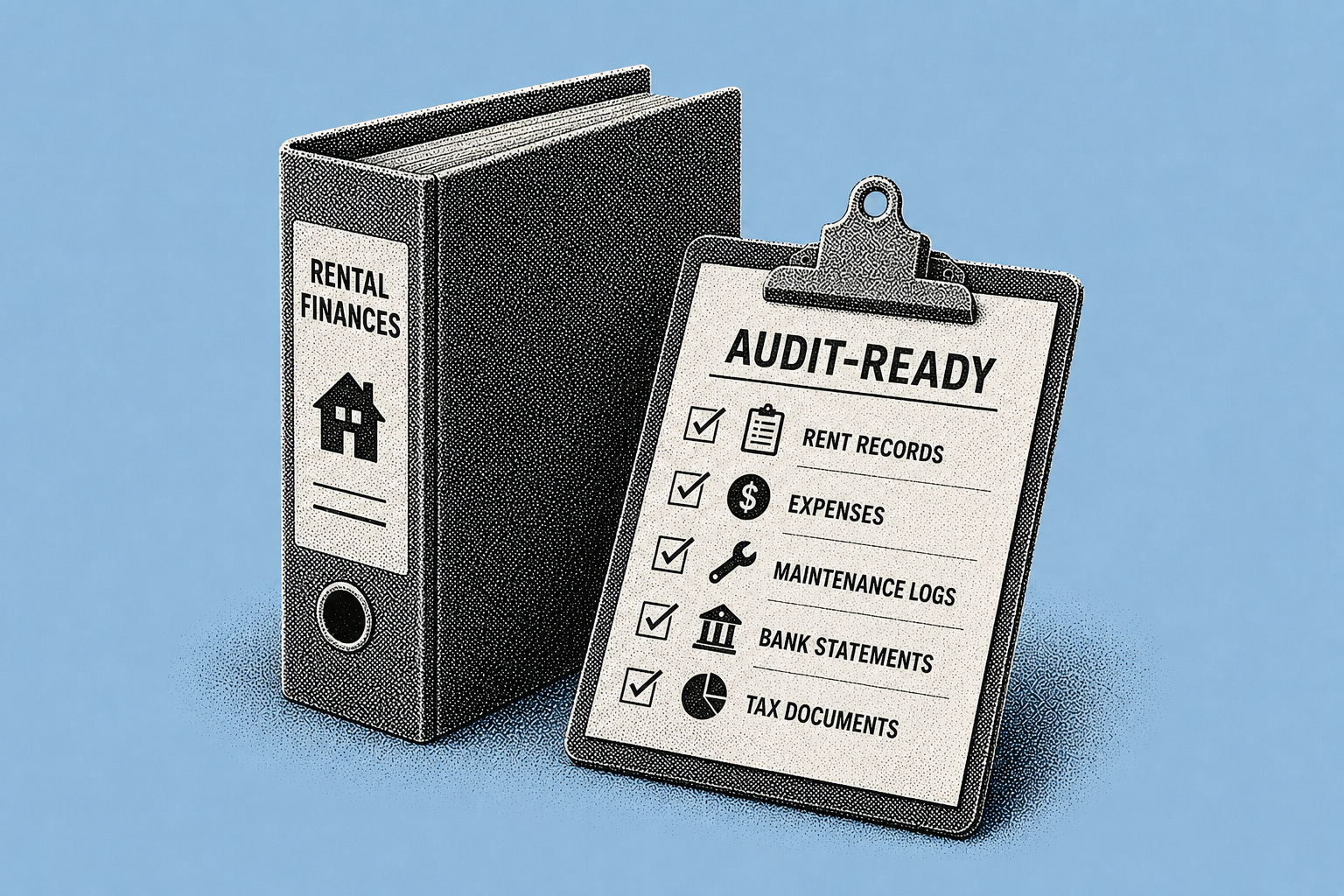
Tax Season Should Not Mean Hunting for Receipts
Tax season should not mean hunting for receipts, reconstructing mileage logs, and guessing at repair dates. Yet that is the reality for many independent landlords, especially when you are managing multiple units, tenants, and vendors while trying to keep your books "good enough." Property management bookkeeping software is designed to handle rental-specific accounting rules automatically, so your numbers stay consistent and defensible all year, not just in March.
Note: This article provides general education about rental property bookkeeping, not tax advice. IRS rules on depreciation, repair vs. improvement classification, and substantiation requirements are complex and fact-specific. Consult a qualified tax professional.
Why Rental Property Bookkeeping Is Harder Than It Looks
IRS Publication 527 emphasizes accurate reporting and record-keeping to substantiate rental income and deductions, including items many landlords forget to treat correctly, like advance rent and lease cancellation fees.
Multiple properties, separate performance. You need clean per-property profit and loss to know what is actually working and to support allocations.
Security deposits are not "income" (until they are). Refundable deposits generally are not income; they become income when you keep them for damages or unpaid rent.
Repairs vs. improvements (CapEx). Publication 527 stresses the difference: repairs are generally deductible now, while improvements are capitalized and depreciated, often over 27.5 years for residential rental property.
Depreciation schedules. IRS depreciation guidance in Publication 534 is closely tied to how you classify purchases and improvements.
Travel and vehicle deductions require logs. Publication 463 underscores substantiation: receipts and contemporaneous records are key.
Generic Accounting Tools vs. Purpose-Built Software
General accounting platforms can track income and expenses, but rentals have accounting "shapes" that do not map cleanly onto a standard chart of accounts. The IRS Schedule E instructions require landlords to report specific expense groupings correctly. Generic tools can be configured, but they do not naturally enforce rental logic like deposit liabilities, per-property allocations, or owner-style statements, so mistakes hide until year-end.
Features Every Landlord Needs
Per-property tracking and reporting. Rental-specific expense categories aligned to Schedule E. Security-deposit tracking as a liability. Tax-ready reports for Schedule E and contractor filings. Receipt capture and centralized document storage (Publication 463 stresses substantiation). Depreciation tracking supporting your fixed-asset list.
5 Costly Bookkeeping Mistakes Software Can Fix
Commingling funds across properties or personal accounts. Recording security deposits as rental income. Misclassifying improvements as repairs (or the reverse). Inconsistent categories month-to-month. Weak substantiation for mileage, travel, and small purchases.
Rental Bookkeeping Checklist
Monthly: Reconcile bank/credit accounts; review uncategorized transactions. Attach receipts/invoices to transactions. Verify security-deposit balances match tenant ledgers.
Quarterly: Review repairs vs. improvements; update fixed assets for depreciation. Run per-property P&L and spot category inconsistencies.
Yearly: Produce Schedule E-ready totals and depreciation reports. Review vendor payments and W-9s for 1099 compliance planning.
How Shuk Supports Audit-Ready Bookkeeping
Shuk's Schedule E-aligned expense organization with digital receipts keeps operating costs categorized consistently per property. Payment and income reports filterable by property, tenant, and date and exportable to PDF or Excel give you the financial records that Schedule E reporting and lender requests require. Security deposit tracking organizes deposits per unit/property so deposit accounting stays clean. Document storage keeps receipts, invoices, and key records attached to the right property, supporting the record-keeping emphasis in IRS guidance.
At as low as $2.00 per unit per month with no setup fees, and with White Glove Onboarding included at no additional cost, Shuk makes audit-ready financial tracking feasible for landlords running 1 to 100 units.
Book a demo at shukrentals.com/book-a-demo to see how income and expense reporting work together so your books stay clean year-round.
Frequently Asked Questions
Do I need property management bookkeeping software for just a few units?
Even with 2 to 5 units, rental bookkeeping has rules that generic tools handle poorly: deposit liabilities, per-property P&L, repair vs. improvement classification, and Schedule E categories. Purpose-built software enforces these by default.
Can I still use my CPA at tax time?
That is the point. Clean categorization and consistent reports exportable to PDF or Excel make it easier to deliver summaries your CPA can use.
What is the most common bookkeeping mistake landlords make?
Recording security deposits as rental income. Refundable deposits are generally not income until legally retained. This single mistake can overstate income and create audit risk.

Landlord Tax Mistakes That Trigger an IRS Audit (and How to Stay Compliant)
An IRS Letter Is Every Landlord's Worst-Case Scenario
An IRS letter is every landlord's worst-case scenario: you filed Schedule E, claimed standard deductions, and now you are being asked to prove everything, including income, expenses, depreciation, and whether that "repair" should have been capitalized. The reality is that rental returns are easy to get wrong and easy for the IRS to flag. Schedule E requires you to report each property's address, rental days, income, and expense categories, and it relies on technical rules like passive activity limits and depreciation methods that frequently trigger audit friction, per IRS Publication 527.
The reassuring part: most issues that lead to a landlord tax audit are not sophisticated schemes. They are common rental property tax mistakes, such as mixing personal and rental expenses, misclassifying improvements, or failing to substantiate deductions. With a consistent system, you can prevent most of these red flags before you file.
Note: This article provides general education about common rental property tax issues and IRS audit triggers, not tax advice. Depreciation rules, passive activity limitations, repair vs. improvement classifications, and reporting requirements are complex and fact-specific. Before making tax decisions, consult a qualified tax professional.
This guide walks you through the mistakes the IRS focuses on (based on IRS publications and audit technique guidance), why they trigger scrutiny, and how consistent record-keeping helps you stay compliant.
Why Rental Returns Get Audited
Schedule E looks straightforward, but it sits on top of complex rules: personal-use allocation, passive loss limitations, depreciation, and the repair-versus-improvement line that often determines whether you deduct a cost now or recover it over years, per IRS Publication 527. The IRS knows this. Its published audit technique guides for real estate instruct examiners to test rental income completeness, verify expenses, and scrutinize capitalization and passive-activity positions.
Audit coverage overall has been relatively low, but the IRS Data Book shows examination activity is concentrated where returns are complex and higher-yield, and the IRS has emphasized modernized analytics to find compliance gaps. TIGTA (the Treasury Inspector General for Tax Administration) has also pushed the IRS toward more targeted enforcement and better use of data, especially where income is harder to track or deductions are easy to inflate. Add the IRS's compliance initiative projects that target short-term rental reporting issues, per The Tax Adviser, and you get a clear theme: rentals are not "set it and forget it" anymore.
If you can recreate your Schedule E from your records in minutes, you are far less likely to panic, or lose deductions, during an exam.
7 Rental Tax Errors That Raise Audit Red Flags
1) Mixing Personal and Rental Expenses
Publication 527 and the Schedule E instructions require accurate reporting of rental expenses and correct allocation when a property has mixed use or when expenses are not strictly rental-related. When you run personal purchases through the same card as rental supplies, or round up a portion of your phone, vehicle, or home office without support, you create a classic substantiation problem that auditors are trained to probe, per IRS audit technique guidance.
The hardware-store blur. You buy paint for your rental and patio furniture for your home on one receipt. At tax time you deduct the full receipt as "Supplies." If examined, the IRS can disallow the personal portion and question your other receipts.
The "one credit card" landlord. A small landlord pays streaming subscriptions and groceries on the same card used for contractor deposits. Even if the totals are correct, the lack of separation makes proving the rental portion time-consuming and error-prone.
The shared mileage claim. You claim mileage for "property visits" but keep no contemporaneous log. In an audit, mileage often collapses without dated records.
How to prevent it. Open a dedicated rental bank account and card (even for one property). Tag every transaction to a property and a Schedule E category as it happens. For any split expense, keep a note showing the allocation method (for example, "$62.10 rental supplies; $118.45 personal, excluded"). Store receipts in a searchable system so you can produce them quickly.
2) Misclassifying Repairs vs. Capital Improvements
This is one of the most common and expensive triggers. The IRS draws a line between deductible repairs and capital improvements that must be depreciated, per Publication 527. Real estate audit technique guidance specifically calls out capitalization issues because reclassifying a deduction into a depreciable asset can create large adjustments and penalties if repeated.
The "new roof repair" problem. You replace a roof and expense $18,000 as "Repairs." In an exam, the IRS can treat it as an improvement and require depreciation, turning your current-year deduction into a multi-year write-off (and potentially creating tax due plus interest).
Kitchen refresh vs. fix. You replace broken cabinet doors (repair) but also upgrade counters and add a dishwasher (improvement). Bundling them all under "Repairs" is a red flag because it inflates immediate deductions.
The invoice that kills the deduction. Your contractor invoice says "remodel" or "renovation." Even if part of the work is repair-like, the wording can push the IRS toward capitalization unless you have detail.
How to prevent it. Demand detailed invoices: line items, materials, and what was restored vs. upgraded. Create a simple rule: if it betters, restores, or adapts the property, expect capitalization. Track improvements in an assets register so depreciation is correct from day one. Keep before/after photos and permits when applicable.
3) Underreporting Rental Income
Underreporting income is the fastest way to turn a routine return into a landlord tax audit. IRS real estate audit techniques emphasize verifying income completeness, including reviewing bank deposits and third-party reporting. This risk is amplified for short-term rentals, where the IRS has run compliance initiatives focused on platform-based reporting and classification issues, per The Tax Adviser.
Security deposit confusion. You treat a deposit as non-taxable forever, but later apply part of it to unpaid rent or damages and do not report it as income in that year.
The "cash discount" tenant. A tenant pays one month in cash; you deposit it but do not record it as rent. Bank deposits can be used to reconstruct income in an exam.
Platform netting mistake. You report only the net payout from a booking platform. If gross receipts are reported elsewhere or can be inferred, mismatches invite questions.
How to prevent it. Reconcile monthly: lease rent roll (or booking reports) to bank deposits to accounting ledger. Track deposits in a liability bucket; move amounts to income only when legally applied. Keep monthly statements from platforms and payment processors.
4) Depreciation Errors
Depreciation is a core area for rental returns, and it is technically easy to miscalculate. Publication 527 emphasizes depreciation rules for residential rental property and the need for correct classification and records. Examiners are directed to scrutinize depreciation because small input errors compound over years.
Land included in depreciation. You buy a property for $420,000 and depreciate the full amount. Land is not depreciable; overstating basis inflates deductions for years.
Placed-in-service date mismatch. You start depreciating in January, but the property was not ready and available for rent until April. That mismatch can trigger an adjustment.
The "forgotten depreciation" trap. You skip depreciation for two years to keep income higher for a refinance. Later, you try to catch up informally. Depreciation issues often require formal correction methods.
How to prevent it. Keep closing documents and a basis worksheet that splits building vs. land. Document "placed in service" with a listing date, occupancy permit, or first lease. Maintain a depreciation schedule that ties to each property and tracks improvements separately.
5) Overstating or Misplacing Deductions
Schedule E expects expenses in defined buckets, and the instructions require property-level detail that lines up with the categories on the form. Excessive "Other" expenses or unusually high write-offs relative to rental income can invite questions.
Meals mislabeled as rental expense. You deduct meals every time you meet a contractor, but have no business purpose notes.
Travel that looks like a vacation. You claim airfare and hotels to "check on the property," but you also visited family and have no itinerary or log.
The "Other" black box. You lump $9,800 into "Other" with no sub-ledger. In an exam, the burden shifts to you to explain each item.
How to prevent it. Use clean categories mapped to Schedule E lines; minimize "Other." Require a note plus receipt for any expense that is not self-explanatory. Run a reasonableness review before filing: compare expense ratios year-over-year per property.
6) Passive vs. Active (and Short-Term Rental) Misclassification
The passive activity rules are a repeated stress point for rentals, and Schedule E reporting intersects with passive loss limitations, per Publication 527. The IRS provides examiner guidance on passive activity issues through audit technique materials, and it is an area that gets attention because it affects whether losses can offset other income. Short-term rentals add another layer: the IRS has explicitly pursued compliance initiatives around short-term rental reporting and proper classification, per The Tax Adviser.
Claiming non-passive losses without support. You deduct large rental losses against W-2 income without documentation of eligibility or participation.
Short-term rental "business" position without records. You treat a short-term rental as non-passive but keep no logs of hours, guest communication, cleaning coordination, or services provided.
Multiple properties, one blended log. You claim material participation across several rentals but cannot tie hours to specific properties.
How to prevent it. Keep contemporaneous participation logs (calendar entries, messages, task lists). Store supporting documents for services provided (cleaning, guest support, supplies). If you are unsure, treat it conservatively and consult a qualified tax professional.
7) Weak Substantiation
Even valid deductions can be lost if you cannot substantiate them. IRS audit guidance and real estate examination techniques emphasize documentation and testing expenses for legitimacy. Publication 527 and Schedule E instructions implicitly require you to support what you report per property, including days rented and expenses claimed.
The shoebox problem. You have receipts, but they are faded, unlabeled, and not tied to properties. Reconstructing becomes guesswork.
The contractor-with-no-paperwork. You pay a handyman via peer-to-peer transfer with no invoice describing the work.
Property manager statements not reconciled. Your manager reports one number, your deposits show another, and you file off the higher "gut feel."
How to prevent it. Save digital copies of receipts and invoices at the time of purchase. Attach context: property, unit, what it was for, and who performed the work. Reconcile monthly so year-end reporting is a push-button exercise, not a scramble.
Your Audit-Ready Rental Tax System
Monthly (per property). Reconcile rent roll/booking report to bank deposits (flag gaps). Categorize every expense to a Schedule E line item (avoid large "Other"). Attach receipt plus note for unclear items (travel, shared costs, mixed receipts). Update deposits tracker: security deposits held vs. applied to rent/damages.
Quarterly. Review repairs vs. improvements; move improvements to an asset list for depreciation. Run a variance report vs. prior year by category (spot outliers early).
Year-end. Confirm placed-in-service dates and improvement dates; refresh depreciation schedule. Export a property-level P&L and category totals that tie directly to Schedule E. Store PDFs: 1099-related vendor totals, property manager statements, platform statements.
If you can export a property P&L and an asset register in minutes, you have eliminated the most stressful part of audit response.
Frequently Asked Questions
How far back can the IRS audit my rental return?
Most exams focus on recent years, but keep rental records at least as long as you may need to substantiate depreciation and basis, because those items affect multiple years and sale calculations, per Publication 527.
What documentation is acceptable if I am audited?
The IRS generally looks for third-party and contemporaneous records: bank statements, invoices, receipts, settlement statements, and clear schedules that tie to your return. Real estate audit technique guidance emphasizes verifying income and testing expenses using these types of documents.
Do I need to issue 1099s to contractors for my rental?
Often, yes. Many landlords must issue Form 1099-NEC for qualifying vendor payments (rules depend on entity type and facts). Property management industry guidance highlights the importance of correct information reporting and form choice, which can reduce audit issues. Confirm your specific obligations with a tax professional.
Are short-term rentals more likely to be scrutinized?
The IRS has run compliance initiatives aimed at short-term rental reporting, which means the category has heightened attention, especially where classification and income reporting are inconsistent, per The Tax Adviser.
What to Do Next
You do not need to fear a landlord tax audit if your bookkeeping is built for verification. The foundation is consistent, property-level income and expense tracking that you can produce on demand.
Shuk's payment and income reports are filterable by property, tenant, and date and exportable to PDF or Excel, so your rent collection records tie cleanly to Schedule E income lines. Schedule E-aligned expense organization with digital receipts keeps operating costs categorized consistently, reducing the "Other" black box and the scramble to match receipts at year-end. Online rent collection with zero ACH transaction fees creates a clean, traceable payment record per unit, which simplifies the monthly reconciliation that audit defense depends on.
At as low as $2.00 per unit per month with no setup fees, and with White Glove Onboarding included at no additional cost, Shuk makes audit-ready financial tracking feasible for landlords and property managers running 1 to 100 units.
Book a demo at shukrentals.com/book-a-demo to see how income and expense reporting work together so your Schedule E numbers are based on real records, not reconstructions.

How Expense Tracking Software Simplifies Tax Prep for Landlords
Tax Season Should Not Feel Like a Second Job
If you manage rental properties, you already wear multiple hats. Leasing agent, maintenance coordinator, customer service, and bookkeeper. Then tax season arrives and expects you to reconstruct twelve months of rental activity from bank feeds, email receipts, paper invoices, and a spreadsheet you meant to update regularly (but did not).
The result: hours spent hunting for receipts, second-guessing expense categories, and trying to remember whether that Home Depot run was a repair you can deduct now or an improvement you need to depreciate over time. The stress is not just about lost time. It is about money left on the table and the risk of getting something wrong.
The IRS requires landlords to maintain records that support income and deductions (receipts, invoices, mileage logs) and to keep them at least three years, often longer depending on the item, per IRS Publications 535 and 527. When documentation is weak (missing receipts, vague descriptions, "rounded" mileage), deductions become harder to defend and audit risk increases.
Expense tracking software turns tax prep from a yearly scramble into a year-round system. Expenses are categorized consistently, receipts are stored digitally next to each transaction, and year-end reports align with Schedule E. Here is how to reduce stress, capture more deductions, and walk into tax season prepared.
Disclaimer: This article is not tax or legal advice. IRS rules on rental property income, deductions, depreciation, recordkeeping, and substantiation are detailed and change over time. The IRS publications referenced below (Schedule E instructions, Publications 527, 535, 463, and 587) are the authoritative sources. Before relying on any tax position discussed here, consult a qualified CPA or tax professional who knows your specific situation.
What Streamlined Expense Tracking Changes
For most independent landlords, tax-prep problems do not come from "not knowing what Schedule E is." They come from friction. Too many transactions, too many categories, and too many decisions made months after the fact.
The IRS expects you to report rental income and expenses on Schedule E (Form 1040), using common expense groupings such as advertising, insurance, legal and professional fees, repairs, utilities, taxes, and more. When your records are not already organized in that structure, you end up doing bookkeeping inside tax prep, often under deadline pressure.
Expense tracking software simplifies this by handling three critical jobs continuously:
- Capture. Bring in expense entries and receipts as they happen, not at year-end.
- Classify. Map each expense to a Schedule E-aligned category and to the correct property or unit.
- Substantiate. Keep the documentation trail (receipt images, vendor, date, amount, business purpose) so your deductions are defensible.
This guide walks you through the end-to-end workflow landlords can use to streamline tax preparation. Categorizing expenses into Schedule E-aligned buckets at the time of entry, digital receipt storage attached to each transaction, property and vendor tagging, depreciable-item flagging, exportable tax-prep reports, and the deductions landlords commonly overlook (mileage, home office, depreciation).
We will also outline common landlord deductions and the pitfalls that get landlords into trouble, then finish with a tax-prep readiness checklist you can use every month.
The goal is not more bookkeeping. It is less tax-season chaos, better deduction capture, and cleaner records that reduce audit stress.
A Practical Workflow for Year-Round Tax Prep
1) Set Up Categories That Match Schedule E
Before you streamline anything, align your expense categories to how you will file. Schedule E commonly includes categories like advertising, auto and travel, cleaning and maintenance, commissions, insurance, legal and professional fees, management fees, mortgage interest, repairs, supplies, taxes, utilities, and depreciation. IRS Publication 527 clarifies what counts as deductible rental expenses and where landlords often go wrong. Repairs vs. improvements, mixed-use allocations, and prepaid expenses.
How a tax-ready software workflow helps. A platform built around Schedule E-aligned categorization saves you from building a custom chart of accounts from scratch in a spreadsheet. You select a rental-friendly category structure, map it to your properties and units, and every expense entered going forward maps to the right place. That is what makes year-end reporting fast, instead of a reclassification project across hundreds of lines in March.
Practical tip. Create two distinct workflows early:
- Repairs and Maintenance (deduct in current year)
- Capital Improvements (capitalize and depreciate)
The IRS distinguishes repairs (keep property in operating condition) from improvements (betterment, adaptation, or restoration), per Publication 527. If you lump these together all year, you will pay for it during tax prep. Tagging depreciable items at the time you enter the expense is far easier than reconstructing the distinction nine months later.
2) Capture Expenses as They Happen, Not at Year-End
Manual spreadsheets fail in predictable ways. Missing entries, inconsistent descriptions ("HD"), and category drift over time. The fix is making expense entry small, fast, and habit-forming, instead of a January cleanup.
How a software workflow helps. Enter each expense once, the moment it happens or the moment the invoice arrives, with the receipt attached. A few minutes weekly beats a few days at year-end. You stay in control: you choose the category, the property, and the notes, but the system keeps the structure consistent.
Why this simplifies taxes. Schedule E reporting becomes a reporting exercise instead of a reconstruction project. If you use a CPA, you can hand them a clean export rather than a patchwork of bank statements and email folders.
Note on bank feeds. Some landlord platforms automatically pull in transactions from connected bank accounts and cards. Shuk's bank feed integration is on the roadmap for August 2026. Until then, expenses are entered manually, which has the benefit of forcing the categorization decision at the moment of entry, when you remember exactly what the expense was for.
3) Categorize Consistently and Tag the Right Property
The biggest time sink in rental bookkeeping is categorization. Deciding where each transaction belongs, whether it is even deductible, and which property it belongs to. IRS rules can be nuanced. Insurance premiums may need proration if prepaid, assessments may need to be capitalized, and mixed-use loans require interest allocation, per Publication 527. When categorization is delayed until year-end, you lose context and accuracy.
How a software workflow helps. When you enter an expense, you assign it to a Schedule E-aligned category, tag it to the right property, and (if relevant) tag the vendor. Over time, you build a clean record of who you paid, what for, and how it should be treated for tax purposes. If a $400 expense is half for one property and half for another, you can split it at entry rather than guessing at the end of the year.
Example. A landlord with four doors used to spend multiple weekends each spring cleaning up a spreadsheet. Sorting bank statements, searching email receipts, and relabeling categories to match Schedule E. After switching to a software workflow with Schedule E-aligned categories from day one, they reviewed expenses weekly in roughly ten minutes, because each entry was already categorized and tagged at the time it happened. By year-end, generating a Schedule E-ready report was essentially immediate.
4) Make Receipts Audit-Ready by Storing Them With the Transaction
Receipts are where most DIY landlord systems break down. The IRS expects you to keep records supporting income and deductions, including receipts and invoices, generally for at least three years (longer in some cases), per Publication 535. Mileage and travel require especially strong substantiation. Date, destination, purpose, and contemporaneous logs, per Publication 463.
How a software workflow helps. Snap a photo of a receipt, forward an email invoice, or upload a PDF. The receipt is stored digitally and linked to the matching expense entry. Because the receipt is tied to a categorized entry and a tagged property, you are building a clean audit trail as you go. Vendor, amount, date, business purpose, and supporting image, all in one place.
What better documentation means for audit risk:
- No shoebox of faded paper.
- No "I think this was for the rental" guessing.
- Clear separation of repair vs. improvement documentation (which the IRS scrutinizes), per Publication 527.
5) Reconcile Monthly. Catch Errors While They Are Small
Landlords often wait until January or February to "do bookkeeping." That is when errors multiply. Duplicate entries, reimbursements not recorded as income, utilities paid for tenants not properly reflected, or repairs misclassified as improvements (or vice versa), per Publication 527. Monthly reconciliation is the difference between a calm tax season and a panicked one.
Use a monthly routine
- Review entries from the past month for completeness.
- Confirm property and unit assignments.
- Attach any missing receipts.
- Split mixed-use expenses where necessary.
- Verify reimbursements (tenant utility reimbursements must be included in income if you deduct the utilities), per Publication 527.
Practical tip. Add a "notes" habit. A one-line note like "Emergency plumber, Unit 2 leak repair" is powerful context if the IRS ever questions an expense's business purpose.
6) Track the Deductions Landlords Commonly Overlook
Even landlords who know the big categories (repairs, taxes, insurance) often miss the deductions that require consistent tracking outside the main expense list.
The three most-missed areas
Mileage and local travel. The IRS requires contemporaneous logs, and "rounded" mileage is a red flag, per Publication 463. The 2025 standard mileage rate is 70 cents per mile. Keep a separate mileage log (a notebook in the car, a notes app, or a dedicated mileage tracker), recording date, destination, purpose, and miles.
Home office. Allowed only if used exclusively and regularly for rental management, using simplified or actual expense methods, per Publication 587. Document the square footage and the exclusive-use rationale.
Depreciation. Residential rentals are depreciated over 27.5 years, and missed depreciation is a common landlord mistake. Per Publication 527. Assets like appliances, tools, and furniture may be depreciated as 5- or 7-year property. Keep the purchase invoice to support basis.
How a software workflow helps. Flagging assets as depreciable at the time you enter the expense (and storing the purchase invoice with that flagged entry) means your CPA has everything needed to set up the depreciation schedule. Mileage and home office still need their own systems (most landlords use a dedicated mileage log or notes app, plus a separate home office workpaper for the CPA).
Example. A landlord managing two single-family rentals was not tracking mileage to showings, supply runs, and periodic inspections. No log, no deduction. After implementing a simple "log trips weekly" routine, they captured hundreds of miles that year. At the 2025 rate of 70 cents per mile, even 800 miles becomes a $560 deduction (tax savings depend on bracket). The bigger win: the log is now substantiated instead of reconstructed.
7) Generate a Year-End Schedule E-Aligned Report
At year-end, you want outputs your tax preparer can use immediately. Income totals, expense totals by category, property-by-property breakdowns, and a receipt archive.
How a software workflow helps. With expenses categorized at the time of entry and receipts attached throughout the year, you can produce:
- A Schedule E-aligned expense report grouped by IRS category.
- Property-level and tenant-level filtered reports.
- An exportable file (PDF or Excel) for your CPA.
- A receipt archive tied to each transaction.
This is the moment where spreadsheets usually collapse. A spreadsheet can total numbers, but it rarely includes the "proof layer." Receipts, notes, allocation logic. The advantage of an integrated system is combining totals plus documentation in one searchable, exportable place.
8) Hand Off Clean Data to Your CPA
Many landlords do not want to replace their accountant. They want to stop paying their accountant (or themselves) to do basic cleanup. Clean data reduces billable hours and back-and-forth.
How a software workflow helps. A streamlined handoff looks like this:
- Export Schedule E-aligned category totals and transaction detail.
- Share the receipt archive instead of emailing PDFs one at a time.
- Provide a property-by-property breakdown so the CPA can map income and expense to each rental on the return.
This matters because the Schedule E categories and IRS rules do not change based on what tool you use. Only how cleanly you can prove and report them.
Tax-Prep Readiness Checklist for Landlords
Use this checklist monthly (and again in December) to make tax season almost automatic.
- All rental expenses entered and assigned to the correct property or unit (especially if you own multiple rentals).
- Schedule E-aligned categories in place (advertising, repairs, taxes, insurance, legal and professional fees, utilities, travel, and so on).
- Repairs vs. improvements separated and supported with notes and invoices (improvements capitalized and depreciated).
- Receipts attached digitally to expense entries (photo, PDF, or email), stored in one system.
- Mileage log updated contemporaneously with date, destination, and business purpose (avoid reconstruction).
- Tenant reimbursements tracked as income if you deduct the related expense (for example, utilities).
- Mortgage interest and property taxes documented (1098s, statements, tax bills; allocate mixed-use correctly).
- Depreciation files updated (basis records and Form 4562 in the first year; residential over 27.5 years).
- Year-end exports generated. Schedule E-aligned summary plus transaction detail plus receipt archive for your CPA.
If you can check off all nine, your tax prep becomes review-and-file, not a forensic accounting project.
FAQ
Do I still need a CPA if I use expense tracking software?
Often yes, especially if you have multiple properties, depreciation questions, passive activity loss limits (IRC Section 469), or you are considering advanced strategies. But software reduces the time your CPA spends organizing and fixing your records, and it helps you bring cleaner Schedule E-ready totals and documentation. Many landlords use software for bookkeeping and a CPA for tax strategy and filing. The combination is usually cheaper than asking the CPA to do both.
Is digital receipt storage IRS-compliant?
The IRS requires you to keep records that substantiate deductions (receipts, invoices, logs) and retain them generally at least three years, per Publication 535. Digital storage is widely used in practice. The key is that records are legible, retrievable, and tied to the transaction. Keeping receipts attached to categorized entries strengthens your substantiation trail, because a receipt sitting alone in a folder is less defensible than a receipt attached to a categorized expense with a vendor, date, amount, and business-purpose note.
What landlord expenses are most likely to be misclassified?
Repairs vs. improvements is the biggest one. Repairs are generally deductible in the year paid. Improvements must be capitalized and depreciated, per Publication 527. Also watch prepaid expenses (like insurance) that may require proration, and mixed-use allocations (loan interest or shared expenses). Flag depreciable items at the time you enter the expense, when you remember the context. Asking yourself in March whether a $1,200 vanity replacement was a repair or an improvement is a setup for an error.
How does software reduce audit risk?
It does not "prevent" audits (no tool can), but it reduces exposure by improving documentation quality. Consistent categorization, contemporaneous mileage logs, stored receipts, and clear separation of capital items. All areas the IRS specifically expects landlords to handle correctly, per Publications 463 and 527. The substantiation trail is what makes a deduction defensible if questioned. A category total in a spreadsheet, with no receipt backing it, is the weakest position to be in.
Make This the Last Stressful Tax Season
If you want tax prep to feel simple, the best move is to stop treating it as a once-a-year project. The landlords who walk into tax season calm are the ones whose system runs in the background. Expenses categorized at the time of entry, receipts attached, depreciable items flagged, property tagging consistent, and exports ready when the CPA needs them.
This is exactly the gap Shuk closes. Shuk's expense organization is built around Schedule E-aligned categorization at the time of entry, not retroactive cleanup. You categorize each expense as you go, tag the property and unit it belongs to, flag depreciable items so basis records are preserved, and attach the receipt (photo, PDF, or email forward) directly to the entry through Shuk's document storage. Vendor tagging lets you keep a clean record of who you paid for what across the year. And when tax season arrives, Shuk's exportable payment and expense reports filter by property, tenant, or date range and export to PDF or Excel, giving you a Schedule E-aligned package your CPA can use immediately.
Around tax-prep workflow, the same Shuk subscription gives you the rest of the rental operations stack. Online rent collection with zero ACH transaction fees and configurable late fees applied automatically, so your income side stays as clean as your expense side. Maintenance request tracking with photos, documents, and a full history per property, so when a repair comes up at tax time, the documentation is already attached and timestamped. Centralized in-app messaging with email and push notifications, creating a record of every tenant communication tied to maintenance, repairs, or other expense-relevant decisions. The Lease Indication Tool for renewal forecasting. Two-Way Reviews. And Year-Round Marketing.
One note on what is coming. Bank feed import is on the Shuk product roadmap for August 2026, which will reduce the manual entry step for landlords who prefer automated transaction capture. Until then, the workflow above is the manual-entry version of the same Schedule E-aligned discipline that is proven to reduce tax-season stress.
At as low as $2.00 per unit per month with no setup fees, and with White Glove Onboarding included at no additional cost (where the Shuk team handles property setup, account preparation, and renter onboarding for you), Shuk makes year-round tax-prep discipline feasible for landlords and property managers running 1 to 100 units. Shuk now supports third-party management with multi-user workflows and role-based access, so a property management team can keep one consistent expense-tracking and reporting workflow across an entire portfolio.
Book a demo at shukrentals.com/book-a-demo to see how Shuk's Schedule E-aligned expense organization, document storage for digital receipts, property and vendor tagging, depreciable-item flagging, exportable payment and income reports, online rent collection with zero ACH fees, automated late fees, maintenance request tracking, centralized in-app messaging, the Lease Indication Tool, and Year-Round Marketing work together so tax prep becomes review-and-file instead of a forensic accounting project.

How to Handle Tenant Turnover: A Step-by-Step Checklist to Cut Vacancy Days and Protect Your Property
Tenant turnover is where rental income and property condition are won or lost. One move-out can trigger a chain reaction: unclear notice dates, missed inspection opportunities, deposit disputes, delayed vendors, stale listings, and ultimately extra vacancy days you cannot get back.
Those empty days are not theoretical. Industry reporting breaks down turnover costs as a mix of hard expenses covering cleaning, paint, repairs, lock changes, and flooring, and soft costs especially lost rent, which can represent 35% to 50% of total turnover expense. When you add it up, turnover commonly lands anywhere from $1,000 to $5,000 per move-out depending on unit condition and market, and one analysis pegged average turnover at approximately $3,872 per resident.
The other challenge is time. Even if your make-ready only takes two weeks, the end-to-end vacant-to-leased period can stretch longer when you factor in marketing, showings, screening, and lease signing. Recent analytics showed average vacant days climbing to 34.4 days by the end of 2024. For independent landlords and property managers, that is a painful drag on cash flow, especially when you are juggling maintenance coordination, compliance deadlines, and tenant communications across text threads and spreadsheets.
This playbook is designed to turn turnover into a repeatable system. You will get an end-to-end checklist from move-out notice through move-in onboarding with practical timelines, legal guardrails especially around security deposits, and efficiency tactics that reduce vacancy days while protecting the asset.
Why Turnover Deserves a System, Not Just a To-Do List
Turnover is unavoidable. Preventable chaos is not. Here is what you are protecting with a disciplined process: revenue continuity through minimized vacancy days and lost rent, asset value through consistent standards in cleaning, paint, repairs, and preventive maintenance, and legal compliance especially around deposits, notices, and documentation.
Vacancy time has expanded in many markets. General operational targets often aim for 20 to 30 vacant days for typical properties while market-wide averages can rise above a month. If you wait to market until the unit is empty, start calling vendors after keys are returned, and assemble deposit documentation at the last minute, you are choosing a longer downtime.
This guide walks you through a practical turnover workflow in ten steps matching the real sequence you experience: move-out notifications and confirmation, pre-move-out instructions and scheduling, inspections with photos, security deposit reconciliation and state deadlines, repairs and cleaning and make-ready planning, preventive maintenance upgrades, marketing and re-listing, tenant screening and selection, lease signing and compliance documentation, and move-in onboarding that prevents the next turnover.
Adopt even half of this system and you will reduce friction, create a consistent resident experience, and build a turnover engine that scales from one unit to one hundred without burning you out.
Ten Steps to Reduce Vacancy Days and Protect Your Property
Step 1. Confirm Notice, Lease End Date, and Local Requirements
Start the turnover the moment you receive notice because every day you delay planning becomes vacancy later. Verify the lease end date, the required notice period, and how notice must be delivered whether by email, written letter, or portal. Month-to-month notice is commonly 30 days but can vary by state and circumstance. California can require 30 or 60 days depending on length of tenancy. In Texas, month-to-month is generally tied to one rental period of approximately 30 days.
What to do: Send a written notice-received confirmation that includes the tenant's confirmed move-out date and time, a forwarding address request which is critical for deposit mail in some states, and a timeline of inspections, utilities, and key return.
Use templates and automated reminders so you are not rewriting the same messages every turnover. Centralizing dates in one calendar covering notice received, pre-inspection, move-out, and deposit deadline reduces missed deadlines and he-said-she-said disputes.
Step 2. Send a Pre-Move-Out Instruction Pack
A clean, consistent move-out process protects your unit and your deposit accounting. Within 24 to 48 hours of notice, send a move-out instruction pack covering cleaning expectations for appliances, bathrooms, floors, and trash removal; what counts as normal wear versus tenant-caused damage with defined examples; rules for patching holes, nail removal, and paint touch-ups if you allow tenant repairs; how to return keys, garage openers, and fobs; and utility transfer requirements.
This step reduces your make-ready scope and speeds listing photo readiness. Turnover cost analyses consistently include cleaning, painting, and junk removal as major line items. If your tenant understands standards early, you are more likely to avoid paying for avoidable labor.
A practical 48-hour countdown to include in your message: At T-minus 48 hours, confirm elevator reservation if applicable and final walkthrough appointment. At T-minus 24 hours, remove all belongings, wipe down appliances, and bag trash. On move-out day, take photos, drop keys, and record meter reads if relevant.
Also schedule a pre-move-out walkthrough where allowed. It reduces conflict by aligning on what will be billed before there is a dispute rather than after.
Step 3. Pre-Inspection and Early Scope of Work
If your state and local rules allow, do a pre-move-out inspection one to two weeks before the tenant leaves. The point is not to nitpick. It is to identify safety issues or major repairs that will block leasing, pre-order materials including paint, blinds, filters, and smoke and CO batteries, and get vendor bids scheduled so day one after move-out is productive rather than spent making calls.
Industry estimates place make-ready costs anywhere from $400 to $5,000 or more depending on condition. The earlier you define your scope of work, the more you can keep costs toward the low end.
A standardized inspection rubric with lease-ready minimums: All lights working with covers intact. No active leaks and drains clear. Appliances functional. Doors and locks operating smoothly. Walls with a patch, sand, and paint plan. Floors with a clean, repair, or replace plan.
Create tasks directly from inspection results and assign them to staff or vendors with due dates so nothing exists only in your head.
Step 4. Move-Out Day: Document Condition Like It Is Evidence, Because It Is
Your move-out inspection should be consistent, photo-rich, and time-stamped. Photograph each room from multiple angles, close-ups of damage covering chips, stains, holes, and broken fixtures, appliances inside and out, floors and baseboards, outdoor areas including patio and yard condition, and keys and fobs returned with a count recorded.
This documentation directly supports deposit deductions and protects you if disputes escalate. Many state deposit statutes require an itemized statement of deductions within a specific deadline window often alongside the refund. Photos combined with an inspection checklist make your itemization far easier to justify and far harder to dispute.
Complete the inspection immediately after possession returns when keys are surrendered to avoid ambiguity about post-move damage. If you allow early key return, document the exact surrender date and time in writing.
Also initiate lock changes and re-key immediately after move-out. Lock changes are a standard line item in turnover cost breakdowns and a safety expectation for professional operations.
Step 5. Security Deposit Reconciliation: Meet Deadlines, Itemize Correctly, and Avoid Penalties
Deposit handling is where small process errors can become expensive. Many states require deposit return within 14 to 60 days and several impose strict penalties for late or incorrect handling.
State-specific timelines to know:
California requires return within 21 days with itemized deductions and potential penalties up to two times the deposit for bad-faith retention.
Texas requires refund within 30 days after surrender, often tied to receiving a forwarding address, with bad-faith penalties that can include $100 plus triple damages plus attorney fees.
Florida requires return within 15 days if no deductions are taken. If claiming deductions, written notice must be sent within 30 days and the tenant has 15 days to object. Missing the notice can forfeit the right to withhold.
New York requires return within 14 days with an itemized statement, and missing the deadline can forfeit the right to keep any portion.
Illinois timelines vary based on whether deductions are taken, typically requiring itemization within 30 days and return of the remainder within 45 days.
Best practice workflow: Export the rent ledger and confirm the balance covering rent, fees, utilities, and damages. Separate wear-and-tear from chargeable damage consistently. Attach invoices and receipts when required or when deductions are substantial. Send the itemization and refund via a trackable method. Deadline tracking, templated itemization letters, attachment storage, and recorded delivery reduce legal exposure significantly.
Step 6. Build a 7 to 14 Day Make-Ready Plan With a Day-Zero Vendor Schedule
Treat make-ready like a project plan rather than a to-do list. Your edge comes from scheduling vendors before the unit is empty rather than after move-out.
Example: a three-day repaint schedule that is tight but realistic with proper preparation.
Day zero, the move-out afternoon: patch and sand, clean walls, tape and cover surfaces.
Day one: prime plus first coat with a two-person crew.
Day two: second coat plus trim and door touch-ups.
Day three morning: walkthrough plus punch-list fixes with photos taken the same afternoon.
Pair this with parallel rather than sequential tasks: Schedule the cleaner immediately after paint cures. Have the flooring vendor on standby for spot repairs. Have maintenance handle smoke and CO batteries, HVAC filter, caulk, and fixtures while paint dries.
Because lost rent is often the biggest turnover expense component, shaving even a week off downtime can materially change your annual return on investment.
Step 7. Do Not Skip Preventive Maintenance
Turnover is the best time to do preventive work with minimal resident disruption. Industry maintenance ROI summaries cite findings that preventive maintenance can deliver a 545% return over 25 years and significantly reduce long-run repair costs. Even if your holding period is shorter, the principle holds: preventive maintenance reduces emergency calls, protects your unit, and helps retain the next tenant longer.
High-impact turnover preventive maintenance items: HVAC service plus filter standardization. Water heater inspection covering leaks, the pan, and straps where applicable. Replacement of worn supply lines in bathrooms and kitchens. GFCI testing and outlet and plate replacement. Door weatherstripping to reduce drafts and complaints. Deep cleaning of dryer vents to reduce risk and improve performance.
Create a turnover PM kit per unit type, such as one-bedroom or two-bedroom, with standard parts. Standardization saves time and reduces vendor dependency.
Step 8. Market Early, Keep Listing Visibility Continuous, and Price With Data
Marketing should start while the unit is still occupied if your local rules and tenant privacy considerations allow showings with proper notice. This continuous visibility reduces dead time between make-ready completion and lease signing. General benchmarks suggest aiming for 20 to 30 vacant days, but recent market data showed averages above that, making early marketing a competitive necessity.
What reduces vacancy days: Pre-schedule photography for day one or two after make-ready. Create a listing template with swap fields for rent, deposit, and availability date. Use a showing calendar to batch tours and reduce back-and-forth scheduling. Post a coming-soon notice with an accurate availability date and avoid bait-and-switch situations.
Mini math example: If rent is $2,100 per month, that is approximately $70 per day in gross rent. A make-ready plus leasing delay that extends vacancy from 14 days to 34 days adds approximately 20 days, or approximately $1,400 in gross rent not collected. That is before utilities, yard care, or additional marketing, reinforcing why lost rent dominates turnover costs.
Step 9. Screening: Standardize Criteria, Document Decisions, and Reduce Fair Housing Risk
A rushed screening decision can create the worst kind of savings: a short vacancy followed by late payments, property damage, or another turnover. Build a consistent process covering written screening criteria for income, credit, and rental history; the same application steps for every applicant; and documented adverse action where required in compliance with local rules.
A practical service-level agreement for yourself: Applications reviewed within 24 hours. Verification calls completed within 48 hours. Approval or decline decision communicated within 72 hours.
This matters because turnover already costs thousands per move-out. Avoid compounding the problem with preventable resident churn. Centralizing applications, storing consent forms, tracking communications, and keeping an audit trail is useful if decisions are questioned later.
Step 10. Lease Signing and Move-In Onboarding: Reduce Future Turnover Before Day One
Lease signing is not the finish line. Onboarding is where you prevent the next turnover. Your goals are to set expectations around maintenance reporting, noise, pets, and parking; make rent payment easy and consistent; and capture baseline condition documentation before disputes can arise.
Move-in best practices: Collect funds for first month and deposit as cleared payment before handing keys. Provide a move-in checklist with photo instructions. Confirm how to submit maintenance requests and what constitutes an emergency. Deliver care and cleaning guidance for countertops, floors, and HVAC filters.
Less friction translates into fewer late payments, fewer misunderstandings, and better retention, lowering the turnover frequency that drives those $1,000 to $5,000 move-out costs.
Vacancy Cost Comparison: Reactive vs. Proactive Turnover
Reactive turnover: Market late, vendors scheduled after move-out, no standardized checklist. Approximately 34 vacant days at $70 per day equals approximately $2,380 in gross rent lost.
Proactive turnover: Market early, vendors pre-booked, standardized checklist applied. Approximately 18 vacant days at $70 per day equals approximately $1,260 in gross rent lost.
Difference: Approximately 16 days and approximately $1,120 saved, not including reduced make-ready expenses from early standards communication or reduced legal risk from tracked deposit deadlines.
Tenant Turnover Checklist
A. Notice and planning: Receive written notice and confirm move-out date and time in writing. Verify lease end date and required notice period for your state and local jurisdiction. Request forwarding address for deposit return. Send move-out instruction pack and cleaning standards. Schedule pre-move-out walkthrough if permitted. Pre-book vendors for paint, cleaning, flooring, and handyman with day-zero and day-one slots reserved.
B. Inspections and documentation: Prepare inspection rubric and photo checklist. Conduct move-out inspection immediately after surrender. Take time-stamped photos and video of every room plus close-ups of all damage. Record key and fob count returned and schedule re-key and lock change. Capture meter reads and utility status if applicable.
C. Deposit and compliance: Reconcile ledger covering rent, fees, and utilities balance. Separate wear-and-tear from chargeable damage. Collect vendor invoices and receipts for deductions where required. Send itemized statement and refund within your state deadline with delivery tracked.
D. Make-ready execution: Finalize scope of work and budget covering materials, labor, and contingency. Complete repairs affecting safety and habitability first. Execute paint plan covering patch, prime, and coats. Schedule deep clean after dust-producing work. Replace consumables including filters, bulbs, and batteries and test smoke and CO devices. Complete preventive maintenance covering HVAC, plumbing checks, caulk, and GFCIs. Conduct quality-control walkthrough and punch list.
E. Re-listing and leasing: Update photos and listing description using a template. Set an accurate coming-soon or available date. Schedule showings in batches and follow up with applicants within 24 hours. Apply screening criteria consistently and document decisions. Issue lease, obtain signatures, and collect funds as cleared payment.
F. Move-in onboarding: Provide move-in checklist with photo instructions. Confirm maintenance request process and emergency protocol. Provide rules covering trash, parking, pets, and noise. Deliver keys and fobs and confirm receipt in writing. Schedule optional 30-day check-in to address early issues before they escalate.
Frequently Asked Questions
How long should tenant turnover take from move-out to new move-in?
There is no single national standard because vacancy time includes both make-ready and leasing time. Some operators report make-ready completion in roughly two weeks with leasing under three additional weeks, while broader analytics recorded 34.4 average vacant days by the end of 2024. You cannot control every market factor, but you can control your workflow. Pre-scheduling vendors, marketing early where allowed, and standardizing screening timelines are the most reliable ways to compress downtime toward a 15 to 30 day target range. If your average is consistently above a month, start by tracking where time is actually spent: waiting on bids, waiting on cleaners, slow applicant follow-up, or delayed listing photos.
What can I legally deduct from a security deposit?
Generally, and state rules vary significantly, you can deduct for unpaid rent and fees and for tenant-caused damages beyond normal wear and tear, supported by an itemized statement and documentation. New York requires return and itemization within 14 days. Florida distinguishes between no-deduction returns within 15 days and deduction claims requiring notice within 30 days. California requires return within 21 days and may require receipts depending on deduction amount. Because penalties can include forfeiture of withholding rights or statutory damages, treat deposit handling like compliance work with consistent inspection photos, clear invoices, and deadline tracking.
Should I renovate during turnover or just do minimum make-ready?
It depends on rent upside and your holding strategy, but do not confuse minimum make-ready with no preventive maintenance. Lost rent can represent 35% to 50% of total turnover cost, so prolonged renovations can erase returns if they extend vacancy too far. A balanced approach is lease-ready now plus preventive maintenance always. Use turnover for fast, high-impact work including paint refresh, fixture swaps, and hardware standardization alongside preventive items that reduce future emergencies. If you are considering a bigger upgrade, run the math: added rent times expected tenancy length minus renovation cost minus additional vacancy days.
How do I reduce turnover time if I only manage a few units and do not have staff?
Your advantage is agility if you build a repeatable system. Start by templating everything: notice confirmation, move-out instructions, inspection rubric, deposit itemization letter, listing description, and screening criteria. Next, pre-build a vendor bench covering painter, cleaner, and handyman and keep turn slots reserved each month. Turnover costs commonly land in the $1,000 to $5,000 range and average vacancy days can exceed a month, so even a small reduction in downtime is meaningful cash flow. If you are overwhelmed, an all-in-one management platform is often the simplest operational upgrade: one place for leasing, screening, e-signatures, payments, maintenance, and document storage.
If tenant turnover feels stressful, it is usually not because you do not know what to do. It is because the process is spread across too many tools, too many messages, and too many mental reminders. The checklist above works best when it is operationalized so tasks generate automatically when notice is received, deposit deadlines are tracked by state, vendors and inspections are scheduled from a single calendar, listings publish quickly, applications flow into one screening pipeline, and all documentation is stored in one place.
Book a demo to see how Shuk's turnover tools work, including task templates, automated reminders, centralized documents, leasing and screening pipeline, and move-in onboarding workflows, so your next turnover is the last one you manage through scattered notes and last-minute scrambling.

Insurance for Rental Properties: The Coverages Landlords Actually Need and How to Choose the Right Limits
You can screen tenants carefully, maintain the property, and collect deposits and still take a six-figure hit from one loss your policy does not fully cover. The most common reason is not bad luck. It is mismatched insurance.
Many self-managing landlords unknowingly buy the wrong form, often a homeowners policy designed for owner-occupied homes rather than tenant-occupied rentals. Others choose limits based on purchase price instead of rebuild cost, or skip the endorsements that seem small until a real claim arrives. A burst pipe that forces your tenants out for eight weeks can erase a year of profit if your loss-of-rent coverage is too low or does not apply. A slip-and-fall on icy steps can turn into a lawsuit where defense costs alone become the main financial threat, especially if you carry minimal liability limits. And if your rental sits vacant during turnover, some policies sharply restrict coverage after a set period unless you plan ahead.
This guide covers which coverages actually protect a rental, which default policy features are often missing, and how to pick limits using a framework tied to rebuild cost, rent, local hazards, and your net worth. You will also get real cost benchmarks so you can sanity-check quotes in today's higher-priced market.
What You Will Learn and Why It Matters
Landlord insurance is not one thing. It is a bundle of decisions. At the center is a Dwelling Property policy form, often called DP-1, DP-2, or DP-3. The form you choose controls how losses are covered, either named perils or open perils, while the limits you choose control how much the insurer may pay. The DP-3 Special Form is commonly viewed as the most robust: it generally provides open-perils coverage for the dwelling and other structures, while personal property is typically covered on a named-perils basis. Importantly, liability is not automatic in the DP-3 form. You add it.
The six core building blocks of a landlord policy: Coverage A for the dwelling, Coverage B for other structures, Coverage C for landlord personal property, Coverage D for loss of rent and fair rental value, Coverage E for liability, and Medical Payments for smaller injuries. Each one is a separate decision, not a default.
By the end of this guide you will have a decision framework you can reuse for every property: select the right policy form, set limits based on your actual exposure rather than the purchase price, close the common gaps with endorsements, and stack liability properly with an umbrella when it makes sense.
The Eight-Step Landlord Insurance Decision Framework
Step 1. Start With the Right Policy Form: DP-1 vs. DP-2 vs. DP-3
The form determines whether you are covered for a short list of named perils, which is more restrictive, or a broader open-perils approach, which is more protective. The DP-3 Special Form generally provides open-perils coverage for the dwelling and other structures, meaning a loss is covered unless it is specifically excluded, while personal property coverage is typically named-perils.
If your goal is fewer claim disputes about cause of loss, DP-3 is usually the cleanest starting point assuming it is available for your property and insurer appetite. Named-peril forms can still be appropriate for low-value properties or when the market pushes you there, but understand what you are trading away: more situations where you may have damage yet no covered peril.
Real-world example: A tenant reports staining on the ceiling after a heavy rain. With an open-perils approach on the dwelling, you are often starting from "covered unless excluded" and then evaluating specific exclusions. With named perils, you may first have to prove the cause fits one of the listed perils. Either way documentation matters, but the form changes the burden of proof and the friction level at claim time.
When you request quotes, ask in writing: "Is this DP-3 Special Form on the dwelling? Is the dwelling settlement Replacement Cost or Actual Cash Value?"
Step 2. Coverage A: Set the Limit by Rebuild Cost, Not Purchase Price
Coverage A protects the physical structure and is your main financial lever. It sets the maximum available to repair or rebuild after covered damage.
How to choose a limit: Use the replacement cost to rebuild covering labor, materials, and contractor overhead at current prices, not what you paid for the property and not an online estimate. Land value is not insured. Rebuild cost is. If your insurer provides a replacement cost estimator, review the inputs covering square footage, roof type, and quality grade. Unique properties with historic features or high-end finishes require accurate specs rather than a standard calculator output.
Replacement Cost versus Actual Cash Value math: Replacement Cost pays what it costs to replace damaged property with like kind and quality without depreciation. Actual Cash Value generally equals replacement cost minus depreciation for age and wear. Here is a simplified example: a 15-year-old roof would cost $18,000 to replace. If depreciation is estimated at 50%, an ACV settlement might start around $9,000 before the deductible, leaving you to fund the difference out of pocket. RC may still involve additional steps depending on policy conditions, but the point is that ACV shifts aging-related costs to you.
Cost benchmark: Landlord policies commonly run 15% to 25% higher than homeowners insurance because rentals present different risks and claim patterns. This varies by location and underwriting.
If you are trying to control premium, increase the deductible before you downgrade dwelling settlement to ACV, especially on properties where a single large loss would strain your cash reserves.
Step 3. Coverage B: Do Not Forget Detached Garages, Fences, and Sheds
Coverage B covers structures set apart from the dwelling including detached garages, storage sheds, and fences depending on policy definitions. Underinsuring this line is common because landlords focus on the main structure.
Limit approach: Inventory what it would cost to rebuild each detached structure. A detached garage may run $25,000 to $60,000 depending on size and finishes. Fences add up quickly. If your policy sets Coverage B as a percentage of Coverage A, confirm the resulting dollar amount is actually sufficient for your site.
Real-world scenario: A wind event destroys a detached garage roof and damages the framing. Your Coverage A may be perfectly sized, but if the garage replacement value is $40,000 and Coverage B is capped at $20,000, you have a structural gap that no amount of good Coverage A will fix.
Take ten minutes: walk the property, list every detached structure, and roughly price each one. Then set Coverage B intentionally rather than accepting the default.
Step 4. Coverage C: Insure What You Own, Not What the Tenant Owns
Tenants' belongings are not your responsibility to insure under your landlord policy. Coverage C is for your property kept at the rental: appliances you provide, maintenance tools stored on-site, lobby furniture in a small multifamily, or landlord-owned furnishings in a furnished unit.
If your property is unfurnished and the tenant supplies everything, you may need very little Coverage C. If you include appliances such as a refrigerator, range, or washer and dryer, you likely need more. DP-3 forms typically treat personal property as named-perils coverage unless endorsed otherwise.
Short-term rental note: If you rent furnished or operate on platforms like Airbnb, your personal property exposure increases substantially covering beds, couches, linens, and kitchenware. Standard landlord policies may not contemplate frequent guest turnover or business-like activity without a short-term rental endorsement designed for that use case.
Make your Coverage C limit match the replacement cost of what you would buy tomorrow to re-furnish or re-equip the unit, then verify whether settlement is Replacement Cost or ACV for contents.
Step 5. Coverage D: Match the Timeline of Real Repairs, Not Your Best-Case Scenario
Coverage D, often called Fair Rental Value or Loss of Rent, replaces rental income when the property is uninhabitable due to a covered loss. It is one of the most misunderstood coverages: it does not pay for general vacancy. It pays when a covered peril causes the loss of use during the period of restoration.
Real-world example: A supply line bursts in an upstairs unit, soaking drywall and flooring. Remediation and rebuild take eight weeks due to drying time and contractor backlog. Rent is $2,200 per month. Your lost rent is roughly $4,400. If your Coverage D is capped at $4,000, you are short even before considering partial loss of rent, additional cleanup delays, or permit timelines.
How to pick a limit: Start with six to twelve months of gross rent as a planning range, then adjust for your market's rebuild times and whether you are in a catastrophe-prone area where contractors become scarce after a regional event. If it is a multi-unit building, consider whether a single loss could displace multiple units such as a fire in a common attic or a plumbing stack failure. That scenario pushes you toward higher limits.
Ask your agent in writing: "Is loss of rent limited to a dollar amount, a time period, or both? Is it based on fair rental value or scheduled rent?" Policy language varies and you should not assume.
Step 6. Coverage E and Medical Payments: Protect Your Balance Sheet From Injury Claims
Property damage can be expensive, but liability losses can be financially devastating because they involve both legal defense and potentially large judgments. Coverage E helps pay for legal defense and damages if you are found responsible for bodily injury or property damage to others. Medical Payments can cover smaller injuries regardless of fault and may reduce the chance a minor incident becomes a lawsuit.
Slip-and-fall scenario: A tenant's guest slips on icy steps, fractures an ankle, and alleges inadequate snow and ice removal. Even before any settlement, defense costs can add up quickly. The right question is not whether you will win. It is whether you can afford to defend the case.
Limit guidance: Many landlords start at $300,000 to $500,000 liability on the landlord policy and then add an umbrella for catastrophic cases. If you have higher net worth, multiple properties, a pool or trampoline, or frequent guest traffic from short-term rentals, pushing to $1 million in underlying liability is often a sensible base.
Stacking strategy with an umbrella: An umbrella sits above your underlying policies covering landlord and auto. The umbrella typically requires minimum underlying limits, and if you are under those minimums you may have a gap. Consider an umbrella when a single serious injury could exceed your landlord liability limit.
If you use a property manager, ask about adding them as an additional insured where appropriate so that liability arising out of property conditions does not become a coverage dispute between parties.
Step 7. Close the Common Gaps With Endorsements
Most landlord policies cover the obvious perils including fire and wind, but landlords get hurt by secondary costs covering code upgrades, water backup damage, and system failures that standard forms often exclude or limit.
Ordinance or Law and Building Code Upgrade: After a covered loss, rebuilding may require you to meet updated building codes covering wiring, smoke and CO detectors, sprinklers, or hurricane straps. Ordinance or law coverage helps pay those extra costs beyond simply putting the property back the way it was. Older properties and jurisdictions with aggressive code enforcement should strongly consider this endorsement.
Water Backup: Water backup is a classic "I assumed it was covered" loss. Many policies exclude or limit damage from sewer or sump pump backup unless you add a specific endorsement. A basement unit damaged when the sewer backs up during a heavy storm is not necessarily covered just because the policy covers "water damage" from a burst pipe.
Equipment Breakdown: This covers sudden, accidental mechanical and electrical breakdown of systems like HVAC units, water heaters, or electrical panels, events that are not always covered under standard property perils. Equipment breakdown coverage fills the gap between a normal covered peril and a mechanical failure.
Theft and Burglary: Some dwelling forms limit theft coverage unless endorsed, particularly in landlord contexts. Verify whether theft is included or requires a separate broadening endorsement.
Think in buckets when evaluating your coverage: Can you rebuild? That is Coverage A and B plus ordinance and law. Can you keep cash flow during a loss? That is Coverage D. Can you survive a lawsuit? That is liability plus an umbrella. Can you handle messy, frequent losses? That is water backup, equipment breakdown, and theft endorsements where relevant.
Step 8. Price It Realistically: Benchmarks, Drivers, and How to Reduce Costs Without Gutting Coverage
Landlord insurance pricing is highly local, but you should know whether your quote is in a reasonable range before you bind.
National benchmark range: Multiple industry summaries put typical landlord insurance at roughly $800 to $3,000 per year, with higher costs in catastrophe-exposed states and recent weather-driven pricing pressure.
Property-type and region examples:
Single-family rentals are often cited in the $2,100 to $4,000 per year range, varying widely by state and dwelling value. Texas market guides have cited approximate annual costs around $3,648. Florida is widely recognized as high-cost due to hurricane exposure, with pricing that remains sensitive to wind risk regardless of recent reform efforts.
Premium drivers to understand: Location hazards including wind, hail, and wildfire are the largest factors. Replacement cost inflation covering labor and materials has pushed limits and premiums higher. The age and condition of roof, plumbing, and electrical systems influence rating. Protection class and fire response characteristics can also affect pricing depending on local rating manuals.
Ways to reduce premium without creating large gaps: Raise the deductible only if you can comfortably cover it out of pocket. Add mitigation through roof upgrades, water leak sensors, and improved wiring or plumbing where needed since many carriers offer premium credits. Bundle policies or consolidate a portfolio with one carrier where it improves pricing and underwriting consistency. Avoid ACV on the dwelling as your savings lever unless you have modeled the worst-case out-of-pocket cost after depreciation.
Coverage Comparison: Homeowners vs. Landlord vs. Short-Term Rental
Homeowners policy: Designed for properties you live in. Renting the property out may violate occupancy rules and void coverage.
Landlord and Dwelling Policy DP-3: Designed for tenant-occupied long-term rentals. Dwelling covered on open-perils basis. Liability added as an endorsement rather than automatic. Loss of rent coverage for covered losses. Personal property coverage for landlord-owned items on the premises. Using the property as a short-term rental may be excluded without a specific endorsement.
Short-term rental endorsement or specialty policy: Designed for frequent guest turnover and host activity. Must contemplate guest injuries and higher foot traffic. Needs a lost booking income approach for revenue protection. Relying solely on platform host guarantees may leave significant gaps in coverage.
The most common and costly mismatch is using an owner-occupied homeowners policy for a tenant-occupied property. The second most common is using a standard landlord policy for a short-term rental without verifying that the policy covers the actual use.
Rental Property Insurance Checklist
Policy form and occupancy: Confirm the policy is written for tenant-occupied use rather than owner-occupied. Identify the form as DP-1, DP-2, or DP-3 Special Form. Ask about any vacancy clause restrictions during turnover. If vacancy may exceed approximately 60 days, ask about a vacancy permit or endorsement.
Property limits: Coverage A for the dwelling set to replacement cost rebuild, not purchase price. Confirm loss settlement as Replacement Cost or Actual Cash Value in writing. Coverage B for other structures covering detached garage, fence, and sheds sized to actual rebuild cost. Coverage C for landlord contents covering appliances and furnishings you own.
Income and liability: Coverage D for loss of rent confirmed as a dollar amount, a time period, or both, with the calculation method understood. Liability through Coverage E with a target of $300,000 to $1 million as a planning range. Umbrella coverage above that with underlying required limits confirmed.
Gap-closing endorsements: Ordinance or law and code upgrade coverage confirmed as yes or no. Water backup coverage confirmed as yes or no. Equipment breakdown coverage confirmed as yes or no. Short-term rental endorsement confirmed as yes or no if applicable.
Frequently Asked Questions
Can you require tenants to carry renters insurance?
In many markets landlords require it by lease terms because your landlord policy generally does not cover a tenant's belongings. Coverage C is for landlord-owned property, not tenant property. Requiring renters insurance protects both parties and reduces the likelihood of disputes after a loss affecting the tenant's possessions.
How often should you review your landlord insurance?
At minimum annually and whenever you renovate, change rent significantly, switch from long-term to short-term rental, or your property sits vacant longer than expected. Vacancy and use changes can affect coverage validity, so a policy that fit your situation last year may not fit it today.
Is flood or earthquake included in landlord insurance?
Typically not. Flood and earthquake are commonly excluded from standard dwelling policies and require separate coverage or endorsements depending on availability in your area. Run your address through FEMA's flood mapping tools to determine whether flood coverage belongs in your risk stack.
What is the biggest coverage mistake landlords make?
Using an owner-occupied homeowners policy for a tenant-occupied property is the most common and most costly mistake. The second is selecting Actual Cash Value settlement to save premium without modeling what depreciation actually costs after a major claim. Both mistakes tend to surface at the worst possible time.
Pull your current declarations page and rebuild your policy using the checklist above. Then get two competing quotes that match the same inputs covering DP-3 versus DP-3, the same deductibles, and the same endorsements so you are comparing equivalent coverage rather than comparing a full policy to a stripped one. If any quote will not clearly answer "RC or ACV" or explain how loss of rent is calculated, treat that as a red flag rather than a savings opportunity.
Book a demo to see how Shuk's expense tracking, vendor coordination, and maintenance documentation tools help you maintain the records that support a clean insurance claim if you ever need to file one.
Frequently Asked Questions
Find answers to common questions about our products and services
How do I manage a rental property if I work full-time?
What are the biggest legal risks for landlords and property managers?
How much should I budget for repairs and maintenance?
Is online rent collection worth it for a small portfolio of 1 to 10 units?
What is the most effective way to reduce vacancy without cutting rent?
What is the biggest risk of scaling a rental portfolio without systems?
The rental management problems that cost landlords the most are almost always rooted in inconsistency: screening decisions applied differently across applicants, rent policies enforced selectively, maintenance requests tracked informally, and financial records assembled from memory rather than documented systems. Platforms like Shuk Rentals address this by bringing rent collection, maintenance tracking, lease management, tenant communication, and renewal workflows into one connected system so every tenancy runs on the same documented process.