

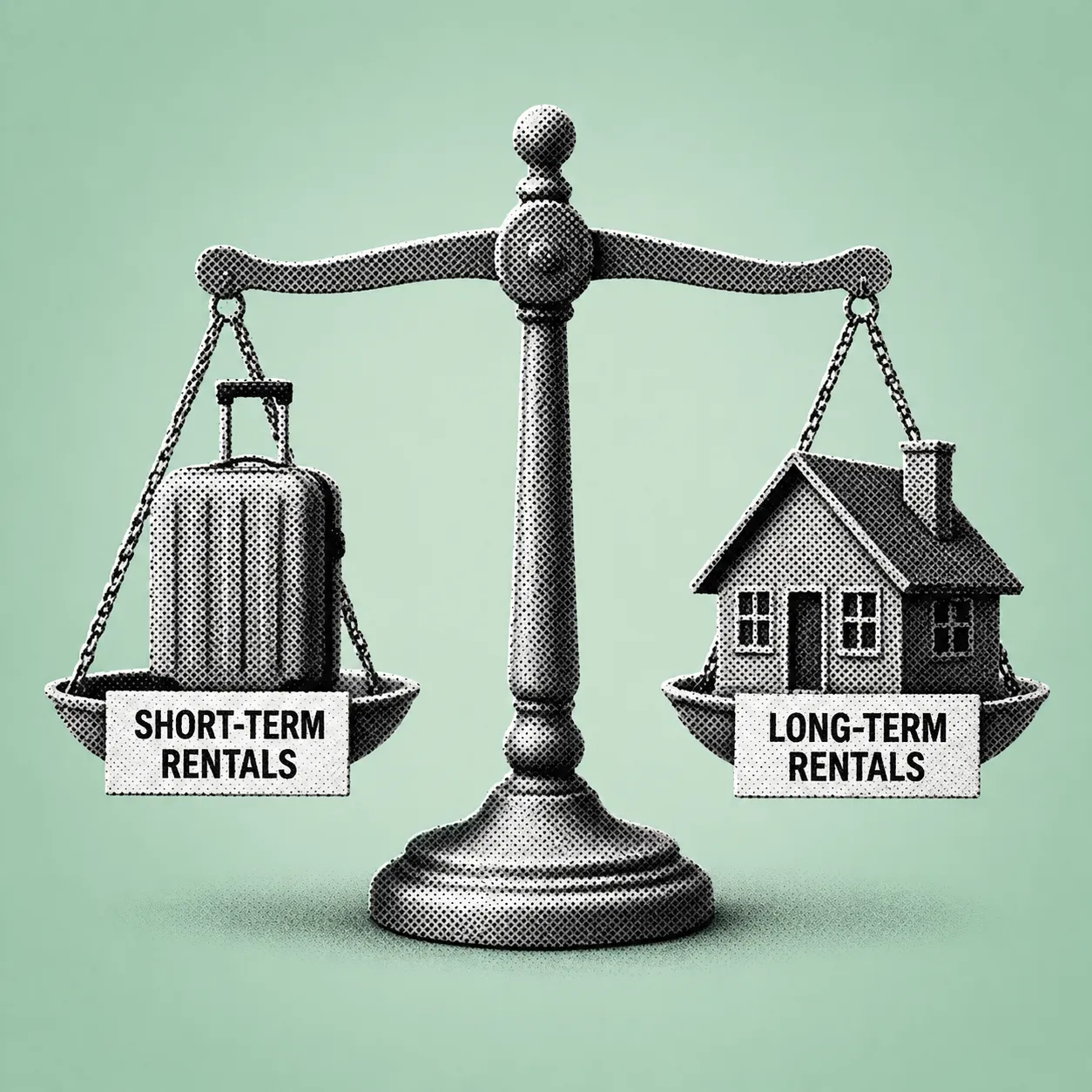

Rental property ownership offers more revenue paths and more ways to misjudge risk than ever before. On one side sits the short-term rental model: Airbnb-style stays, dynamic pricing, and hospitality operations. On the other sits the long-term rental model: traditional 12-month leases, predictable cash flow, and landlord-tenant compliance. The question many landlords now ask is more nuanced than which earns more. It is whether to run short-term versus long-term rentals, or whether to build a hybrid strategy that adapts to seasonality and market cycles.
The decision is not just about which option generates more money. In 2024, U.S. short-term rentals generated $67.3 billion in revenue with an average daily rate around $310 and occupancy at 54.3%, a large market with real demand but also real competition and volatility. Meanwhile, the traditional rental market is being reshaped by shifting vacancies, with the national rental vacancy rate reaching 7.2% in Q4 2025, ranging from 5.2% in the Northeast to 9.1% in the South, and ongoing rent growth pressures.
The best strategy depends on your property, your tolerance for operational complexity, local regulations, and how you want to be taxed, especially since short-term rental income can behave more like business income while long-term rental income is typically passive. Before you optimize revenue, decide what you are optimizing for: stability, time, risk, or maximum net income.
Short-term rentals trade operational intensity for revenue upside. Long-term rentals trade some upside for predictability. The deciding factor is usually net operating income and cash flow stability after accounting for platform fees, utilities, cleaning, turnover, maintenance, insurance, and compliance overhead rather than gross revenue.
Short-term rental market reality: Performance has normalized after the post-2020 boom. AirDNA's U.S. overview describes a new equilibrium where 2024 saw supply growth of 6.4% and demand growth of 10.7% alongside slightly lower occupancy at 54.3% but improved revenue per available room thanks to rate gains. The market is still large, but hosts compete harder and must operate smarter. Pricing, reviews, amenity packages, and response times all matter more than they did in 2021.
Long-term rental market reality: Long-term rentals respond more slowly and are shaped by vacancy, wage growth, and new supply. In markets like Austin, rents fell from highs as inventory increased, with two-bedroom rents around $1,713 in one snapshot with noted declines before projected recovery. Nationally, vacancy differences matter because they change lease-up risk and the need for concessions.
Hybrid rental strategy: A hybrid model sits between the two. You run short-term rentals during peak seasons or around local events and convert to medium-term stays of 30 or more days or annual leases in slow months. Hybrid approaches are especially relevant in tourism-heavy markets where short-term demand spikes seasonally and in cities with tighter short-term rental rules where longer stays may reduce regulatory friction.
How owners choose based on market type:
In a tourism metro like Orlando, AirDNA projects an average daily rate near $245 with strong demand patterns, often supportive of short-term rentals if regulations and HOA rules allow it. In a supply-heavy long-term market like Austin, falling rents can pressure long-term rental pricing, and short-term rental can look attractive on gross revenue but must beat higher operating costs and competition to win on net operating income. In a high-vacancy region like the South at 9.1% vacancy, long-term lease-up risk increases and short-term rentals might diversify demand, but only if the property can attract travelers and you can manage seasonality.
Build two models: short-term rental as a hospitality business and long-term rental as a housing service. Then compare net operating income, risk profile, and time requirements before committing to either.
A clean comparison starts with the same output: net operating income calculated as income minus operating expenses before debt service. Short-term rentals often look better at the top line, but expenses can scale faster because every stay creates work and cost.
Use market baselines to sanity-check your short-term rental revenue assumptions. AirDNA reports 2024 occupancy of 54.3% and an average daily rate of $310 as national benchmarks, with market-specific results varying widely. If you model 75% occupancy at premium rates in a saturated market, your forecast is likely optimistic unless your property is unusually differentiated.
Example calculations: Short-term rental gross at an average daily rate of $250 times 54% occupancy times 365 days equals approximately $49,275 in gross revenue. Long-term rental gross at $2,000 per month times 12 months equals $24,000 in gross revenue. Then subtract the full expense stack. Short-term rentals may include cleaning, supplies, utilities, platform fees, higher wear-and-tear, and more administrative time. Long-term rentals commonly include repairs, leasing, and management costs that are more predictable.
Model base, conservative, and downside scenarios including occupancy minus ten percentage points and average daily rate minus five percent, because short-term rental revenue fluctuates with demand and supply. Track expense ratios as percentages of revenue. Your short-term rental profit margin is often the real differentiator between a good investment and a break-even operation.
Expense realism is where many first-time short-term rental operators lose money. Short-term rental variable costs include cleaning, utilities, and platform fees, while fixed costs include furnishings and elevated maintenance due to higher turnover. Long-term rental expenses tend to cluster around ongoing maintenance, leasing and turnover, and property management.
Long-term rental expense benchmarks: A common planning range is 12% to 15% of rent for maintenance and 8% to 12% for property management, with taxes, insurance, and other costs on top. Even if your actual numbers differ, these ranges help you avoid underestimating what stable rentals cost to run.
Mini-examples: If cleaning costs $140 per turnover and your average stay is three nights, that is effectively approximately $47 per night in cleaning cost alone. Increasing average stay length often improves short-term rental margins significantly. Paying 10% management on a $2,000 rent is $200 per month, but it may reduce vacancy days and improve compliance documentation. Short-term rental furniture replacement every three to five years can be a meaningful annualized cost, while long-term rentals often have lower furnishing needs but may face larger capital expenditures at turnover.
For short-term rentals, design for durability using commercial-grade linens and stain-resistant finishes to control replacement cycles. For long-term rentals, budget vacancy and turnover explicitly covering lease-up costs, make-ready, and marketing even if you self-manage.
Regulatory risk is asymmetric. In many municipalities, your short-term rental can be legal today and restricted tomorrow. Municipal rules vary significantly, making it essential to map your property to three regulatory layers before spending money on furnishing or setup.
The three layers to verify: City and county short-term rental ordinances covering permits, caps, primary residence rules, night limits, and lodging taxes. Zoning and land-use rules confirming whether short-term rentals are allowed in the district. Private restrictions including HOA rules, condo bylaws, and lease terms if you are subletting.
Examples of regulatory friction: Permit caps and waitlists can make a profitable short-term rental impossible to legally operate if permits are capped and transfer rules are strict. Primary residence requirements can force investors relying on non-owner-occupied short-term rentals to convert to long-term or mid-term rentals. Noise and parking enforcement can trigger fines or permit revocation, raising operational demands significantly.
Before spending on furnishing, confirm the path to compliance covering registration, inspections, local lodging taxes, and insurance requirements. Build a conversion-ready plan and know what rent you would need to break even if you must switch to a long-term rental quickly.
Short-term rentals are hospitality. Long-term rentals are housing. The skill sets overlap but they are not identical.
Growing competition in the short-term rental market means smarter pricing and improved guest experiences are increasingly required, both of which add management overhead. In practice, short-term rental operators handle dynamic pricing, guest messaging, cleaner coordination, restocking, same-day issue resolution, and reputation management through reviews. Long-term rental owners focus more on tenant screening, leases, maintenance scheduling, renewals, and compliance documentation.
Realistic operator outcomes: A short-term rental success story involves an owner in a tourism corridor who improves profitability by switching to data-driven pricing, tightening minimum-stay rules in high season, and reducing vacancy gaps with weekday discounts, stabilizing occupancy despite rising listings. A short-term rental failure story involves a host who underestimates operations: inconsistent cleaning leads to poorer reviews, which reduces bookings, and occupancy falls below the national 54.3% benchmark so the unit cannot cover fixed costs. A long-term rental success story involves a small landlord who prioritizes tenant quality and a renewal strategy, with fewer turnovers reducing make-ready costs and vacancy loss even when rent is slightly below the top of market.
If you want short-term rental returns without short-term rental labor, price in professional management or simplify with longer minimum stays. For long-term rentals, invest in screening and renewals. One bad placement can wipe out a year of stable cash flow.
Your rental strategy should match the demand engine of your location rather than a national average.
Short-term rental market forces: In 2024, demand and supply rose at nearly the same pace with competition remaining intense even as the market grows. Earlier in 2023, revenue per available room fell 14.1% due to declining average daily rate and occupancy, an important reminder that short-term rentals can swing materially year to year.
Long-term rental market forces: Vacancy is your key macro signal. The U.S. rental vacancy rate reached 7.2% in Q4 2025 with the South at 9.1% and the Northeast at 5.2%, a spread that materially changes leasing risk and rent growth power. Research from NMHC links vacancy to rent growth dynamics, reinforcing that supply shifts can quickly change landlord leverage in any given market.
Market-specific examples: In Orlando, short-term rental can thrive with tourism-driven demand and projected average daily rates around $245, but owners must plan for shoulder seasons and rising competition. In Austin, as rents retreat from highs amid increased supply, long-term rental owners may need concessions or unit upgrades to maintain occupancy. In suburban markets with strong livability signals like Overland Park, Kansas, renter demand can concentrate even when other markets soften.
Use short-term rental data covering average daily rate, occupancy, and revenue per available room alongside long-term rental data covering vacancy and rent trends before choosing a model. If your market is volatile, consider a hybrid plan that adjusts with seasons and local events.
Taxes can flip the winner between models, especially since short-term rental income may be treated differently from long-term rental income depending on your situation.
Long-term rental basics: Long-term rentals are typically reported on Schedule E as passive rental income, allowing deductions for mortgage interest, property taxes, insurance, repairs, and depreciation. Confirm specifics with a tax professional for your situation.
Short-term rental tax considerations: Short-term rentals often involve more services such as cleaning, linens, and guest support. Depending on facts and circumstances including average stay length, services provided, and participation level, income may be treated more like active business income and could trigger additional tax considerations. Expense categories can also expand to include supplies, software, and cleaning labor.
Examples of tax-driven strategy choices: A high-income W-2 landlord may prefer long-term rentals to keep operations passive and simple, with depreciation and stable income fitting a long-term wealth plan. An operator with time and systems may lean toward short-term rentals, tracking expenses meticulously and treating the property like a small hospitality business. A hybrid owner using mid-term stays of 30 or more days can potentially reduce turnover costs and simplify certain local tax and compliance burdens, though rules vary by jurisdiction.
Decide early how you will keep books. Short-term rentals need category-level tracking of cleaning, supplies, and platform fees to defend deductions. Get professional tax guidance before switching models since the best strategy is often the one with the best after-tax outcome for your household, not the highest gross revenue.
A hybrid model can be a smart middle path when you have seasonality, regulatory uncertainty, or personal time constraints.
Common hybrid patterns: Short-term rental in peak months combined with mid-term stays in the off-season reduces vacancy gaps and cleaning frequency while capturing high-season average daily rates. Event-based short-term rental keeps a unit on long-term leases most of the year and adjusts to short-term or mid-term only when legally and contractually feasible, which requires careful lease structure. A dual-unit strategy operates one unit as a short-term rental and one as a long-term rental to balance risk and workload across the portfolio.
Mini-examples: A beach-market owner runs short-term rentals during summer and targets traveling nurses or corporate stays during winter through mid-term arrangements, stabilizing occupancy year-round. An urban owner shifts to longer minimum stays as competition rises, trading some average daily rate for fewer turnovers and steadier reviews. A landlord in a tightening regulatory environment keeps the unit long-term-rental-ready with durable neutral furnishings and a leasing plan ready if permit rules change.
Hybrid works best when your property can appeal to multiple tenant segments without constant reconfiguration. Write your operating plan like a switch and define the trigger metrics covering occupancy threshold, regulatory change, or vacancy rate movement that cause you to pivot between models.
Strategy fit scoring: Score each factor from one to five with five being strongly favorable, then total each column.
Local rules clearly allow the model covering permits, zoning, and HOA. Demand profile supports the model covering tourism versus resident renters. Revenue outlook using realistic benchmarks covering average daily rate and occupancy for short-term rentals or rent and vacancy for long-term rentals. Expense control covering cleaning and utilities for short-term rentals versus maintenance and management for long-term rentals. Your time availability or budget for professional management. Risk tolerance for year-to-year swings. Financing and insurance compatibility. Tax complexity you are willing to handle.
True NOI template to fill in monthly averages:
Income: short-term rental is average daily rate times occupancy times days. Long-term rental is monthly rent.
Operating expenses: property taxes, insurance, maintenance and repairs benchmarked at 12% to 15% of rent for long-term rental planning, management benchmarked at 8% to 12% for long-term rental planning. Short-term rental only: cleaning, utilities, platform fees, and supplies.
Net operating income equals income minus operating expenses.
Downside test: occupancy minus ten percentage points for short-term rental or vacancy plus one month per year for long-term rental, and record the resulting net operating income.
Is an Airbnb-style short-term rental always more profitable than a long-term lease?
No. Short-term rentals can produce higher gross revenue, but they often carry higher variable expenses and more volatility. National short-term rental benchmarks show 54.3% occupancy in 2024 and rates that vary widely by market, so even a modest occupancy drop can materially change net operating income. The comparison must be made at the net operating income level, not gross revenue.
What occupancy rate should I assume for a short-term rental?
Start conservative and ground your model in local market data. AirDNA's national snapshot is 54.3% occupancy for 2024, but your neighborhood, property type, and seasonality can push you above or below that figure. Build a base case and a downside case before committing to any furnishing investment.
How do vacancy rates affect long-term rental strategy?
Vacancy determines pricing power and lease-up risk. The U.S. rental vacancy rate was 7.2% in Q4 2025, but regions vary significantly with the South at 9.1% and the Northeast at 5.2%. Higher vacancy in your region can change how aggressively you underwrite rent and how many concessions you need to budget.
When does a hybrid rental strategy make the most sense?
Hybrid is most effective when demand is seasonal, regulations are uncertain, or you want to balance workload and income stability. It works best when the unit can succeed with both traveler and resident segments without major reconfiguration between uses. Define your pivot triggers in advance rather than reacting under pressure.
Pick one property and run the decision tool above this week. Pull short-term rental benchmarks for your city covering average daily rate, occupancy, and revenue per available room alongside local long-term rental rent and vacancy signals, then build two true net operating income models covering a base case and a downside case. If short-term rental only wins in the optimistic scenario, consider a hybrid strategy or default to a strong long-term lease with renewal-focused management. When the numbers and your lifestyle both agree, you have found the right model.
Book a demo to see how Shuk's leasing, maintenance, and financial tracking tools support both long-term and hybrid rental strategies so you can manage your portfolio with the same rigor regardless of which model you choose.
Rental property ownership offers more revenue paths and more ways to misjudge risk than ever before. On one side sits the short-term rental model: Airbnb-style stays, dynamic pricing, and hospitality operations. On the other sits the long-term rental model: traditional 12-month leases, predictable cash flow, and landlord-tenant compliance. The question many landlords now ask is more nuanced than which earns more. It is whether to run short-term versus long-term rentals, or whether to build a hybrid strategy that adapts to seasonality and market cycles.
The decision is not just about which option generates more money. In 2024, U.S. short-term rentals generated $67.3 billion in revenue with an average daily rate around $310 and occupancy at 54.3%, a large market with real demand but also real competition and volatility. Meanwhile, the traditional rental market is being reshaped by shifting vacancies, with the national rental vacancy rate reaching 7.2% in Q4 2025, ranging from 5.2% in the Northeast to 9.1% in the South, and ongoing rent growth pressures.
The best strategy depends on your property, your tolerance for operational complexity, local regulations, and how you want to be taxed, especially since short-term rental income can behave more like business income while long-term rental income is typically passive. Before you optimize revenue, decide what you are optimizing for: stability, time, risk, or maximum net income.
Short-term rentals trade operational intensity for revenue upside. Long-term rentals trade some upside for predictability. The deciding factor is usually net operating income and cash flow stability after accounting for platform fees, utilities, cleaning, turnover, maintenance, insurance, and compliance overhead rather than gross revenue.
Short-term rental market reality: Performance has normalized after the post-2020 boom. AirDNA's U.S. overview describes a new equilibrium where 2024 saw supply growth of 6.4% and demand growth of 10.7% alongside slightly lower occupancy at 54.3% but improved revenue per available room thanks to rate gains. The market is still large, but hosts compete harder and must operate smarter. Pricing, reviews, amenity packages, and response times all matter more than they did in 2021.
Long-term rental market reality: Long-term rentals respond more slowly and are shaped by vacancy, wage growth, and new supply. In markets like Austin, rents fell from highs as inventory increased, with two-bedroom rents around $1,713 in one snapshot with noted declines before projected recovery. Nationally, vacancy differences matter because they change lease-up risk and the need for concessions.
Hybrid rental strategy: A hybrid model sits between the two. You run short-term rentals during peak seasons or around local events and convert to medium-term stays of 30 or more days or annual leases in slow months. Hybrid approaches are especially relevant in tourism-heavy markets where short-term demand spikes seasonally and in cities with tighter short-term rental rules where longer stays may reduce regulatory friction.
How owners choose based on market type:
In a tourism metro like Orlando, AirDNA projects an average daily rate near $245 with strong demand patterns, often supportive of short-term rentals if regulations and HOA rules allow it. In a supply-heavy long-term market like Austin, falling rents can pressure long-term rental pricing, and short-term rental can look attractive on gross revenue but must beat higher operating costs and competition to win on net operating income. In a high-vacancy region like the South at 9.1% vacancy, long-term lease-up risk increases and short-term rentals might diversify demand, but only if the property can attract travelers and you can manage seasonality.
Build two models: short-term rental as a hospitality business and long-term rental as a housing service. Then compare net operating income, risk profile, and time requirements before committing to either.
A clean comparison starts with the same output: net operating income calculated as income minus operating expenses before debt service. Short-term rentals often look better at the top line, but expenses can scale faster because every stay creates work and cost.
Use market baselines to sanity-check your short-term rental revenue assumptions. AirDNA reports 2024 occupancy of 54.3% and an average daily rate of $310 as national benchmarks, with market-specific results varying widely. If you model 75% occupancy at premium rates in a saturated market, your forecast is likely optimistic unless your property is unusually differentiated.
Example calculations: Short-term rental gross at an average daily rate of $250 times 54% occupancy times 365 days equals approximately $49,275 in gross revenue. Long-term rental gross at $2,000 per month times 12 months equals $24,000 in gross revenue. Then subtract the full expense stack. Short-term rentals may include cleaning, supplies, utilities, platform fees, higher wear-and-tear, and more administrative time. Long-term rentals commonly include repairs, leasing, and management costs that are more predictable.
Model base, conservative, and downside scenarios including occupancy minus ten percentage points and average daily rate minus five percent, because short-term rental revenue fluctuates with demand and supply. Track expense ratios as percentages of revenue. Your short-term rental profit margin is often the real differentiator between a good investment and a break-even operation.
Expense realism is where many first-time short-term rental operators lose money. Short-term rental variable costs include cleaning, utilities, and platform fees, while fixed costs include furnishings and elevated maintenance due to higher turnover. Long-term rental expenses tend to cluster around ongoing maintenance, leasing and turnover, and property management.
Long-term rental expense benchmarks: A common planning range is 12% to 15% of rent for maintenance and 8% to 12% for property management, with taxes, insurance, and other costs on top. Even if your actual numbers differ, these ranges help you avoid underestimating what stable rentals cost to run.
Mini-examples: If cleaning costs $140 per turnover and your average stay is three nights, that is effectively approximately $47 per night in cleaning cost alone. Increasing average stay length often improves short-term rental margins significantly. Paying 10% management on a $2,000 rent is $200 per month, but it may reduce vacancy days and improve compliance documentation. Short-term rental furniture replacement every three to five years can be a meaningful annualized cost, while long-term rentals often have lower furnishing needs but may face larger capital expenditures at turnover.
For short-term rentals, design for durability using commercial-grade linens and stain-resistant finishes to control replacement cycles. For long-term rentals, budget vacancy and turnover explicitly covering lease-up costs, make-ready, and marketing even if you self-manage.
Regulatory risk is asymmetric. In many municipalities, your short-term rental can be legal today and restricted tomorrow. Municipal rules vary significantly, making it essential to map your property to three regulatory layers before spending money on furnishing or setup.
The three layers to verify: City and county short-term rental ordinances covering permits, caps, primary residence rules, night limits, and lodging taxes. Zoning and land-use rules confirming whether short-term rentals are allowed in the district. Private restrictions including HOA rules, condo bylaws, and lease terms if you are subletting.
Examples of regulatory friction: Permit caps and waitlists can make a profitable short-term rental impossible to legally operate if permits are capped and transfer rules are strict. Primary residence requirements can force investors relying on non-owner-occupied short-term rentals to convert to long-term or mid-term rentals. Noise and parking enforcement can trigger fines or permit revocation, raising operational demands significantly.
Before spending on furnishing, confirm the path to compliance covering registration, inspections, local lodging taxes, and insurance requirements. Build a conversion-ready plan and know what rent you would need to break even if you must switch to a long-term rental quickly.
Short-term rentals are hospitality. Long-term rentals are housing. The skill sets overlap but they are not identical.
Growing competition in the short-term rental market means smarter pricing and improved guest experiences are increasingly required, both of which add management overhead. In practice, short-term rental operators handle dynamic pricing, guest messaging, cleaner coordination, restocking, same-day issue resolution, and reputation management through reviews. Long-term rental owners focus more on tenant screening, leases, maintenance scheduling, renewals, and compliance documentation.
Realistic operator outcomes: A short-term rental success story involves an owner in a tourism corridor who improves profitability by switching to data-driven pricing, tightening minimum-stay rules in high season, and reducing vacancy gaps with weekday discounts, stabilizing occupancy despite rising listings. A short-term rental failure story involves a host who underestimates operations: inconsistent cleaning leads to poorer reviews, which reduces bookings, and occupancy falls below the national 54.3% benchmark so the unit cannot cover fixed costs. A long-term rental success story involves a small landlord who prioritizes tenant quality and a renewal strategy, with fewer turnovers reducing make-ready costs and vacancy loss even when rent is slightly below the top of market.
If you want short-term rental returns without short-term rental labor, price in professional management or simplify with longer minimum stays. For long-term rentals, invest in screening and renewals. One bad placement can wipe out a year of stable cash flow.
Your rental strategy should match the demand engine of your location rather than a national average.
Short-term rental market forces: In 2024, demand and supply rose at nearly the same pace with competition remaining intense even as the market grows. Earlier in 2023, revenue per available room fell 14.1% due to declining average daily rate and occupancy, an important reminder that short-term rentals can swing materially year to year.
Long-term rental market forces: Vacancy is your key macro signal. The U.S. rental vacancy rate reached 7.2% in Q4 2025 with the South at 9.1% and the Northeast at 5.2%, a spread that materially changes leasing risk and rent growth power. Research from NMHC links vacancy to rent growth dynamics, reinforcing that supply shifts can quickly change landlord leverage in any given market.
Market-specific examples: In Orlando, short-term rental can thrive with tourism-driven demand and projected average daily rates around $245, but owners must plan for shoulder seasons and rising competition. In Austin, as rents retreat from highs amid increased supply, long-term rental owners may need concessions or unit upgrades to maintain occupancy. In suburban markets with strong livability signals like Overland Park, Kansas, renter demand can concentrate even when other markets soften.
Use short-term rental data covering average daily rate, occupancy, and revenue per available room alongside long-term rental data covering vacancy and rent trends before choosing a model. If your market is volatile, consider a hybrid plan that adjusts with seasons and local events.
Taxes can flip the winner between models, especially since short-term rental income may be treated differently from long-term rental income depending on your situation.
Long-term rental basics: Long-term rentals are typically reported on Schedule E as passive rental income, allowing deductions for mortgage interest, property taxes, insurance, repairs, and depreciation. Confirm specifics with a tax professional for your situation.
Short-term rental tax considerations: Short-term rentals often involve more services such as cleaning, linens, and guest support. Depending on facts and circumstances including average stay length, services provided, and participation level, income may be treated more like active business income and could trigger additional tax considerations. Expense categories can also expand to include supplies, software, and cleaning labor.
Examples of tax-driven strategy choices: A high-income W-2 landlord may prefer long-term rentals to keep operations passive and simple, with depreciation and stable income fitting a long-term wealth plan. An operator with time and systems may lean toward short-term rentals, tracking expenses meticulously and treating the property like a small hospitality business. A hybrid owner using mid-term stays of 30 or more days can potentially reduce turnover costs and simplify certain local tax and compliance burdens, though rules vary by jurisdiction.
Decide early how you will keep books. Short-term rentals need category-level tracking of cleaning, supplies, and platform fees to defend deductions. Get professional tax guidance before switching models since the best strategy is often the one with the best after-tax outcome for your household, not the highest gross revenue.
A hybrid model can be a smart middle path when you have seasonality, regulatory uncertainty, or personal time constraints.
Common hybrid patterns: Short-term rental in peak months combined with mid-term stays in the off-season reduces vacancy gaps and cleaning frequency while capturing high-season average daily rates. Event-based short-term rental keeps a unit on long-term leases most of the year and adjusts to short-term or mid-term only when legally and contractually feasible, which requires careful lease structure. A dual-unit strategy operates one unit as a short-term rental and one as a long-term rental to balance risk and workload across the portfolio.
Mini-examples: A beach-market owner runs short-term rentals during summer and targets traveling nurses or corporate stays during winter through mid-term arrangements, stabilizing occupancy year-round. An urban owner shifts to longer minimum stays as competition rises, trading some average daily rate for fewer turnovers and steadier reviews. A landlord in a tightening regulatory environment keeps the unit long-term-rental-ready with durable neutral furnishings and a leasing plan ready if permit rules change.
Hybrid works best when your property can appeal to multiple tenant segments without constant reconfiguration. Write your operating plan like a switch and define the trigger metrics covering occupancy threshold, regulatory change, or vacancy rate movement that cause you to pivot between models.
Strategy fit scoring: Score each factor from one to five with five being strongly favorable, then total each column.
Local rules clearly allow the model covering permits, zoning, and HOA. Demand profile supports the model covering tourism versus resident renters. Revenue outlook using realistic benchmarks covering average daily rate and occupancy for short-term rentals or rent and vacancy for long-term rentals. Expense control covering cleaning and utilities for short-term rentals versus maintenance and management for long-term rentals. Your time availability or budget for professional management. Risk tolerance for year-to-year swings. Financing and insurance compatibility. Tax complexity you are willing to handle.
True NOI template to fill in monthly averages:
Income: short-term rental is average daily rate times occupancy times days. Long-term rental is monthly rent.
Operating expenses: property taxes, insurance, maintenance and repairs benchmarked at 12% to 15% of rent for long-term rental planning, management benchmarked at 8% to 12% for long-term rental planning. Short-term rental only: cleaning, utilities, platform fees, and supplies.
Net operating income equals income minus operating expenses.
Downside test: occupancy minus ten percentage points for short-term rental or vacancy plus one month per year for long-term rental, and record the resulting net operating income.
Is an Airbnb-style short-term rental always more profitable than a long-term lease?
No. Short-term rentals can produce higher gross revenue, but they often carry higher variable expenses and more volatility. National short-term rental benchmarks show 54.3% occupancy in 2024 and rates that vary widely by market, so even a modest occupancy drop can materially change net operating income. The comparison must be made at the net operating income level, not gross revenue.
What occupancy rate should I assume for a short-term rental?
Start conservative and ground your model in local market data. AirDNA's national snapshot is 54.3% occupancy for 2024, but your neighborhood, property type, and seasonality can push you above or below that figure. Build a base case and a downside case before committing to any furnishing investment.
How do vacancy rates affect long-term rental strategy?
Vacancy determines pricing power and lease-up risk. The U.S. rental vacancy rate was 7.2% in Q4 2025, but regions vary significantly with the South at 9.1% and the Northeast at 5.2%. Higher vacancy in your region can change how aggressively you underwrite rent and how many concessions you need to budget.
When does a hybrid rental strategy make the most sense?
Hybrid is most effective when demand is seasonal, regulations are uncertain, or you want to balance workload and income stability. It works best when the unit can succeed with both traveler and resident segments without major reconfiguration between uses. Define your pivot triggers in advance rather than reacting under pressure.
Pick one property and run the decision tool above this week. Pull short-term rental benchmarks for your city covering average daily rate, occupancy, and revenue per available room alongside local long-term rental rent and vacancy signals, then build two true net operating income models covering a base case and a downside case. If short-term rental only wins in the optimistic scenario, consider a hybrid strategy or default to a strong long-term lease with renewal-focused management. When the numbers and your lifestyle both agree, you have found the right model.
Book a demo to see how Shuk's leasing, maintenance, and financial tracking tools support both long-term and hybrid rental strategies so you can manage your portfolio with the same rigor regardless of which model you choose.

{
"@context": "https://schema.org",
"@type": "FAQPage",
"mainEntity": [
{
"@type": "Question",
"name": "Is an Airbnb-style short-term rental always more profitable than a long-term lease?",
"acceptedAnswer": {
"@type": "Answer",
"text": "No. Short-term rentals can produce higher gross revenue, but they often carry higher variable expenses and more volatility. National benchmarks show 54.3% occupancy in 2024 and rates that vary widely by market, so even a modest occupancy drop can materially change net operating income. The comparison must be made at the net operating income level, not gross revenue."
}
},
{
"@type": "Question",
"name": "What occupancy rate should I assume for a short-term rental?",
"acceptedAnswer": {
"@type": "Answer",
"text": "Start conservative and ground your model in local market data. The national snapshot is 54.3% occupancy for 2024, but your neighborhood, property type, and seasonality can push you above or below that figure. Build a base case and a downside case before committing to any furnishing investment."
}
},
{
"@type": "Question",
"name": "How do vacancy rates affect long-term rental strategy?",
"acceptedAnswer": {
"@type": "Answer",
"text": "Vacancy determines pricing power and lease-up risk. The U.S. rental vacancy rate was 7.2% in Q4 2025, but regions vary with the South at 9.1% and the Northeast at 5.2%. Higher vacancy in your region changes how aggressively you underwrite rent and how many concessions you need to budget."
}
},
{
"@type": "Question",
"name": "When does a hybrid rental strategy make the most sense?",
"acceptedAnswer": {
"@type": "Answer",
"text": "Hybrid is most effective when demand is seasonal, regulations are uncertain, or you want to balance workload and income stability. It works best when the unit can succeed with both traveler and resident segments without major reconfiguration. Define your pivot triggers in advance rather than reacting under pressure."
}
}
]
}
Shuk helps landlords and property managers get ahead of vacancies, improve renewal visibility, and bring more predictability to every lease cycle.
Book a demo to get started with a free trial.

Recovering funds from a mismanaged rental property is a legal process that moves through five stages: securing evidence, sending a formal demand, filing regulatory complaints, pursuing court action, and applying to state recovery programs if the manager held a real estate license. For independent landlords, the path from discovery to recovery is rarely fast, but it is structured. The landlords who recover the most are the ones who act quickly to stop additional losses, reconstruct the money trail with documented evidence, and escalate through the correct channels in the right sequence.
Mismanaged rental funds typically fall into a few patterns: rent collected but never remitted to the owner, security deposits not held in a proper trust account, maintenance charges that are inflated or fictitious, and late fees or utility reimbursements that disappear from statements without explanation.
The nature of the failure matters because it shapes your recovery strategy. Sloppy bookkeeping, where a manager fails to reconcile trust accounts monthly, is a compliance violation that regulators treat seriously. Commingling, where client funds are mixed with the manager's operating money, is treated as a trust violation in most states and can trigger license revocation. Outright conversion, where the manager takes funds that belong to you or your tenants, is civil theft and in some circumstances criminal conduct.
Many states maintain recovery funds specifically for losses caused by licensed real estate professionals. California's Consumer Recovery Account provides up to $50,000 per transaction and $250,000 per licensee. Texas's Real Estate Recovery Trust Account raised its per-transaction cap to $125,000 with a $250,000 per-licensee maximum as of January 1, 2024. Florida's Real Estate Recovery Fund provides up to $50,000 per transaction and $150,000 per licensee, and paid out $3.2 million in a recent fiscal year. These programs typically require a court judgment and documented collection attempts before paying a claim, which means the civil litigation step is not optional even when a recovery fund is available.
The first 48 hours after discovering a problem determine how much additional damage occurs and how much evidence survives. Act on both simultaneously.
To stop further losses, revoke the manager's access to your owner portal, bank ACH authorizations, vendor payment approvals, and any property management software accounts. If the manager controls the trust account where tenant security deposits are held, notify tenants in writing of new payment instructions, consistent with your lease terms and applicable state notice requirements. Consider consulting local counsel on the correct wording before sending tenant notices.
To secure evidence, export and back up everything you can access: the management agreement, owner statements, ledgers, rent rolls, deposit logs, vendor invoices, work orders, emails, text messages, inspection photos, and any tenant communications about rent payments or deposits. Store everything in a read-only folder organized by document type. State regulators consistently emphasize documentation when evaluating complaints, and your ability to produce a clean, organized evidence file affects both the speed and outcome of everything that follows.
In writing, formally request a full accounting from the manager. The request should ask for the general ledger, trust or escrow bank statements, cancelled checks, deposit slips, and a monthly reconciliation report. A refusal to provide this documentation is itself evidence of a compliance problem and can support a regulatory complaint and later subpoena requests in litigation.
Your recovery claim needs a clear, defensible number: how much is missing, from which property, during which dates, and under what authority. Build a spreadsheet with four columns for each month in the period under review: rent due per lease, rent collected per tenant receipts or payment records, deposits held per move-in documentation, and distributions and expenses per bank statements.
Pay particular attention to security deposits. In most states, deposits are treated as trust funds that must be tracked separately from operating funds. If your manager cannot show a separate trust account or cannot provide a monthly reconciliation, that is a pattern regulators across California, Texas, and Florida have identified as among the most common trust-accounting violations.
When the amounts are significant or the transactions are complex, consider hiring a CPA or forensic bookkeeper for a fixed-scope engagement to reconstruct trust account activity and owner distributions for the relevant period. A professional accounting report is more persuasive in settlement discussions and court proceedings than a spreadsheet prepared by the property owner.
The reconciliation process should match lease rent to the rent roll, match the rent roll to bank deposits, match the deposit log to trust account statements, flag every transfer that lacks a corresponding invoice or written authorization, and calculate a conservative minimum missing figure. Courts respond well to careful math with documented assumptions.
A demand letter is a legal record that you asserted your rights clearly, gave the manager a defined opportunity to cure, and warned of the consequences of non-response. It should be factual, attach a short exhibit list, and be sent by a trackable delivery method with proof retained.
The letter should state the exact amount demanded or a reasonable range if the audit is still in progress, include a firm deadline of 10 to 14 days for payment, identify where payment should be sent, demand all outstanding records including trust statements, reconciliations, and invoices, and notify the manager that you will file complaints with state regulators and pursue court action including recovery fund claims if applicable.
If the manager holds a real estate license, the demand letter should reference the risk of regulatory action specifically. State real estate commissions can investigate, discipline, and revoke licenses for trust-fund mishandling, and managers who depend on their license for income often respond to a demand that makes that risk explicit.
Send the letter by certified mail and email, retain delivery confirmation for both, and keep a complete copy of the letter and all attachments.
Regulators cannot typically write you a check directly, but they can create significant pressure, uncover additional evidence through their investigative authority, and impose consequences that motivate settlement. Filing a regulatory complaint is not a substitute for civil litigation, but it is a parallel track that often accelerates resolution.
The primary complaint target for a licensed property manager is the state real estate commission. California's Department of Real Estate processes thousands of complaints annually and has issued significant fines and license actions tied to trust account violations. Texas's Real Estate Commission and Florida's Department of Business and Professional Regulation both have formal complaint pathways for consumers who experience losses from licensed real estate professionals.
Additional complaint targets depending on the facts include the state attorney general's consumer protection division when deception or unfair trade practices are involved, and local licensing authorities if the manager operated without required credentials.
Before filing, organize your exhibits into a coherent timeline. Focus allegations on verifiable facts with specific dates, amounts, and account references. Keep a copy of every document submitted and note any confirmation or case number assigned to the complaint.
If the manager held a state real estate license, state recovery funds provide a mechanism for reimbursement after you obtain a civil judgment and demonstrate that you attempted to collect from the manager's assets. California requires a final judgment and documented collection efforts before a claim against its Consumer Recovery Account is processed. Texas and Florida have similar procedural requirements.
Separately, review your management agreement for requirements that the manager carry a surety bond or fidelity coverage. Some agreements require these and some brokerages carry errors-and-omissions insurance, though E&O policies often exclude intentional theft. Request bond and insurance policy details in writing as part of your evidence gathering, and be aware that insurers and sureties have strict notice deadlines for submitting claims.
If the manager was unlicensed, recovery fund options may not be available, but that fact strengthens your leverage for regulatory complaints about unlicensed activity and may open consumer protection complaint pathways.
For losses within the applicable jurisdictional limit, small-claims court provides the fastest path to a judgment without requiring an attorney. For larger losses or cases involving commingling and conversion, civil court is necessary and is also required before applying to most state recovery funds.
Your legal theories typically include breach of contract under the management agreement, conversion for wrongful control of funds, breach of fiduciary duty where applicable, and an accounting claim to compel production of all financial records. Attach your audit spreadsheet and a numbered exhibit list to whatever you file.
File in the county where the manager lives or does business to ensure you can actually enforce any judgment you receive. Bring to the hearing or trial: the management agreement, bank records, tenant payment receipts, your audit summary, and proof that you sent a formal demand before filing.
A judgment creates a legal right to payment but does not produce automatic collection. Post-judgment collection tools vary by state and commonly include bank levies, wage garnishment, judgment liens on real property, and post-judgment discovery requiring the debtor to disclose assets. If you are pursuing a state recovery fund, documenting your collection attempts is typically a procedural requirement before the fund will pay.
If you reach a settlement, put it in writing with a clear payment schedule, a provision for automatic judgment entry if payments are missed, mutual releases that do not waive claims you have not yet discovered, and a requirement for the manager to return all records.
Consult your tax professional about the deductibility of any unrecovered amounts. Treatment depends on your entity type and the characterization of the loss. Keeping a clean paper trail through the audit, litigation, and collection process supports both the tax analysis and any recovery fund application.
Day 0 to 2: Revoke manager access to banks and portals. Notify tenants of new payment instructions. Freeze nonessential vendor payments pending review.
Day 1 to 7: Gather management agreement, owner statements, ledgers, rent rolls, deposit registers, trust or escrow bank statements, cancelled checks, and tenant payment receipts. Write a one-page timeline of key events.
Day 3 to 10: Reconcile rent due against rent collected against bank deposits. Identify missing deposits and unauthorized transfers. Calculate a minimum missing amount with documented assumptions.
Day 7 to 14: Send formal demand letter with audit summary and exhibit list by trackable delivery method with proof retained.
Day 14 and forward: File regulatory complaint with the applicable state real estate commission. Evaluate surety bond, E&O insurance, and state recovery fund eligibility. File in small-claims or civil court. Plan collection steps immediately after judgment.
After recovering from a management failure, the most important operational change is rebuilding with systems that make the same failure impossible to repeat. Shuk's rent collection platform creates a documented payment record for every transaction, with ledger entries and payment confirmations that can be exported at any time. Maintenance request tracking with cost records and expense tracking organized by property and category gives owners real-time visibility into where money is going rather than discovering discrepancies months later in an owner statement.
Centralized tenant communication logs and lease document storage mean that the evidence required to support a legal claim, including lease terms, payment history, and repair records, is already organized and accessible rather than requiring emergency reconstruction at the moment it is needed most.
How long does recovering funds from a property manager typically take?
If records are organized and the manager is solvent, a strong demand letter can produce settlement within weeks. If recovery requires a regulatory investigation, a court judgment, and a state recovery fund application, the process commonly takes several months. State recovery funds such as California's Consumer Recovery Account and Texas's Real Estate Recovery Trust Account both require a final judgment and documented collection attempts before paying a claim, which extends the timeline regardless of how strong the underlying case is.
Do I need an attorney to recover funds from a property manager?
For smaller losses, many landlords handle demand letters, regulatory complaints, and small-claims filings without an attorney. For larger losses, suspected conversion, or cases involving complex trust-account activity across multiple properties, an attorney can help with subpoenas, injunctions, and recovery fund compliance procedures. Cases involving potential criminal conduct such as mail fraud should be reviewed with counsel before any filings are made.
Can I recover attorney fees and court costs from a property manager?
Sometimes. Fee recovery depends on whether your management agreement includes a fee-shifting clause and on state law for your specific claims. Courts often allow recovery of filing and service fees. Attorney fees are not automatic. State recovery funds are designed to reimburse actual losses from licensed professional misconduct up to program caps and do not typically cover attorney fees separately.
What if the property manager was not licensed?
An unlicensed manager cannot benefit from state real estate recovery funds, which are available only for losses caused by licensed professionals. However, operating as a property manager without a required license is a regulatory violation in most states, which opens unlicensed-activity complaint pathways. Civil claims for breach of contract, conversion, and fraud are still available regardless of licensing status, and the unlicensed status may strengthen your position in those proceedings.
Are unrecovered losses from a property manager tax deductible?
Losses from rental property mismanagement may be deductible as business-related losses, but the correct treatment depends on your entity type, the characterization of the loss, and how it is documented. Maintain a complete paper trail including your audit, the judgment, and all collection attempts, and work with a CPA who understands rental real estate to ensure the loss is reported correctly.

Most independent landlords do not lose money because they cannot analyze deals. They lose money because they analyze the wrong metrics at the wrong time.
A property that looks solid on closing day can turn into a cash drain after the first tenant cycle. Another deal that feels tight in month one might become a portfolio cornerstone once operations stabilize and rents reset. A third property might deliver mediocre early cash flow but build meaningful wealth over 30 years through amortization, inflation-adjusted rent growth, and a smart refinance strategy.
Here is the problem the 3-3-3 Rule solves: it forces you to underwrite an acquisition across three distinct time horizons, three months, three years, and three decades, so you do not confuse "survives onboarding" with "performs as a business" or "builds long-term wealth." The framework is a phased evaluation method designed to reduce time-horizon mistakes in acquisition decisions.
Common examples of this mistake: A great cash-on-cash return that ignored vacancies and capital expenditures, then collapsed after the first HVAC replacement. A rent projection that assumed perfect renewal behavior, but churn forced constant leasing and concessions. A long-term plan that assumed refinancing later without tracking debt service coverage ratio, which most lenders and investors prefer at approximately 1.25 or above for adequate cushion.
Treat the 3-3-3 Rule as a sequence, not a slogan. Pass the three-month stress test first, then earn the right to plan the three-year reposition, then decide whether the 30-year hold fits your life and portfolio.
The 3-3-3 Rule is a decision framework for buy-and-hold investing that evaluates a property through three lenses.
The first three months ask whether the property can stabilize operationally and validate assumptions. This is the horizon of operational truth: are repairs, leasing, rent collection, and tenant onboarding working the way you underwrote?
The first three years ask whether the property can prove durable economics through at least one to three tenant cycles. Do you have a repeatable leasing engine, a predictable expense profile, and a realistic rent strategy? This is a classic hold versus refinance versus sell decision point.
The next three decades ask whether the property builds wealth through amortization, appreciation, and inflation-linked rent growth, and whether it matches your long-term exit and lifestyle goals. Historical U.S. rent growth averages approximately 2.5% annually, with NAR forecasting approximately 3.1% growth for 2026, but local underwriting always takes precedence over national averages.
The reason these distinctions matter in practice: a duplex may pass the three-month test but fail the three-year test if expenses drift and rents never get reset. An eight-unit may fail early if occupancy is unstable even when the long-term neighborhood story is strong. A high-cost market deal may be thin on cash flow but still represent a valid 30-year plan if you have reserves and financing flexibility.
Use different metrics at different horizons. Gross rent multiplier and a quick DSCR check for the first pass, a full operating expense ratio and rent and renewal plan for the three-year view, then IRR and refinance and exit scenarios for the 30-year view. Note that GRM ignores expenses and vacancy, making it a screening tool rather than a decision tool. IRR can mislead if reinvestment assumptions or timing are unrealistic.
The first 90 days are about proving your assumptions around rent collection, repair cadence, and tenant fit. The goal is not perfection. It is avoiding a deal that requires constant emergency cash infusions.
Metrics to track in the first three months: Actual versus pro forma rent collected including timing and delinquencies. Initial maintenance and make-ready costs. Vacancy and lease-up time. A basic DSCR check using real expenses rather than projected figures.
Concrete examples: If your duplex underwriting assumed $300 per month in maintenance but month one required a $1,800 plumbing repair, your three-month truth is that reserves matter more than the spreadsheet. If you priced rent at the top of the market and attracted many inquiries but low-quality applicants, your screening and pricing strategy needs adjustment rather than patience. If one unit sits vacant longer than expected, your leasing system covering photos, follow-up speed, and listing distribution is the real bottleneck rather than the market.
Shuk's continuous marketing approach supports faster stabilization by keeping demand active rather than posting once and waiting. Use Shuk's workflow and performance tracking to watch early leasing and rent collection patterns in one place so month-one surprises become measurable inputs rather than vague stress.
Define a three-month pass-fail threshold before closing: if stabilization requires more than a specified amount in unexpected repairs or occupancy cannot reach a target level by month three, pause new acquisitions and rebuild reserves.
The bridge between three months and three years is a realistic first-year model. This is where independent landlords most commonly underwrite too optimistically, especially around vacancy, capital expenditures, and expense creep.
Metrics to track in the first year: Net operating income calculated as income minus operating expenses. Operating expense ratio, often benchmarked in the 35% to 50% range depending on property type and market, with a high ratio signaling maintenance intensity or operational inefficiency. Cash-on-cash return calculated as annual pre-tax cash flow divided by cash invested, used carefully because it can ignore long-term drivers and mislead when capital expenditures and vacancies are under-modeled.
Concrete examples: A property with a great cash-on-cash return can still be fragile if it is one significant repair away from negative cash flow. A low operating expense ratio in month two can be a mirage if you have not yet experienced a turnover or a major service call. A DSCR that looks adequate on projected rents can drop quickly if insurance or taxes reset higher than expected.
Do not rely on a single metric. Combine operating expense ratio with DSCR and a conservative vacancy and capital expenditure line so you can distinguish "temporarily tight" from "structurally risky."
The three-year horizon is where rentals either become predictable businesses or remain owner-dependent side projects. This window is about verifying economic performance and serves as a decision point to hold, refinance, or sell.
Metrics to track through year three: Occupancy trend, where stability matters more than perfection since ultra-high occupancy can hide deferred turns and maintenance. Rent growth relative to local context and the historical U.S. average. Turnover and renewal performance, since leasing costs and downtime are portfolio profitability killers. Expense drift across taxes, insurance, utilities, and repairs.
Concrete examples: If your duplex renewals are strong, you can plan measured rent increases and reduce make-ready costs, improving the three-year outcome without major renovations. If your eight-unit has frequent move-outs, the cap rate on paper is irrelevant because the business is leaking money through vacancy and turns. If expenses rise faster than rents, you need operational changes around utility billing, preventive maintenance, or vendor renegotiation before adding doors.
Shuk's predictive renewal insights map directly to the three-year proof window. Knowing which tenants are likely to renew and why helps you plan pricing, maintenance timing, and marketing lead time so you are not reacting at day 28 of a 30-day notice.
Make year three your formal portfolio checkpoint. Decide in advance what performance triggers a refinance attempt, a rent-reset renovation, or a sale.
Thirty years is where rentals become a wealth strategy rather than just an income stream. The 30-year view centers on wealth accumulation through amortization, appreciation, and inflation-adjusted rent growth.
Metrics to track over ten to thirty years: Amortization and equity buildup, noting that early payments are interest-heavy and principal paydown accelerates later. Long-term return measures like IRR, useful for comparing scenarios across time but potentially misleading if reinvestment assumptions are unrealistic. Refinance feasibility through DSCR and cash-flow stability. Exit strategies including selling, executing a 1031 exchange if applicable, or holding for debt-free cash flow, all of which depend on your specific situation and tax circumstances.
Concrete examples: A property that breaks even early can become strong as rents rise while a fixed-rate payment stays constant, creating an inflation tailwind that compounds over time. A refinance may reduce risk through a longer term or fixed rate, or increase it through a rate reset, depending entirely on DSCR and the rate environment at the time. A 30-year plan without capital expenditure lifecycle budgeting is incomplete. Roofs, HVAC systems, and building exteriors do not respect your pro forma.
Use Shuk's historical performance views and analytics to produce lender-ready operating statements and trend lines when you revisit financing or consider portfolio expansion. Treat financing as a timeline rather than a one-time choice. Underwrite at least two paths: hold with current debt, and refinance in years three to seven if DSCR and NOI hit targets.
Scenario A: $250,000 duplex
Purchase price $250,000. Rents at $1,300 per unit equal $2,600 per month gross. Assuming 5% vacancy, effective gross is approximately $2,470 per month. If the operating expense ratio trends toward 45%, NOI is approximately $1,359 per month. If debt service is $1,200 per month, DSCR is approximately 1.13, which is thin.
Three-month decision: If the first turnover costs $4,000 and one tenant pays late twice, the deal may still be viable but only if reserves and leasing systems are strong. Use continuous marketing so you are never starting from zero on demand. Three-year decision: If predictive renewal indicators suggest one tenant is unlikely to renew, you can pre-market early, schedule upgrades between leases, and protect occupancy. Thirty-year decision: If rents grow near long-run historical averages and debt amortizes over time, this can shift from thin to strong, but only if year-one expense discipline is genuine.
Scenario B: $900,000 eight-unit building
Purchase price $900,000. Rents at $1,250 per unit equal $10,000 per month gross. Assuming 6% vacancy, effective gross is approximately $9,400 per month. At a 50% operating expense ratio, NOI is approximately $4,700 per month. With debt service of $4,000 per month, DSCR is approximately 1.18.
Three-month decision: The key risk is stabilization. One vacant unit and one delinquency can swing results significantly. Track leasing velocity and tighten collections immediately. Three-year decision: This is where operational scale pays off. Renewal forecasting and continuous marketing reduce vacancy loss across multiple units simultaneously. Thirty-year decision: If you plan to refinance after NOI improves, you need clean operating history and a DSCR cushion. Do not underwrite a refinance that only works under perfect rent growth assumptions.
In both scenarios, the rule is not the math. It is the discipline to re-evaluate the deal at three months and three years using real performance rather than hopeful projections.
The 3-3-3 Rule can overwhelm newer investors if treated as a giant spreadsheet rather than phased checkpoints. The tracking intensity can feel heavy without good tooling, which is a legitimate critique of any multi-horizon framework.
Common pitfalls and fixes: Over-relying on cash-on-cash. Pair it with operating expense ratio, DSCR, and a capital expenditure reserve line. Using GRM to decide rather than to screen. GRM ignores expenses and vacancy, so use it as a first filter and then underwrite NOI. Assuming rent growth will bail out bad operations. Let renewals, occupancy stability, and expense control be your three-year proof points rather than growth projections.
Software reduces blind spots rather than just adding data. Shuk's predictive renewal insights and continuous marketing reduce two of the largest small-landlord risks: surprise vacancy and reactive leasing. Its analytics dashboards help keep each "3" measurable without building a custom reporting stack.
Write a one-page playbook for each horizon: if a specific event happens in three months, execute this response. If a key performance indicator is missed by year three, refinance, sell, or reposition.
Three-month stabilization checklist: Confirm actual rent collected versus underwritten rent including timing and delinquencies. Track vacancy days and leasing lead volume. Log all repairs and categorize by safety, habitability, preventive, and upgrade. Run a quick DSCR check using real expenses. Set a minimum cash reserve threshold for surprises.
12-month operating template for year one: Monthly income covering base rent and fees. Vacancy and credit loss line item. Operating expenses with categories covering taxes, insurance, utilities, maintenance, and administration. Operating expense ratio target in the 35% to 50% range. Annual cash-on-cash calculated carefully with capital expenditures and turnovers included.
Three-year proof checklist: Occupancy trend and turnover count. Renewal rate trend with reasons for move-outs categorized by pricing, maintenance, and life events. Rent increase policy tied to market conditions and tenant retention goals. Expense drift across taxes, insurance, and repairs with explanations for increases. Decision gate covering hold versus reposition versus refinance versus sell.
Thirty-year design checklist: Financing plan covering fixed versus adjustable rate risk. Amortization awareness noting that principal paydown accelerates in later years. Long-term return view using IRR as one tool with sanity-checked assumptions. Exit options and timeline aligned with life and portfolio goals.
If you cannot fill a line item confidently, that is not a reason to guess. It is a reason to investigate further or renegotiate terms before closing.
How is the 3-3-3 Rule different from the 1% rule or other quick screens?
Quick rules focus on immediate rent-to-price relationships. The 3-3-3 Rule is broader: it tests whether a deal can stabilize in three months, prove sustainable economics over three years, and build long-term wealth over three decades. It is designed to reduce time-horizon mistakes and prevent judging a long-term asset by short-term performance snapshots.
Can I use the 3-3-3 Rule for a house flip?
It can inform risk thinking but is designed for rentals and phased hold decisions. A flip is primarily a short-duration execution and resale spread business. The three-month lens may still be useful for scope, burn rate, and timeline management, but the three-year and three-decade lenses will not map cleanly to a flip scenario.
What if capital expenditures are unpredictable? Does that break the framework?
No. It is exactly why the framework exists. The first three months reveal maintenance reality, and the first three years reveal repeatability. Use operating expense ratio benchmarks as a reference point and track expense drift explicitly rather than hoping it stays within original projections.
Does the rule work in high-cost markets with low initial cash flow?
Often yes, if you are intentional about the 30-year plan and have reserves for the three-month and three-year phases. Long-run rent growth context provides a tailwind, but you still need local underwriting and strong operations. A thin early cash flow supported by strong fundamentals and disciplined expense management is a different risk profile than a thin cash flow produced by poor underwriting.
Apply the 3-3-3 Rule to the deals you are already evaluating. Pick one property in your pipeline. Run the three-month stabilization stress test and a 12-month operating model. Set your three-year decision gate with explicit hold, refinance, and sell triggers. Use Shuk to track leasing performance, get predictive renewal insights, keep continuous marketing running, and monitor KPIs in analytics dashboards so each "3" is based on real performance rather than memory or projection.
Book a demo to see how the 3-3-3 workflow operates in Shuk and how the platform's renewal intelligence, continuous marketing, and performance tracking support each phase of the framework.

How much does a property manager cost is the first question most landlords ask when deciding between self-managing and outsourcing. The headline answer, typically 8% to 12% of collected monthly rent, understates the real expense. Leasing fees, renewal charges, maintenance markups, inspection fees, and vacancy-related costs compound on top of that base percentage, often pushing the true annual cost to 15% to 25% of scheduled rent for small portfolio owners.
This guide is part of the self-managing vs. hiring a property manager decision series for independent landlords.
This guide breaks down every fee category, shows how costs scale across 1, 3, 5, and 10-unit portfolios, and gives you a worksheet to calculate your own all-in number before signing a management agreement. Understanding the full cost stack is the first step in deciding whether to self-manage, hire a PM, or use software as a middle path.
To make a smart decision about how much a property manager costs, replace vague percentages with a full-year, all-in estimate. Here is the breakdown of every common fee category.
Monthly management fee is the base layer, commonly 8% to 12% of rent. Leasing or tenant placement fees typically run 50% to 100% of one month's rent per turnover. Renewal fees are commonly $150 to $300 per renewal. Maintenance markups or coordination fees often add 5% to 15% on vendor invoices.
Vacancy-related charges and lease-up admin fees vary by firm and are sometimes embedded in leasing fees, sometimes billed separately. Early termination and offboarding charges vary widely and can be material. Hidden add-ons like setup fees ($200 to $500), inspections (around $100), and eviction admin round out the cost stack.
The practical framework is straightforward: compare what you are buying (time, systems, compliance discipline, vendor coordination) against what you are paying (a predictable base fee plus less-predictable event fees). Because rents vary dramatically by market, this guide uses a $1,500/unit/month base scenario and scales it across portfolio sizes.
Before comparing PM fees against self-management costs, use the free amortization calculator to see exactly how your mortgage payment splits between principal and interest — so your cost comparison includes your true carrying cost per property.
Once you have the true cost number, use the when to hire a property manager decision framework to evaluate whether the fee is justified.
The ongoing fee for day-to-day management covers rent collection, tenant communication, basic coordination, and owner reporting. Nationwide, this commonly runs 8% to 12% of monthly rent, sometimes calculated on collected rent rather than scheduled rent.
Check whether the fee is based on collected or scheduled rent. If collected, the manager's fee drops during vacancy, but you may still pay other vacancy or lease-up fees. Some firms set a minimum monthly fee, which hits low-rent units harder. Small multifamily buildings (5 to 10 units) may get a slightly better percentage than scattered single-family homes, but the contract often shifts costs into maintenance coordination, inspections, or lease-up.
Dollar example (1 unit at $1,500 rent): At 10% management: $150/month, or $1,800/year.
Portfolio scaling (assume 10% and full occupancy): 1 unit: $1,800/year. 3 units: $5,400/year. 5 units: $9,000/year. 10 units: $18,000/year.
Management fees directly reduce NOI and cap rate. Use the free cap rate calculator to see exactly how a 10% management fee affects the cap rate on your specific property.
How to reduce this cost. Negotiate tiered pricing ("10% for the first unit, 8% after unit 3"). Clarify what is included: ask whether inspections, renewals, and maintenance coordination are part of the percentage or billed separately. If you have higher rents, request a fee cap above a certain rent level.
Many landlords save the 8-12% management fee by using property management software for small landlords instead — these platforms automate 80% of what a property manager does at a fraction of the cost.
This fee covers marketing the property, showings, screening applicants, preparing the lease, and coordinating move-in. Typical ranges run 50% to 100% of one month's rent.
Check whether the contract says "leasing fee," "placement fee," or "first month's rent," as each can mean a different dollar amount. Ask about lease-break protection: if the tenant breaks the lease early, do you pay another placement fee? Professional photos, premium listings, and signage may also be extra.
Dollar example (1 unit at $1,500 rent): Placement at 75% of one month: $1,125 per turnover. Placement at 100% of one month: $1,500 per turnover.
Compounding effect across a small portfolio (assume one turnover per unit every 2 years, or 0.5 turnovers/unit/year): 1 unit: $562.50/year. 3 units: $1,687.50/year. 5 units: $2,812.50/year. 10 units: $5,625/year.
How to reduce this cost. Negotiate a leasing fee cap (for example, "no more than $900") for lower-rent units. Ask about renewal incentives where the manager reduces placement frequency by focusing on retention. Demand a marketing plan in writing: photos, syndication channels, showing process, and screening criteria.
To see exactly how management fees reduce your annual cash-on-cash return, run your numbers through the free cash on cash return calculator.
A charge to renew an existing tenant, often covering lease paperwork, rent adjustments, and documentation. Renewal fees are commonly quoted around $150 to $300.
Check whether the renewal fee applies even for month-to-month conversions. Some firms bundle it into the monthly management fee, while others charge per renewal.
Dollar examples: Single unit with a stable tenant: 1 renewal/year at $200 equals $200/year. 3-unit small multifamily with good retention: 2 renewals/year at $200 equals $400/year. 10 units: 7 renewals/year at $200 equals $1,400/year (if 70% renew annually).
How to reduce this cost. Ask for renewals included if you are paying 10% or more monthly. If they will not remove it, request a reduced renewal fee tied to performance such as on-time owner statements and low delinquencies.
Many managers either add a percentage markup to vendor invoices or charge a maintenance coordination fee. Common maintenance markups run 5% to 15%. Ancillary revenue from maintenance coordination has become an increasingly important part of the property management business model.
Check whether the manager uses preferred vendor networks that charge you more than the vendor's direct invoice. Clarify trip fees and after-hours premiums. Review owner approval thresholds: "no approval needed under $300" can be convenient but expensive if repeated.
Dollar examples (assume annual maintenance spend of $1,200/unit): Markup at 10%: $120/unit/year. Portfolio scaling: 1 unit: $120/year. 3 units: $360/year. 5 units: $600/year. 10 units: $1,200/year.
Now add one big-ticket event: a $4,000 HVAC replacement in a year. A 10% markup equals $400 on one event. If you have 5 to 10 units, you are more likely to experience at least one major event annually, which means markups stop being theoretical.
How to reduce this cost. Ask for "no markup, coordination fee only" or vice versa so you can predict the pricing model. Require invoice transparency: "Provide vendor invoice; markup line item must be explicit." Set approval rules: "Owner approval required over $250 except emergencies."
Vacancy costs show up in three ways: lost rent (the biggest cost), leasing and placement fees (already covered above), and vacancy-related admin charges that vary by company and may be marketed as "re-rent fee," "marketing fee," or "lease-up coordination."
Vacancy rates vary by market and cycle. Your practical takeaway: model vacancy in months per year, not as a generic percentage.
Dollar examples (using $1,500 rent): 1 month vacant: $1,500 lost rent. 2 weeks vacant: $750 lost rent.
Portfolio scaling (assume 0.5 months vacancy per unit per year as a planning placeholder): 1 unit: $750/year. 3 units: $2,250/year. 5 units: $3,750/year. 10 units: $7,500/year.
A scattered single-family rental may take longer to re-rent if it is in a niche school district or has seasonality. Small multifamily in a dense rental market may re-lease faster but could see higher churn. Either way, vacancy is the cost driver, and it is separate from management fees.
How to reduce this cost. Ask for leasing cycle metrics: average days on market, showing volume, and application-to-approval timeline. Require a price-reduction plan: "If no qualified applications in 14 days, propose rent adjustment." For a deeper look at reducing vacancy through year-round visibility and early renewal signals, see Essential Systems for Self-Managing Landlords.
For the complete list of systems that replace PM operational functions, see essential systems for self-managing landlords.
Two different early termination issues can cost you money. First, you terminate the property manager early (owner cancellation). Contracts may include notice periods, termination fees, or charges tied to lost management revenue. Second, the tenant terminates early (lease break). You may pay a second placement fee when re-leasing, plus vacancy loss.
Dollar examples (owner termination): If a contract requires 60-day notice and you pay $150/month management fee, that is $300 you may owe even if you switch managers immediately. If there is a flat termination fee of $300 to $500, that is on top.
Dollar examples (tenant lease break): 1 month vacant ($1,500) plus placement fee ($1,125) equals a $2,625 hit for one unit.
How to reduce this cost. Negotiate a trial period (first 60 to 90 days) with reduced termination friction. If you are considering transitioning away from a PM, see How to Switch from a Property Manager to Self-Managing for a step-by-step process.
If you are ready to leave your PM, see the step-by-step guide on how to switch from a property manager to self-managing.
Many firms charge one-time and per-event fees beyond the headline percentage. Common items include setup or onboarding fees (often $200 to $500), inspection fees (often around $100), eviction admin or court coordination (varies), and miscellaneous charges like postage, statements, and ACH fees.
Dollar examples (typical first-year extras for 1 unit): Setup: $300. Two inspections: $200. Miscellaneous admin: $50. Total extras: $550 first year.
Portfolio scaling (assume setup per owner, inspections per unit): 3 units: setup $300 plus inspections $600 equals $900. 5 units: setup $300 plus inspections $1,000 equals $1,300. 10 units: setup $300 plus inspections $2,000 equals $2,300.
How to reduce this cost. Ask for a fee schedule exhibit attached to the agreement: "If it is not listed, it cannot be charged." Request inspections be event-driven (move-in and move-out only) unless there is a compliance reason.
Here is a realistic, transparent baseline. Adjust these assumptions to your market.
Assumptions: Rent: $1,500/unit/month. Management fee: 10%. Placement fee: 75% of one month's rent. Turnover: 0.5 per unit per year. Renewal fee: $200 per renewal, with 70% renewals. Vacancy: 0.5 months per unit per year. Maintenance spend: $1,200/unit/year with 10% markup. Inspections: 2 per year per unit at $100. Setup: $300 first year.
Per-unit annualized costs (excluding setup): Management: $1,800. Vacancy loss: $750. Placement annualized: $562.50. Renewal annualized: $140. Maintenance markup: $120. Inspections: $200. Total per unit: $3,572.50/year.
Portfolio totals (add $300 setup in year one): 1 unit: $3,872.50/year. 3 units: $11,017.50/year. 5 units: $18,162.50/year. 10 units: $36,025/year.
What this means. Your "10% manager" is not costing 10% in this model. Compare to annual scheduled rent per unit: $1,500 times 12 equals $18,000. True cost ratio per unit: $3,572.50 divided by $18,000 equals approximately 19.85%, plus any major repairs.
That does not automatically make it a bad deal. It means you should judge value based on whether the manager reduces vacancy, increases retention, improves rent pricing, prevents legal mistakes, and saves you meaningful time. But you deserve to see the full cost stack before signing.
Use this worksheet to calculate your annual true cost in under 15 minutes. The goal is a decision-grade estimate you can compare against DIY plus software.
1) Scheduled Gross Rent (SGR): Units multiplied by monthly rent multiplied by 12. Example: 5 units times $1,500 times 12 equals $90,000.
2) Base Management Fee: SGR multiplied by management percentage. Example: $90,000 times 10% equals $9,000.
3) Vacancy Loss: Units multiplied by monthly rent multiplied by vacancy months per unit per year. Example: 5 times $1,500 times 0.5 equals $3,750.
4) Leasing and Placement Fees: Units multiplied by turnovers per unit per year multiplied by placement fee. Example: 5 times 0.5 times ($1,500 times 75%) equals $2,812.50.
5) Renewal Fees: Units multiplied by percent that renew annually multiplied by renewal fee. Example: 5 times 0.7 times $200 equals $700.
6) Maintenance Markup: Annual maintenance spend multiplied by markup percentage. Example: (5 times $1,200) times 10% equals $600.
7) Inspections plus Setup plus Admin: Inspections: units times inspections per year times fee. Setup: flat if charged. Example: 5 times 2 times $100 equals $1,000 plus $300 setup.
8) True Cost Total: Items 2 through 7 combined. True Cost as a percentage of SGR: True Cost divided by SGR.
Ask any property manager these questions before signing.
Is the monthly fee based on collected or scheduled rent? What is the leasing or placement fee in dollars and as a percent of rent? Are there renewal fees and when are they charged? Do you charge maintenance markups, and will you share vendor invoices? What are setup, inspection, and admin fees? What are the termination terms, including notice period, fees, and handover costs?
For a full breakdown of what property managers actually do and which tasks are easy to handle yourself, see the companion guide in this series.
One unit is where PM fees feel heaviest because there is no scale. At 10% on $1,500 rent, the base cost alone is $1,800/year before leasing, vacancy, renewals, and markups. It can still be worth it for remote owners, time-constrained landlords, or high-maintenance properties, but run the full worksheet first.
Yes. Higher-cost metros often land at the upper end of common ranges, while less expensive markets may be lower. Treat national ranges (8% to 12% monthly, 50% to 100% placement) as a starting point and request a full fee schedule from local firms for your exact property type.
Generally, ordinary and necessary expenses for managing rental property are deductible against rental income. However, tax rules depend on your situation, and some costs may need to be capitalized when tied to improvements. Consult a qualified tax professional for your specific facts.
Many do, either through maintenance markups of 5% to 15% or coordination charges, plus other ancillary services. That is not automatically wrong since you are paying for coordination, after-hours response, and vendor management. The key is transparency: know whether you are paying a markup, how it is calculated, and whether invoices are shared.
Focus negotiations on clarity and alignment, not just shaving the percentage. Negotiate renewals included, lower leasing fee caps, no maintenance markup with an explicit coordination fee instead, and clear approval thresholds. Those changes reduce surprise costs while still respecting the manager's workload.